Mid-Year Market Outlook: Looking Beyond the AI Trade

Mid-Year Market Outlook: Looking Beyond the AI Trade

By Angel Sanz, CIO, NS Partners

The first half of the year was marked by significant geopolitical events, evolving inflation expectations and continued enthusiasm for artificial intelligence. Despite periods of uncertainty, global equity markets remained remarkably resilient.
With oil prices now back to pre-crisis levels, we believe investors should focus once again on the key drivers of long-term returns: economic growth, inflation and corporate earnings.

Inflation Should Remain Under Control

Provided the geopolitical situation remains stable and energy prices remain around current levels, inflation should continue to trend lower across developed economies.
Our central scenario is one of moderate but healthy growth, accompanied by inflation that gradually returns towards central bank targets. In this environment, we do not expect major monetary tightening from either the Federal Reserve or the European Central Bank in the coming months.

The AI Opportunity Remains Intact, But Valuations Matter

Artificial intelligence continues to be one of the most powerful structural themes in global markets. As discussed in our most recent chart of the month, Will Artificial Intelligence Change Equity Market Returns?, AI has the potential to reshape productivity, profitability and long-term market returns. While we remain constructive on these long-term opportunities, investors should distinguish between the structural impact of AI and the valuation risks that can emerge when enthusiasm becomes concentrated in a narrow group of stocks.

At NS Partners, we therefore believe portfolio construction should remain disciplined. We have reduced exposure to selected AI and semiconductor-related investments and reallocated capital towards areas where valuations remain more compelling.

Beyond the AI Trade: Where Opportunities May Emerge

Market leadership rarely remains concentrated indefinitely.
While AI-related businesses continue to attract substantial investor attention, many high-quality companies in other sectors have experienced limited share-price appreciation or have even declined despite solid fundamentals.
We have increased exposure to selected defensive businesses, including companies operating in:

  • Medical technology

  • Industrial innovation

  • Electrification and infrastructure

  • Essential service providers

These businesses offer attractive long-term growth potential while currently trading at valuations that we believe better reflect the underlying fundamentals.

Diversification Remains Essential

One of the key investment risks today is assuming that current market trends will continue forever.
Technology giants continue to announce substantial AI-related capital expenditure programmes. While we do not question the importance of these investments, it remains uncertain whether spending can continue at the same pace indefinitely.
Even a modest reduction in future investment plans could significantly affect the companies that have benefited most from the AI boom.
For this reason, diversification remains a central pillar of our approach. We seek balanced exposure to a broad range of quality businesses rather than relying excessively on a single investment theme.

Constructive on Equities

Despite elevated valuations in parts of the market, we remain constructive on global equities over the next twelve months.
Corporate earnings growth remains positive and should continue to support equity markets. Our investment process remains fundamentally driven, focusing on quality companies, attractive valuations and sustainable earnings growth rather than geographic preferences alone.
The United States continues to offer numerous opportunities thanks to its innovation leadership, energy independence and entrepreneurial culture. At the same time, attractive opportunities exist in other markets and sectors that have received far less investor attention over recent years.

Preserving and Growing Capital

Our clients expect disciplined investing rather than speculative bets.
The objective is not simply to participate in the market’s strongest trends, but to build portfolios capable of generating attractive long-term returns while preserving capital through changing market conditions.
As markets evolve, we remain committed to identifying durable businesses, maintaining valuation discipline and adapting portfolios when opportunities shift.
In investing, as in nature, adaptability remains one of the most valuable qualities.

Source

This article is adapted from an interview with Angel Sanz, Chief Investment Officer of NS Partners, originally published by Allnews in French.

Read the original French interview:
NOUS AVONS DIMINUÉ L’EXPOSITION À L’IA ET AUX SEMI-CONDUCTEURS 


Past performance is not indicative of future results. The views, strategies and financial instruments described in this document may not be suitable for all investors. Opinions expressed are current opinions as of the date(s) appearing in this material only. References to market or composite indices, benchmarks or other measures of relative market performance over a specified period of time are provided for your information only. NS Partners provides no warranty and makes no representation of any kind whatsoever regarding the accuracy and completeness of any data, including financial market data, quotes, research notes or other financial instruments referred to in this document. 

This document does not constitute an offer or solicitation to any person in any jurisdiction in which such offer or solicitation is not authorized or to any person to whom it would be unlawful to make such offer or solicitation. Any reference in this document to specific securities and issuers are for illustrative purposes only, and should not be interpreted as recommendations to purchase or sell those securities. References in this document to investment funds that have not been registered with the Finma cannot be distributed in or from Switzerland except to certain categories of eligible investors. Some of the entities of the NS Partners group or its clients may hold a position in the financial instruments of any issuer discussed herein, or act as advisor to any such issuer.

Additional information is available on request. 

© NS Partners Group

Artificial Intelligence is changing the world. But will it change long-term equity market returns?

Artificial intelligence Is Changing the World. But Will It Change Long-Term Equity Market Returns?

S&P 500 long-term trend showing major technological revolutions including the PC, Internet, Cloud, Smartphone and Artificial Intelligence.


Artificial Intelligence is transforming industries, reshaping business models and accelerating productivity across the global economy. Many investors therefore assume that AI will also permanently increase stock market returns. But history tells a more nuanced story. Looking back at previous technological revolutions—from the personal computer and the Internet to cloud computing and smartphones—provides valuable perspective on what AI may, and may not, mean for long-term investors.rtificial Intelligence is transforming industries, reshaping business models and accelerating productivity across the global economy.

Many investors therefore assume that AI will also permanently increase stock market returns. But history tells a more nuanced story. Looking back at previous technological revolutions—from the personal computer and the Internet to cloud computing and smartphones—provides valuable perspective on what AI may, and may not, mean for long-term investors.

Artificial Intelligence Is Changing the World. But Will It Change Long-Term Equity Market Returns?

Since 1976, the S&P 500 has lived through the personal computer (1981), the World Wide Web (1991), the Internet boom (1995), cloud computing (2006), the smartphone revolution (2007), and now Artificial Intelligence (2022).

Each of these innovations changed the world. Consumers benefited enormously. Productivity increased. Entire industries emerged while others disappeared. Joseph Schumpeter described this process as creative destruction: old technologies and business models fade away, new ones take their place, and living standards improve. AI may prove no different. 

The late 1990s provide a useful reminder. During the dot-com bubble, many investors believed the Internet had permanently changed the rules of investing. In many ways, it did change the economy. The Internet transformed commerce, communication and productivity. Yet after the bubble burst, the S&P 500 gradually returned to its long-term trend, as illustrated in the chart. Few investors would have predicted this outcome in 1999.

At first glance, this may seem counterintuitive. If technological revolutions reshape the economy, why don’t they permanently change the long-term return of the equity market?

The answer is simply Economics 101. A technological advantage attracts competition. Competitors adopt the innovation, barriers to entry gradually decline, and profit margins normalise over time. While a handful of companies may generate extraordinary returns, much of the economic value created by innovation ultimately accrues to consumers through better products, lower prices and higher productivity, rather than to shareholders.

Artificial Intelligence is today’s great technological revolution. It will undoubtedly create winners and losers, disrupt industries and transform the way businesses operate. But for the overall market, history suggests that this time may not be different. The long-term trend of the S&P 500, around 10.5% per year, is already remarkable. Investors should not assume that AI will permanently change the slope of that trend.

Written by ANGEL SANZ

Download PDF version AI Is Changing the World. But Will It Change Long-Term Equity Market Returns?

This content is provided for information purposes only and does not constitute investment advice, an offer, solicitation or recommendation to buy or sell any financial instrument or investment product.

The views and opinions expressed are those of NS PARTNERS SA at the date of publication and may change without notice. References to specific securities, sectors or market developments are provided for illustrative purposes only and should not be interpreted as investment recommendations or investment research.

Past performance does not predict future returns. The value of investments and the income derived from them may fluctuate and investors may not recover the amount originally invested. Investments involve risks, including possible loss of capital.

References to market indices, benchmarks or other measures of relative market performance are provided for information purposes only. NS PARTNERS SA makes reasonable efforts to ensure the accuracy of the information contained herein but provides no warranty or representation as to its completeness or accuracy.

Some entities of the NS Partners Group or their clients may hold positions in the financial instruments mentioned or may act as advisor to related issuers.

This content may not be distributed or used in any jurisdiction where such distribution or use would be contrary to local laws or regulations. Additional information is available upon request.

© NS Partners Group

Chart of the month: US economic consensus 2025 less good than expected

US economic consensus 2025 less good than expected


Donald Trump’s November 2024 election victory sparked optimism for a revitalized US economy, with expectations of good GDP growth and a reduction in the hefty budget deficit inherited from the Biden administration. Equity markets soared after Election Day, signaling confidence in Trump’s economic agenda. The initial Bloomberg Consensus for 2025 projected GDP growth at 2.2%, with hopes of fiscal discipline to tackle the long-standing deficit challenge.

Yet, Trump’s tariff obsession, marked by “Tariffs Day” in April 2025, defied David Ricardo’s free trade principles, creating a lose-lose scenario. The updated 2025 consensus reveals a GDP growth drop to 1.4% and a core PCE inflation spike to 3.0%, reflecting expected short-term inflationary pressures. This tariff-driven approach has disrupted global trade, stifled growth, decreased corporate profits and raised consumer costs, undermining the early economic optimism.

The situation deteriorated further with the first draft of Trump’s “Big Beautiful Bill,” which unexpectedly widened the budget deficit disappointing investors who anticipated fiscal restraint. While tariff revenues may partially offset the deficit, the bill has hampered DOGE’s (Department of Government Efficiency) efforts to curb spending. Rising concerns over sustained borrowing have caught the attention of bond vigilantes, pushing US 30-year government bond yields to 5.0%.

The 2025 consensus now paints a less rosy picture: GDP growth at 1.4%, higher inflation (set to ease in 12-18 months), and a persistent -6.5% budget deficit. This has weakened the dollar, driven interest rates higher, left equity markets flat, and fueled uncertainty among consumers and corporations.

However, Trump has shown a willingness to pivot when needed, so we may see tariff reductions and a revised “Big Beautiful Bill” that better aligns with market expectations, potentially easing some of these economic strains.


Past performance is not indicative of future results. The views, strategies and financial instruments described in this document may not be suitable for all investors. Opinions expressed are current opinions as of date(s) appearing in this material only. References to market or composite indices, benchmarks or other measures of relative market performance over a specified period of time are provided for your information only. NS Partners provides no warranty and makes no representation of any kind whatsoever regarding the accuracy and completeness of any data, including financial market data, quotes, research notes or other financial instrument referred to in this document. This document does not constitute an offer or solicitation to any person in any jurisdiction in which such offer or solicitation is not authorized or to any person to whom it would be unlawful to make such offer or solicitation. Any reference in this document to specific securities and issuers are for illustrative purposes only, and should not be interpreted as recommendations to purchase or sell those securities. References in this document to investment funds that have not been registered with the FINMA cannot be distributed in or from Switzerland except to certain categories of eligible investors. Some of the entities of the NS Partners Group or its clients may hold a position in the financial instruments of any issuer discussed herein, or act as advisor to any such issuer.  Additional information is available on request.
© NS Partners Group
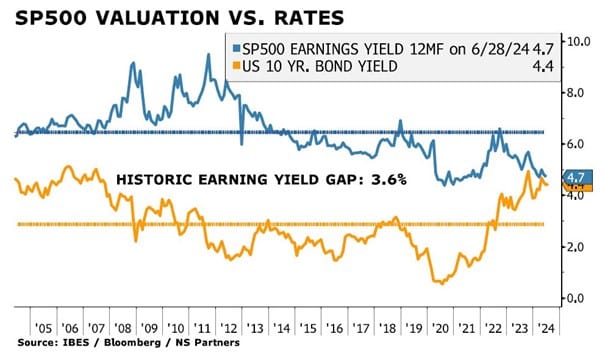
Chart of the Month – There is life outside the SP500

There is life outside the SP500

The S&P 500 has dominated performance charts for the last decade, with its lead becoming even more pronounced in the past three years, outpacing global indices. This stellar performance is driven by several factors: a robust US economy, healthy corporate profits, and the prominence of megacap stocks benefiting from the artificial intelligence boom. Additionally, the Federal Reserve is expected to cut rates this year and potentially lower them by another 1.00% in 2025.

However, this impressive performance comes at a cost. The chart above compares the Earnings Yield 12-month forward (EY12MF) of the S&P 500 with the yield of a US 10-year government bond. Historically, the average gap between these two yields has been around 3.6%, but it currently stands at just 0.3%. This indicates an extreme or very extreme valuation gap, suggesting that the S&P 500 may be overvalued.

Navigating Market Timing and Seeking Alternatives

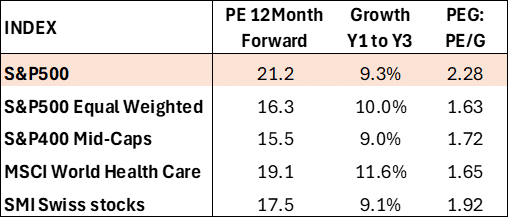
Experienced investors understand that market timing can be challenging and often frustrating. So, what should investors do with this information? Our recommendation is to diversify investments by considering the following alternatives, which offer attractive valuations and growth prospects (See table below).

S&P 500 Equal Weighted Index: Unlike the traditional S&P 500, assigns equal weight to each company, resulting in better performance during periods when smaller companies excel. It offers attractive valuation and similar growth levels, making it a compelling choice.

S&P 400 Midcap Index: This index focuses on medium-sized companies, offering a balance between growth potential and stability. With favorable valuations, it allows investors to acquire stocks at a lower price relative to their earnings growth prospects.

Health Care Sector: This sector stands out for its attractive valuation relative to expected growth and its defensive nature. This sector remains resilient during economic downturns, making it a prudent choice for stability and appreciable returns. It benefits from the ageing population trend.

Swiss Market Index (SMI): This index includes major Swiss stocks known for strong fundamentals and consistent performance. With more attractive valuations than the S&P 500 and a defensive stance, it offers a solid choice for geographic diversification.

CONCLUSION: There is a good a life also outside the S&P500


Past performance is not indicative of future results. The views, strategies and financial instruments described in this document may not be suitable for all investors. Opinions expressed are current opinions as of date(s) appearing in this material only. References to market or composite indices, benchmarks or other measures of relative market performance over a specified period of time are provided for your information only. NS Partners provides no warranty and makes no representation of any kind whatsoever regarding the accuracy and completeness of any data, including financial market data, quotes, research notes or other financial instrument referred to in this document. This document does not constitute an offer or solicitation to any person in any jurisdiction in which such offer or solicitation is not authorized or to any person to whom it would be unlawful to make such offer or solicitation. Any reference in this document to specific securities and issuers are for illustrative purposes only, and should not be interpreted as recommendations to purchase or sell those securities. References in this document to investment funds that have not been registered with the FINMA cannot be distributed in or from Switzerland except to certain categories of eligible investors. Some of the entities of the NS Partners Group or its clients may hold a position in the financial instruments of any issuer discussed herein, or act as advisor to any such issuer.  Additional information is available on request.
© NS Partners Group
Time to Take Profits in the SP500

Time to Take Profits in the SP500

Introduction to the Current Economic Climate and Stock Performance

The U.S. economy is demonstrating robust health, with GDP growth exceeding 2%. Following a series of interest rate hikes, the GDP core deflator has significantly decreased from 5.6% to 2.8% as of March 2024, with projections suggesting a further dip to 2.6% by year-end. Coupled with an exceptionally low unemployment rate of 3.8%, the economic environment seems favorable. Additionally, the surge in Artificial Intelligence technologies is profoundly influencing the S&P 500, driving profits which are expected to sustain a growth rate of over 10% for the next three years. This ensemble of positive developments naturally underpins the impressive performance of the S&P 500.

Evaluating Valuations and Strategic Alternatives

However, valuations remain a critical consideration. The current 12-month forward P/E ratio of the S&P 500 stands at 20.9, reflecting a 27% premium over the 15-year average of 16.5. This premium is even more pronounced when juxtaposed with current 10-year bond yields of 4.3%, significantly higher than the 15-year average of 2.4%. The optimism embedded in these valuations, fueled by AI’s transformative impact across several sectors such as software, semiconductors, and communications, brings to mind the adage, “This time is different.” Despite this new paradigm, we believe that the S&P 500’s valuation has stretched too thin.

For investors seeking to remain engaged in the market while adopting a conservative stance, there are several strategies to consider. One approach involves shifting part of the S&P 500 investment towards high-quality corporate bonds offering a 5.8% yield with a 3-year maturity. Alternatively, investors might consider the S&P 500 Equal Weight Index, which trades at a P/E of 17.2, closer to its 15-year average of 16.1, thereby reducing exposure to overvalued megacaps. The S&P 400 Midcap Index, with its more reasonable P/E of 15.5, presents another viable option. For those concerned about potential economic downturns, the Swiss Market Index (SMI), with its defensive positioning in pharmaceuticals, consumer staples, and insurance, and a P/E of 17.6, offers a safer haven.

Innovative Financial Instruments and Risk Mitigation

More sophisticated alternatives include investing through reputable long/short managers who can navigate market volatility more adeptly, or engaging in structured products like capital-protected notes or semi-protected “Airbag” notes, with maturities ranging from 18 to 24 months. These products allow participation in market gains while shielding against severe downturns. Additionally, advanced investors might consider protective options strategies such as the Seagull strategy; buying a Put option for December 2024 with a strike of 5300, while selling a Put at 4750 and a Call at 5725, can create a cost-neutral position with an attractive asymmetric risk profile.

Conclusion

Despite the stretched valuations, the equity market is ripe with opportunities for discerning investors. By carefully selecting investment alternatives, one can adhere to the prudent maxim of “buy low, sell high,” optimizing returns while mitigating risks in a potentially overvalued market. This balanced approach will allow investors to navigate the current economic landscape with confidence and strategic foresight.

Chart of the Month – Time to invest in midcaps in the us equity market

Chart of the Month – Time to invest in midcaps in the us equity market


The investment landscape in the United States is often dominated by the allure of large-cap stocks, as evidenced by the S&P 500’s remarkable 26.3% rise in 2023. However, a closer examination of the market reveals an intriguing opportunity in mid-cap stocks. Despite the S&P 400 (Mid Caps) experiencing a lower rise of 16.4% in the same year, there’s a compelling case for why now might be the ideal time to partially pivot towards midcaps.

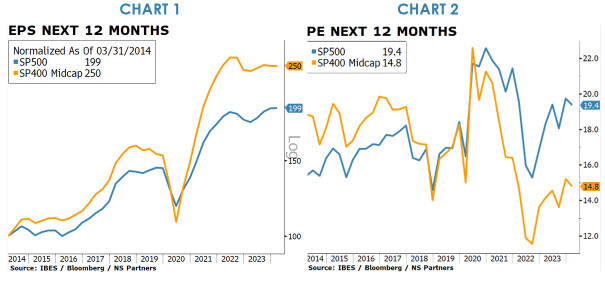
Over the last decade, the cumulative performance of the S&P 500, inclusive of dividends, stands at 212%, surpassing the S&P 400’s 143%. This disparity, however, opens a window into an underexplored investment avenue. According to Ibbotson data, smaller companies tend to outperform larger ones over the long term, primarily due to their faster profit growth. This trend is highlighted by Chart 1, which shows a 150% increase in Next 12 Month (NTM) profits for the S&P 400 over the last decade, compared to a 99% increase for the S&P 500.

A further analysis of market valuations and expectations reveals a striking disparity in Chart 2. The S&P 400 is currently trading at a Price-to-Earnings (PE) ratio of 14.8x NTM, a significant discount compared to the S&P 500’s 19.4x. Moreover, while the S&P 500 is expected to see a profit growth of 9.3% from year 1 to year 3, the S&P 400 anticipates a slightly higher growth rate of 10%. Thus, the market presents an opportunity to invest in an asset class with similar growth prospects to the S&P 500 but at a 24% discount.

Several factors contribute to this valuation gap. Firstly, the S&P 500’s higher exposure to the Information Technology sector (28% vs. 10%), boosted by advancements in Artificial Intelligence, skews its valuation upwards. Secondly, there have been significant inflows into ETFs linked to the S&P 500, particularly in the last three years. Lastly, midcaps are generally perceived as riskier than large caps, with a beta of 1.10 over the past decade.


Conclusion

The market, in its complex dynamics, often aligns closely with underlying economic realities. The current undervaluation of the S&P 400, when juxtaposed against its large-cap counterparts, seems excessive. For investors looking to adopt a defensive strategy, reallocating some investments from large caps to midcaps could be a prudent move. This shift not only leverages the historical trend of smaller companies outperforming larger ones but also takes advantage of the current market anomalies in valuation.


Past performance is not indicative of future results. The views, strategies and financial instruments described in this document may not be suitable for all investors. Opinions expressed are current opinions as of date(s) appearing in this material only. References to market or composite indices, benchmarks or other measures of relative market performance over a specified period of time are provided for your information only. NS Partners provides no warranty and makes no representation of any kind whatsoever regarding the accuracy and completeness of any data, including financial market data, quotes, research notes or other financial instrument referred to in this document. This document does not constitute an offer or solicitation to any person in any jurisdiction in which such offer or solicitation is not authorized or to any person to whom it would be unlawful to make such offer or solicitation. Any reference in this document to specific securities and issuers are for illustrative purposes only, and should not be interpreted as recommendations to purchase or sell those securities. References in this document to investment funds that have not been registered with the FINMA cannot be distributed in or from Switzerland except to certain categories of eligible investors. Some of the entities of the NS Partners Group or its clients may hold a position in the financial instruments of any issuer discussed herein, or act as advisor to any such issuer.  Additional information is available on request.
© NS Partners Group
US economy: landing at last?

US economy: landing at last?

At the beginning of the year, there were fears of a sharp slowdown, but the US economy has proved surprisingly resilient.

At the beginning of the year, US GDP growth for 2023 was forecast at 0.3% according to the Bloomberg consensus. The question was not whether the US economy would slow down, but rather whether its landing would be soft or hard. Interest rates had risen sharply and the yield curve had inverted. But the US economy proved these pessimistic forecasts wrong, surprising everyone with its robustness (see table below). Today, the consensus forecast is for GDP growth of 2.2% in 2023.

How could the market have been so wrong? Firstly, because consumption has remained very strong, thanks to additional post-Covid household savings and an unemployment rate that has remained very low. In addition, the US government stimulated the economy thanks to the various programs approved by the Biden administration in 2022, such as “The Chip Act” and “The Inflation Reduction Act”. These two major forces offset the negative impact of rising interest rates. Indeed, the FED cited the strength of the US economy as one of the reasons for persistently high interest rates.

And what happens now?

But that’s in the past. Let’s look to the future. On the consumption side, households have used up all the extra savings accumulated during the Covid. What’s more, students began repaying their loans in October, which could further reduce their purchasing power. Lastly, rising interest rates are likely to have an impact on purchases of durable goods. As for the Government, the situation has also changed. The House of Representatives is now controlled by the Republicans, who are seeking to force the Biden administration to cut spending. We may also see government shutdowns if Congress and the White House fail to pass the legislation needed to raise the debt ceiling. According to Goldman Sachs, each week of government shutdown could reduce GDP growth by 0.2%. Finally, the “bond vigilantes” continue to put pressure on the government to spend less.

In view of these factors, our outlook for US GDP growth over the next three quarters could be similar, if not a little more pessimistic. In fact, we expect a significant slowdown over the next few quarters.  But this time, we think the US economy is ready for a landing, probably a soft one.


Past performance is not indicative of future results. The views, strategies and financial instruments described in this document may not be suitable for all investors. Opinions expressed are current opinions as of the date(s) appearing in this material only. References to market or composite indices, benchmarks or other measures of relative market performance over a specified period of time are provided for your information only. NS Partners provides no warranty and makes no representation of any kind whatsoever regarding the accuracy and completeness of any data, including financial market data, quotes, research notes or other financial instruments referred to in this document. This document does not constitute an offer or solicitation to any person in any jurisdiction in which such offer or solicitation is not authorized or to any person to whom it would be unlawful to make such offer or solicitation. Any reference in this document to specific securities and issuers are for illustrative purposes only, and should not be interpreted as recommendations to purchase or sell those securities. References in this document to investment funds that have not been registered with the Finma cannot be distributed in or from Switzerland except to certain categories of eligible investors. Some of the entities of the NS Partners group or its clients may hold a position in the financial instruments of any issuer discussed herein, or act as advisor to any such issuer. Additional information is available on request.

© NS Partners Group

Towards a slowdown in the US economy at the end of the year

Towards a slowdown in the US economy at the end of the year

At present, the US economy appears to be in good health: growth is approaching 2%, core and underlying inflation are falling, unemployment is low and oil and petrol prices are lower than this time last year. What’s more, corporate profits are starting to rise and artificial intelligence could lead to an unprecedented increase in productivity. However, there are some challenges on the horizon.

A few clouds in a blue sky
The Core PCE, the inflation indicator favoured by the Federal Reserve (FED), presents a major challenge. Despite a target of 2%, this index is still at a worrying level of 4.6%. In order to rectify the situation, the FED is considering raising rates one or two more times this year, which could hamper economic growth and investment.
Another potential slowing factor is the exhaustion of the surplus savings accumulated during and after the Covid-19 pandemic. According to several estimates, this surplus savings could dry up by the fourth quarter of 2023, considerably limiting the support that consumers provide to the economy.
Admittedly, after two disappointing seasons in 2020 and 2021, the tourism sector rebounded in 2022 and 2023 thanks to the desire of American families for holidays. However, this momentum is expected to run out around September-October this year, marking the end of the peak tourist season.
Another worrying phenomenon is the clear inversion of the US yield curve. Historically, this phenomenon has always been a precursor to recession or a period of virtually zero growth. Monetary policy, which operates with a certain time lag, could therefore begin to reflect this economic reality in the months ahead.
In addition, the US government is facing a substantial budget deficit, exceeding 5.5% by 2023. Maintaining this level of public spending is unsustainable for the country’s economy.
As a result, the valuation of the US stock market is starting to look a little high, at around 19 times projected earnings for 2024. However, investors do not seem to be worried about the economic situation.

A similar situation in Europe
Although we have mainly been talking about the US, similar observations can be made for the European economy, including the UK, except that company valuations in Europe are more moderate than in the US.

Given these factors, it seems likely that we will see a significant slowdown in the economy between now and the fourth quarter of 2023, which could go as far as a moderate recession or very weak growth of around 0.5%. Against this backdrop, defensive growth sectors (such as healthcare and staples), as well as quality investment bonds with maturities of 3 to 5 years, appear to be wise choices.
It’s a good time to take a break, just like the summer break we’re all taking.


Past performance is not indicative of future results. The views, strategies and financial instruments described in this document may not be suitable for all investors. Opinions expressed are current opinions as of the date(s) appearing in this material only. References to market or composite indices, benchmarks or other measures of relative market performance over a specified period of time are provided for your information only. NS Partners provides no warranty and makes no representation of any kind whatsoever regarding the accuracy and completeness of any data, including financial market data, quotes, research notes or other financial instruments referred to in this document. This document does not constitute an offer or solicitation to any person in any jurisdiction in which such offer or solicitation is not authorized or to any person to whom it would be unlawful to make such offer or solicitation. Any reference in this document to specific securities and issuers are for illustrative purposes only, and should not be interpreted as recommendations to purchase or sell those securities. References in this document to investment funds that have not been registered with the Finma cannot be distributed in or from Switzerland except to certain categories of eligible investors. Some of the entities of the NS Partners group or its clients may hold a position in the financial instruments of any issuer discussed herein, or act as advisor to any such issuer. Additional information is available on request. © NS Partners Group

Energy Transition: What can you do during this particularly hot summer?

Energy Transition

What can you do during this particularly hot summer?

Even if growth slows down, the theme of energy transition has plenty to appeal to investors.

Squaring the circle

Growth in the global economy remains modest and, with rising interest rates, is set to slow in the US, Europe and Asia. Against this backdrop, equities in growth sectors should be good investments, but their valuations are already demanding. Admittedly, there are some value sectors that benefit from very attractive valuations, such as oil companies and banks, but these two sectors are experiencing structural problems over the long term.

What’s more, although most investors support responsible investment, the world is still very polarised on the subject, and not everyone agrees to subject their investments to sustainability constraints.

So is it possible to find an investment theme that combines growth with reasonable valuations? Can we find investments that will be attractive to both ESG and non-ESG supporters? The answer is YES, with companies involved in the much-touted energy transition.

A topic on which everyone agrees

This is a very cross-cutting theme, bringing together the main companies involved in the energy transition. It is not replicable through a specific index, which requires good active management. Let’s summarise the most important sub-themes that will be present over the next 30 years:

  • Solar panel manufacturing, for large-scale operations or small rooftop installations. These investments include solar panels, inverters and batteries to store excess energy.
  • Manufacture of wind turbines for onshore and offshore installations. In conjunction with these, rare earth metals and copper will be widely used.
  • Nuclear power: Although nuclear power has its detractors, the fact remains that it is a continuous source of energy that compensates for the intermittent nature of solar and wind power generation and emits no CO2. A new group of mini-reactors should be available for industrial use by the end of the decade, which will increase demand for uranium.
  • Electric vehicles and their value chain: car manufacturers, chargers, battery manufacturers, rare earth metal miners, copper miners.
  • Energy savings, thanks to the use of better insulating materials and electrical equipment that optimises the energy consumed in households and businesses.
  • Producers of hydrogen, which will be used to produce green steel, cement and ammonia. We need electrolysers and fuel cells. Hydrogen will also be used to produce ammonia for fertilisers and as fuel for ships.
  • Carbon sequestration. In cases where it will be impossible to do without CO2-emitting fuels, carbon sequestration techniques will have to be used.
  • Companies that invest more and more money in non-CO2 emitting energies, whether for new investments or to replace existing installations that pollute, will be favoured.

United we stand

This summer, the film “Oppenheimer” was one of the box-office hits. It shows how, when the scientific community works together towards a very specific goal, it manages to achieve it quickly. More recently, this was also the case with the “Warp Speed” project, which succeeded in obtaining 2 vaccines against Covid-19 in less than 9 months. Meeting the “energy transition” challenge will be possible thanks to the efforts of the global scientific community, supported by public and private investment.

In the meantime, we as investors have a wide range of themes and companies that make good investments at reasonable valuations and are capable of appealing to all groups of investors.


Past performance is not indicative of future results. The views, strategies and financial instruments described in this document may not be suitable for all investors. Opinions expressed are current opinions as of the date(s) appearing in this material only. References to market or composite indices, benchmarks or other measures of relative market performance over a specified period of time are provided for your information only. NS Partners provides no warranty and makes no representation of any kind whatsoever regarding the accuracy and completeness of any data, including financial market data, quotes, research notes or other financial instruments referred to in this document. This document does not constitute an offer or solicitation to any person in any jurisdiction in which such offer or solicitation is not authorized or to any person to whom it would be unlawful to make such offer or solicitation. Any reference in this document to specific securities and issuers are for illustrative purposes only, and should not be interpreted as recommendations to purchase or sell those securities. References in this document to investment funds that have not been registered with the Finma cannot be distributed in or from Switzerland except to certain categories of eligible investors. Some of the entities of the NS Partners group or its clients may hold a position in the financial instruments of any issuer discussed herein, or act as advisor to any such issuer. Additional information is available on request.

© NS Partners Group

Gráfico del verano – Una oportunidad de inversión de 3 billones de dólares para la transición energética

Una oportunidad de inversión de 3 billones de dólares para la transición energética

Muchos economistas se refieren a este cambio como “la nueva revolución industrial”. Un vistazo al gráfico presentado por la Agencia Internacional de la Energía (AIE) pone claramente de manifiesto el enorme esfuerzo inversor necesario en todo el mundo para descarbonizar la economía. Para visualizar esta oportunidad de inversión, nos embarcamos en un viaje imaginario en el que nuestra invitada descubrirá una serie de ideas y empresas interesantes en las que invertir.

Mary encendió su Tesla, una maravilla de la tecnología de los coches eléctricos conocida por su diseño ecológico. El salpicadero digital se iluminó, indicando un nivel de carga de la batería del setenta y cinco por ciento. Mary admiró su vehículo, no sólo por su conducción rápida y silenciosa, sino también por lo que simbolizaba: un paso hacia el cuidado del medio ambiente.

La acompañaba su copiloto, un recién licenciado en química. Juntos, admiraron la vista de los altísimos molinos de viento que salpicaban el paisaje. Eran molinos Vestas, famosos por su eficacia para transformar la energía eólica en electricidad limpia. El copiloto observó que los motores y rotores de estos molinos, al igual que los de su Tesla, dependían de elementos de tierras raras debido a sus propiedades magnéticas únicas.

Su viaje los llevó junto a campos repletos de paneles solares de First Solar, Canadian Solar y otros fabricantes. Estas granjas solares, gestionadas por Iberdrola, captaban la luz del sol y la transformaban en energía. En medio de estas granjas había electrolizadores, que utilizaban la electricidad para separar el agua en hidrógeno y oxígeno. Este hidrógeno se almacenaba y posteriormente se utilizaba para crear amoníaco, un combustible limpio y potente. Parte de este hidrógeno se enviaba a una empresa siderúrgica que lo utilizaba para producir acero limpio.

Cerca de allí había una planta que utilizaba el amoníaco para fabricar fertilizantes, enriqueciendo el suelo para producir buenas cosechas. El amoníaco también se cargaba en los barcos, alimentando sus viajes por todo el mundo sin dejar tras de sí un rastro de contaminación.

Cuando el Tesla indicó que necesitaba una recarga, Mary se detuvo en una estación de carga cercana. La estación obtenía su energía de un compacto pero potente minirreactor nuclear de 200 MW. Su copiloto le explicó cómo el uranio, a pesar de su controvertida historia, era fundamental para estos reactores nucleares debido a su inmensa capacidad de producción de energía.

Al llegar a su moderna y ecológica casa en el campo, Mary pudo ver los paneles solares que adornaban el tejado. Conectados a eficientes inversores Enphase, estos paneles aprovechaban la luz solar y la convertían en electricidad. La energía sobrante se almacenaba en fiables baterías Samsung SDI, un componente crucial que requiere importantes cantidades de litio, un metal ligero pero de gran densidad energética.

La casa también estaba equipada con un sistema de bomba de calor Johnson Controls de última generación y un sistema doméstico inteligente Schneider, que proporcionaban no sólo confort sino también un uso eficiente de la energía.

Este viaje mostró varias ideas para aprovechar esta oportunidad de inversión de 3 billones de dólares. Estas oportunidades serán atractivas para los inversores ESG, los no ESG, los inversores en crecimiento y los inversores en valor. Tanto los países en desarrollo como los emergentes están invirtiendo en estas tecnologías, y las valoraciones actuales aún no reflejan el crecimiento previsto.

Embárquese en un viaje de inversión de 3 billones de dólares, ¡feliz inversión!


Los resultados pasados no implican resultados futuros. Las opiniones, estrategias e instrumentos financieros que se describen en el presente documento pueden no ser convenientes para todos los inversores. Las opiniones expresadas son sólo las del momento en la(s) fecha(s) que aparece(n) en este material. Las referencias a índices de mercado o compuestos, índices de referencia u otras medidas de resultados relativos de los mercados durante un período específico sólo se proveen a título informativo. NS Partners no garantiza ni es responsable de la exactitud o la integridad de las informaciones (datos financieros de mercado, precios de bolsa, resultados de investigación u otros instrumentos financieros) que se mencionan en este documento. El presente documento no constituye una oferta ni solicitud a ninguna persona ni jurisdicción donde tal oferta o solicitud no esté autorizada ni a ninguna persona a quien sería ilegal hacer dicha oferta o solicitud. Toda referencia en este documento a instrumentos específicos o a emisores sólo tiene una finalidad ilustrativa y no debe ser interpretada como una recomendación para la compra o venta de dicho instrumento. Las referencias en este documento a fondos de inversión se aplican a fondos que no han sido registrados por la Finma y que por lo tanto no pueden ser distribuidos en o desde suiza excepto a ciertas categorías de inversores. Algunas de las empresas del grupo NS Partners o sus clientes pueden tener posiciones en los instrumentos financieros de alguno de los emisores mencionados en este documento, o ser asesor de uno de ellos. Hay información adicional disponible a solicitud.

© Grupo NS Partners