February general market comments

“Duel” – Propaganda, 1985

In politics and geopolitics, it often feels like duels prevail: East/West, North/South, Left/Right, Democracy/Dictatorship, Liberalism/Collectivism… And in financial markets too: Bulls/Bears, US/RoW, Developed Markets/Emerging Markets, Large Caps/Small Caps, Growth/Value, Public Markets/Private Markets, Fixed Income/Equities, Gold/Fiat, and the list goes on.

February 2025 has been an eventful month for both geopolitics and markets: whatever the outcome, it seems we might get closer to a peace deal in Ukraine, and if there’s no clarity yet, the Middle East situation evolves rapidly, while markets have performed disorderly, showing some signs of reversals from here to there in the famous duels mentioned above.

First, the longstanding convergence between Italian and German yields blew up, temporarily or not, with a 52 bps spread widening between both last month. Then, after a spectacular rally, Bitcoin’s momentum came to a screeching halt as the crypto lost 17.5% for the month. Perhaps more importantly, in the context of a stable dollar versus the euro, European equity markets largely outperformed the rest of the pack: the Stoxx 600 added 3.3% in February and is now up 9.8% year to date, which can be compared to -1.42%/+1.24% for the S&P500, -3.82%/-3.69% for the Topix and +0.35%/+2.02% for the MSCI Emerging Markets.

Europe tends to be seen as a Value play, with large weightings in Financials, Energy, Staples and Utilities, which can explain the strong show from European equities, corroborated by another reversal in the secular duel between Growth and Value: the MSCI World Growth lost 2.89% in February and is down 0.33% year to date, while the MSCI World Value returned 1.43% and is up 5.89% for the year.

Most S&P 500 companies have reported their Q4 2024 results, and a striking fact is that, for once, the Magnificent 7 struggled in terms of performance; results and outlooks were mostly fine, but Meta is the only member of the club showing a positive return year ta date; what a difference when compared with the last 2 years!
Finally, Gold shone again and added 2.12%, Oil tumbled 3.82%, and Credit posted a decent month with a +0.43% return for the Itraxx Crossover, in the midst of very narrow spreads.

That’s it for this month’s Market Comments, stay tuned, markets never skip a beat.


Past performance is not indicative of future results. The views, strategies and financial instruments described in this document may not be suitable for all investors. Opinions expressed are current opinions as of date(s) appearing in this material only. References to market or composite indices, benchmarks or other measures of relative market performance over a specified period of time are provided for your information only. NS PARTNERS SA provides no warranty and makes no representation of any kind whatsoever regarding the accuracy and completeness of any data, including financial market data or other financial instruments referred to in this general comment. This document does not constitute an offer or solicitation to any person in any jurisdiction in which such offer or solicitation is not authorized or to any person to whom it would be unlawful to make such offer or solicitation. Any reference in this document to specific securities and issuers are for illustrative purposes only, and should not be interpreted as recommendations to purchase or sell those securities. References in this document to investment funds that have not been registered with the FINMA cannot be distributed in or from Switzerland except to certain categories of eligible investors. Some of the entities of the NS Partners Group or its clients may hold a position in the financial instruments of any issuer discussed herein, or act as advisor to any such issuer. Additional information is available on request. © NS Partners Group
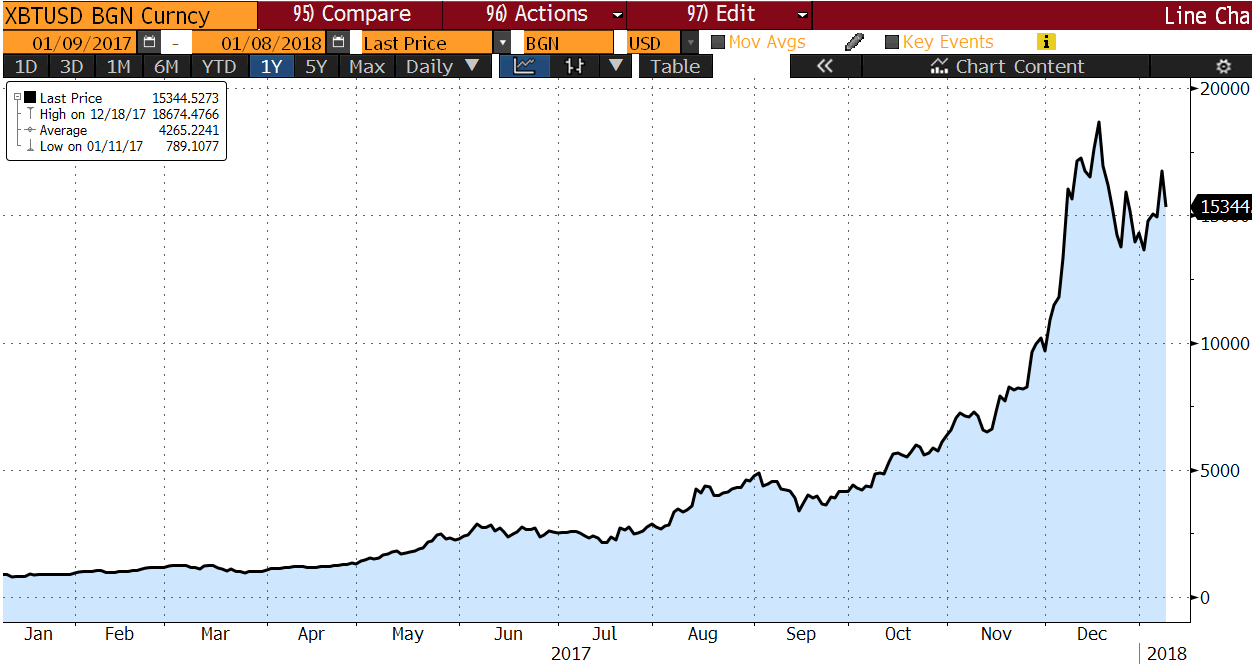
Chart of the Month – Bitcoin

Bitcoin

Source: Bloomberg

The chart above shows the price of bitcoin, a so-called cryptocurrency. Bitcoin has been appreciating for several years, but it has exploded during the last 12 months with a performance of 1600%. During the last 5 years Bitcoin has gained a staggering 10900% versus the USD.

Bitcoin is a digital currency created in 2009. It follows the ideas set out in a white paper by Satoshi Nakamoto, whose true identity has yet to be verified. Bitcoin offers the promise of lower transaction fees than traditional online payment mechanisms and is operated by a decentralized authority, unlike government-issued currencies. Bitcoin is a type of cryptocurrency: balances are kept using public and private “keys”, which are long strings of numbers and letters linked through the mathematical encryption algorithm that was used to create them.

As of December 2017, there were 16.78 million bitcoins in circulation, so the total market value of bitcoins was $257 bn. (It is the same market cap of companies like Nestlé and AT&T.) US currency in circulation (coins and notes) was $1612 bn, the aggregate money supply known as M2 was $13800 bn, as of the end of 2017, and the Bloomberg World Market Cap was $83424 bn, to put a perspective on the bitcoin size.

On 11-Dec-17, the CBOE launched the first future contract on bitcoin (the CME did it also one week later), somehow recognizing the importance of this new “financial asset”. Daily volume of the two exchanges amounts to $58 million.

WHY DO PEOPLE BUY BITCOIN?

  • In a world where central banks are running a very expansive monetary policy and, so, trying to debase their currencies, some investors perceive that bitcoin will hold the value as there will be a maximum of 21 million bitcoins and every year only a small amount of bitcoin can be “mined”. Somehow bitcoin might be a “digital gold”.
  • Protection from payment fraud, as the payments must be confirmed by many.
  • Direct transfers for immediate settlement. Bitcoin contracts can be designed and enforced to eliminate or add third party approvals.
  • Access to historically inaccessible markets: There are approximately 2 billion people with access to the internet who do not currently have access to traditional exchange systems.
  • Lower transaction fees, as bitcoin miners are compensated by the network with newly created bitcoins.

WHY DO PEOPLE THINK BITCOIN IS VERY RISKY?

  • Bitcoin can never be a currency or means of payment with this level of high volatility (86% volatility with daily observations last year), meaning that bitcoin price changes 5.3% on a daily basis.
  • The cost (mainly electricity) to “mine” a bitcoin is around $3000 to $4000. Bitcoin price at $15334 is very far from “marginal cost of production” if we were to use a well-known valuation methodology for other assets.
  • Some believe the appeal of bitcoin is that it can be used anonymously for illegal acts.
  • It is not a well-regulated asset, so some questions may arise in terms of applications, security, etc.
  • Many people (including this humble writer) do not understand how to value a bitcoin, as there is no yield (bonds, equities, real estate) nor comparable purchasing power (currencies).
  • In September, JPMorgan Chase CEO Jamie Dimon said: “it is worse than tulip bulbs. It won’t end well. Someone is going to get killed”; “it is a fraud”; “it is just a real thing, eventually it will be closed”… When he said this on Sep 12th, bitcoin was trading at $4200.
  • In January 2018, Merrill Lynch banned its clients, advisors from trading bitcoin related investments. (CNBC).

It is difficult to have an opinion on bitcoin, as apparently less well-informed investors or/and speculators are piling up on bitcoin, whereas “savvy investors” are staying away from it and even calling it a fraud.

Blockchain, the technology behind bitcoin, is well accepted by everybody and it is here to stay and to be used in many other areas.

OUR ADVICE

There are thousands of bonds, shares, currencies and commodities in the market that we can understand and value reasonably well, whereas this writer is unable to give a value to bitcoin (neither positive nor negative), so DO NOT TOUCH the assets that you do not understand.