Chart of the Month – The return of higher yields marks the end of an era

The return of higher yields marks the end of an era


The film “The return of the Jedi marks the end of an era” suggests the conclusion of a significant period of time. Similarly, the current bond market marks the end of an era in which central banks pushed interest rates to 0% and expanded their balanced sheets through the implementation of Quantitative Easing (QE). Just as in the famous George Lucas’ trilogy, there are two key events in the bond market that preceded this new era: The Great Financial Recession in 2008-09 and the Covid19 pandemic, both of which led to extremely lax monetary policies.
Now, inflation has returned to our daily lives and central banks are normalising monetary policy. As a result, bond yields across all the spectrum have increased significantly to levels that are attractive again. Unfortunately, the bond index displayed in the chart lost 15% during 2022.
The chart shows the Yield To Worst (YTW) of the Bloomberg Global Aggregate Baa Index Hedged to USD. We can identify two main points:

  • During the period from 2013 to 2021, when central banks significantly relaxed monetary policy, these bonds yielded an average of 2.6% in USD. When hedged to EUR, this yield was lower than 1% and when hedged to CHF, it was close to 0%. During this “era” it was difficult to achieve decent returns in the conservative portfolio of fixed-income securities, especially in EUR or CHF.
  • As of today, in this “new era”, we can invest in liquid Baa securities that yield 5.3% in USD (when hedged to EUR, around 4.1%; when hedged to CHF around 3.1%). This makes this asset class attractive again, as it was in 2010-11-12.

A savvy investor might point out that with US headline inflation at 7.1%, bond investors are certain to lose purchasing power before taxes, and lose even more after taxes. However, a further analysis of inflation shows that break-even inflation predictions for the next 7-10 years suggest price increases of around 2.2%. This means that we would gain 3.1% in real returns investing in relatively secure Baa bonds (BBB using S&P ratings) with average maturities of 8.9 years and a duration of 6.2 years.
SO, WHAT CAN WE EXPECT IN THIS “NEW ERA” FOR BOND INVESTORS IN 2023?

  • Case 1: Bond yields remain stable at these levels: Expected return 5.3%.
  • Case 2: Inflation is worse than expected and central banks tighten more than expected, causing the YTW to increase from 5.3% to 6.3%. Expected return -0.9%.
  • Case 3: Inflation follows the expected path and cental banks become less hawkish or dovish, causing the YTW to decrease from 5.3% to 4.8%. Expected return: 8.4%

Past performance is not indicative of future results. The views, strategies and financial instruments described in this document may not be suitable for all investors. Opinions expressed are current opinions as of date(s) appearing in this material only. References to market or composite indices, benchmarks or other measures of relative market performance over a specified period of time are provided for your information only. NS Partners provides no warranty and makes no representation of any kind whatsoever regarding the accuracy and completeness of any data, including financial market data, quotes, research notes or other financial instrument referred to in this document. This document does not constitute an offer or solicitation to any person in any jurisdiction in which such offer or solicitation is not authorized or to any person to whom it would be unlawful to make such offer or solicitation. Any reference in this document to specific securities and issuers are for illustrative purposes only, and should not be interpreted as recommendations to purchase or sell those securities. References in this document to investment funds that have not been registered with the FINMA cannot be distributed in or from Switzerland except to certain categories of eligible investors. Some of the entities of the NS Partners Group or its clients may hold a position in the financial instruments of any issuer discussed herein, or act as advisor to any such issuer.  Additional information is available on request.
© NS Partners Group

Quarterly Investment Outlook

The dominant feature of financial markets remains the low yields offered by bond markets, and in particular the increase in the quantity of bonds which carry negative yields.

In the third quarter world markets as measured by the MSCI World were flat. Year to date the S&P is up 18.7% and the MSCI World is up 15.7%, though much of this performance is recovering the steep losses of the fourth quarter of last year. Over the past twelve months the S&P is 2.1% and the MSCI World is down slightly.

The dominant feature of financial markets remains the low yields offered by bond markets, and in particular the increase in the quantity of bonds which carry negative yields. Approximately $15 trillion of debt is trading in the market with a negative yield, representing about a third of all Sovereign debt, which is the liquid part of the market. Perhaps more importantly about two thirds of all Sovereign bonds now offer a negative real yield (i.e. after taking inflation into account). This is historically unique, and truly bizarre in which one of the best investments this year would have been to buy assets that were already negative yielding at the start of the year, and therefore had a 100% guarantee to produce a loss if held to maturity. In such an environment investors have been desperate to find quality bonds with a positive yield.

Getty Image

The US bond market has been one of the few that still does, partly explaining the strength of the dollar. The plunge in yields has led to some prices which would have been thought impossible a few years ago. For example at the end of 2017 Austria issued a 100 year bond with a coupon of 2.1%. This year it has risen 64%, in the third quarter alone rising by 23%. It now yields 0.8% for the remaining 98 years. Can a yield of 0.8% in a fiat currency that was only launched twenty years ago be deemed truly safe? A lot can happen in 100 years, and in the last 100 years a lot did happen in Austria. If interest rates were to rise by 1% it would take 26 years to break even on the current coupon. Equally bizarre is the performance of gilts which have soared despite the Brexit chaos, as the UK still offers a positive yield which is relatively attractive against other European countries where one pays for the privilege of lending to their governments. Such countries now include Latvia, Ireland and Slovenia, while Bulgaria, Lithuania and Spain are a hair’s breadth from joining them in the negative yield club. The implications of these yields are wide ranging. Vast amounts of money is sacrificing purchasing power for the next decade, for example, at minus 1% a Swiss pension that buys the ten year bond guarantees a capital loss of 10%. Worse with the Swiss interest rates negative out to 50 years there are no Swiss government bonds available with a positive nominal yield, meaning that investors will lose money in any Swiss government bond held to maturity. How do such countries provide for the social claims of a rapidly ageing world? Even stranger is that this is taking place at a time of growth not recession. For comparison in the depths of the 1930’s US depression when industrial production declined 25% the 10-year yield fell only to 2.31%. Today world growth is slowing but it is still positive. Moreover monetary policy is loose, fiscal stimulus is being advocated by most governments and wages are rising. Many of the conditions necessary for inflation are present at a time when the fixed income investor has no yield to cushion them. The last time fiscal policy was expanded at a time of full employment was in the early 1970’s, an equally febrile political period, and inflation became a problem for the next decade. The integration of the labour force of the Emerging Markets mean that labour has less bargaining power than that period, but bond prices do not provide protection against a rise in inflation or the cost of living.

Click here to download the full document.

Chart of the Month – “Who you trying to get crazy with this thing? Don’t you know I’m loco?”

Chart of the month

“Who you trying to get crazy with this thing? Don’t you know I’m loco?”(*)

Hip-hop does not have a lot in common with financial markets and this 1993 song from Cypress Hill was obviously not aimed at giving any reference to any asset class whatsoever.

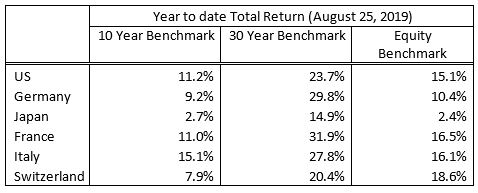
But when looking at the overall bond market today, “insane” is clearly the first word that comes to mind. To put it bluntly, how can so many investors accept to pay for holding debt securities? And why do so many market observers try to find far-fetched reasons to justify this present insane situation?

With some hindsight, it is difficult not to feel some reminiscences of the 1999 tech bubble: crazy valuations, spikes in prices, incoherent reasoning, abruptly all good reasons to buy because “things are different this time”, and in many cases the quasi-certitude to lose money over the long term. In fact, those buying German, French, Japanese or Swiss Government bonds today are sure to lose money if they hold it to maturity, whereas in 1999 at least those buying stupidly valued Internet companies could eventually have hoped to see them acquired at an even more stupid price.

In such a situation, it is unfortunately impossible to time the end of the madness, therefore extremely perilous to go short the assets that, in a logical world, should be shorted. A dear price had been paid by many brilliant investors in 1999 for having gone short the Nasdaq too early; the same applies this year with shorts on extended duration fixed income assets. But, remember how rewarding it was in 2000 to be short the Nasdaq, or at least to be away from it; it is a lesson that must be remembered.

The market will, from time to time, test convictions and drive prices far too high or far too low, much farther than most participants can cope with, which explains why there are buyers at tops and sellers at bottoms when common sense would recommend doing the opposite. Driving investors crazy and pushing them to make insane decisions is not an unusual behavior from Mr Market: “Who you trying to get crazy with this thing? Don’t you know I’m loco?”.

Coming back to today’s situation, how to deal with these negative yielding assets? For those who were brave and smart enough to hold them until now, we would advise to drastically reduce the exposure; and for the others to shy away, and concentrate on real businesses which generate cash-flow, increase earnings, invest, and are reasonably valued. Because this is the other insane consequence of abnormally low yields: how to discount future flows with incoherent factors? In theory a good company with low debt, good cash flow and an attractive dividend could be valued at insane multiples as well…

This comforts us with our positive stance towards equities, well balanced across sectors.

(*)“Insane in the brain”, Cypress Hill (https://www.youtube.com/watch?v=RijB8wnJCN0 )

Quarterly Investment Outlook

The performance and current level of the world bond markets are extraordinary.
President Emmanuel Macron

The French example illustrates the bizarreness of this situation. French government debt reached €2.3 trillion at the end of 2018 and is estimated to expand by a further €80 billion this year, largely as a result of President Macron’s concessions to the gilet jaunes protestors. This puts its debt to GDP ratio at close to 100%, not as large as Italy’s but France’s debt is growing more quickly. France has not run a budget surplus since 1974 (before the current President was born), state spending is the highest of any country in the developed world at 56% of GDP, and it will be hard to raise taxes further as they are already the highest in the developed world at 46% of GDP having just overtaken Denmark, and the gilet jaunes movement indicates that the limits have been reached. It will also be challenging to grow out of this problem as economic growth has been lacklustre for several years. Most concerning of all is that France owes its debt in a currency that it does not control and cannot print, and most of it is borrowed from outside France (unlike say Italy where most of the debt is held internally). France has an outstanding credit record, not having defaulted since 1812, but it stands out among the negative yielding sovereign issuers for the combination of the poor profile of its finances and its inability to print money independently. It is irrational that such an issuer is paid for the debt it issues. For context, in the depths of the Great Depression of the early 1930’s when industrial production fell by a quarter the US ten year bond bottomed at a yield of 2.31%. Japan and a number of European countries’ debt markets are suggesting depression conditions, even though their economies are still growing.

Click here to download the full document.

Investment Outlook Q4 2016

Notz Stucki has just released its investment outlook for the last quarter of 2016.

Please click here to download the document.