China Narrows The AI Capability Gap

CHINA NARROWS THE AI CAPABILITY GAP

China's AI capabilities improving over time


This month’s chart illustrates one of the most significant developments in the global technology landscape: the rapid rise of China’s frontier AI capabilities and the narrowing performance gap with the United States. The graph tracks the top-performing AI model from each country between mid 2023 and late 2025. While the United States maintains a slight lead throughout the period, the visual trend is unmistakable: China is accelerating quickly, with breakthrough moments that reshape expectations about global AI competition.


The most dramatic shift occurs in early 2025 with the release of DeepSeek R1, highlighted in the chart. This model marks a turning point not only in China’s domestic AI progress but also in the broader perception of what Chinese companies can achieve under resource constraints. According to the European Union Institute for Security Studies, DeepSeek R1 demonstrated performance on par with leading American models while using far less computing power and dramatically lower training costs, challenging the assumption that semiconductor export restrictions would slow China’s progress. This breakthrough signals a structural shift: algorithmic efficiency and model design have become strategic strengths within China’s AI ecosystem.


Stanford University’s 2025 AI Index report supports the trend displayed in the graph, noting that China has significantly closed the performance gap with the United States, even though the U.S. continues to produce more frontier models overall. Chinese models such as DeepSeek R1 now rank very close to top U.S. systems on independent benchmarks including LMSYS. The chart reflects this convergence clearly, as the red line representing China rises sharply from 2023 onward, narrowing the distance with the U.S. trajectory.


DeepSeek R1’s impact also stems from its unprecedented efficiency. Reports indicate that the model was trained for approximately $6 million, far below the estimated $100 million-plus investment required for models like OpenAI’s GPT-4. This efficiency not only enabled rapid iteration but also disrupted global markets, with U.S. technology stocks experiencing significant volatility following the model’s release. The economic effects reinforce what the chart shows technologically: China is no longer simply following developments in AI but increasingly shaping the competitive landscape.


Beyond individual models, China’s broader AI ecosystem has strengthened in ways that help explain the steep upward trajectory seen in the graph. Chinese companies have embraced open-source development, improving adoption and accelerating innovation cycles. They have also benefited from strong government support, growing domestic talent pipelines, and an expanding volume of high-quality research output. According to Recorded Future’s 2025 analysis, Chinese generative AI models now trail U.S. counterparts by only three to six months, a remarkably small window given earlier expectations and one that aligns directly with the chart’s near convergence by late 2025.


Overall, the chart captures a moment of profound technological shift. While the United States retains a narrow lead in frontier AI models, China’s rapid progress—driven by efficiency, innovation, and strategic investment—has brought the two countries closer than at any previous point. The upward movement of China’s capability line is not just steep; it is indicative of a maturing ecosystem capable of producing globally competitive models despite resource constraints and external pressures. As the pace of development continues, the global AI landscape in 2026 and beyond is likely to be more multipolar, more competitive, and more dynamic than ever before.


Written by Gabriele Casati


Past performance is not indicative of future results. The views, strategies and financial instruments described in this document may not be suitable for all investors. Opinions expressed are current opinions as of date(s) appearing in this material only. References to market or composite indices, benchmarks or other measures of relative market performance over a specified period of time are provided for your information only. NS Partners provides no warranty and makes no representation of any kind whatsoever regarding the accuracy and completeness of any data, including financial market data, quotes, research notes or other financial instrument referred to in this document. This document does not constitute an offer or solicitation to any person in any jurisdiction in which such offer or solicitation is not authorized or to any person to whom it would be unlawful to make such offer or solicitation. Any reference in this document to specific securities and issuers are for illustrative purposes only, and should not be interpreted as recommendations to purchase or sell those securities. References in this document to investment funds that have not been registered with the FINMA cannot be distributed in or from Switzerland except to certain categories of eligible investors. Some of the entities of the NS Partners Group or its clients may hold a position in the financial instruments of any issuer discussed herein, or act as advisor to any such issuer.  Additional information is available on request.
© NS Partners Group

Beyond the wall: transforming China’s inefficiencies into alpha opportunities through equity long short investing

Beyond the wall: transforming China’s inefficiencies into alpha opportunities through equity long short investing


China


China continues to offer one of the richest, and most misunderstood, equity opportunity sets in global markets. Macro uncertainty, regulatory interventions, shifting policy priorities and persistent market inefficiencies have created an environment where traditional long-only investing often struggles to capture value. However, these very complexities make China a highly attractive market for long/short strategies, where differentiated insights, disciplined risk management, and active exposure adjustment can extract meaningful alpha from both winners and losers.

A macro landscape that rewards selectivity
China’s macro landscape is still in transition. Policymakers are steering the economy away from overcapacity, speculative excess, and the so-called involution dynamic, where firms compete aggressively without generating real productivity gains. Recent measures targeting property developers, exporters with razor-thin margins, and manufacturers benefiting from subsidies highlight a clear policy direction: quality over quantity.

At the same time, China is fostering strategic sectors such as AI, semiconductors, renewables, healthcare technology and high-end industrial automation. These policy signals generate strong divergence across industries. In such an environment, long/short investors can go long companies aligned with policy tailwinds while shorting those facing structural or regulatory headwinds, turning macro uncertainty into an alpha source rather than a risk.

Market inefficiencies: a structural advantage
China remains one of the world’s most inefficient major equity markets. Retail investors still account for a large portion of daily trading volumes, contributing to:

  • High levels of sentiment-driven volatility
  • Momentum overshoots
  • Rapid rotation between themes
  • Behavioral biases such as herd behavior and panic selling

These characteristics create mispricing on both sides of the market. While long-only investors suffer from these swings, long/short managers can systematically exploit them, building long positions in oversold quality names and short positions in speculative or structurally challenged companies.

A market of leaders and laggards
Despite the headlines, many Chinese companies are not only thriving, they are becoming global leaders. In advanced manufacturing, robotics, EV supply chains, battery technologies and digital services, China has produced companies with accelerating earnings, strong balance sheets and expanding competitive advantages. These belong on the long side of a portfolio.

Conversely, firms trapped in industries targeted by the government’s overcapacity crackdown, traditional manufacturing, low-margin exporters, uncompetitive commodity producers, face structural pressure. These make compelling short candidates, especially when valuations remain disconnected from fundamentals.

Strong alpha generation: what the chart shows
The attached Chart of the Month illustrates precisely this dynamic.

Over the past decade, the Chinese equity market, represented by the MSCI China Index, has delivered only modest performance. In contrast, Chinese long/short equity managers, as measured by the Eurekahedge Index, have achieved returns approximately twice as high. Moreover, through disciplined manager selection, it has been possible to enhance results even further, generating performance levels that exceed the Eurekahedge Index by a substantial margin.

Conclusion: the right strategy for the right market
China is a market where macro shifts are decisive, policy direction matters, and inefficiencies are abundant. This environment naturally favors investors who can go long the future winners and short the inevitable losers, a capability that long-only strategies simply do not possess.

As the Chinese economy continues to evolve, so too will its equity markets. The long/short approach offers a disciplined, opportunity-driven way to harness China’s growth potential while managing risks in a market that rewards agility, research depth and selective exposure. For investors seeking to participate in China’s next chapter, long/short is not only a smart approach, it is the most adaptive one.


Past performance is not indicative of future results. The views, strategies and financial instruments described in this document may not be suitable for all investors. Opinions expressed are current opinions as of date(s) appearing in this material only. References to market or composite indices, benchmarks or other measures of relative market performance over a specified period of time are provided for your information only. NS Partners provides no warranty and makes no representation of any kind whatsoever regarding the accuracy and completeness of any data, including financial market data, quotes, research notes or other financial instrument referred to in this document. This document does not constitute an offer or solicitation to any person in any jurisdiction in which such offer or solicitation is not authorized or to any person to whom it would be unlawful to make such offer or solicitation. Any reference in this document to specific securities and issuers are for illustrative purposes only, and should not be interpreted as recommendations to purchase or sell those securities. References in this document to investment funds that have not been registered with the FINMA cannot be distributed in or from Switzerland except to certain categories of eligible investors. Some of the entities of the NS Partners Group or its clients may hold a position in the financial instruments of any issuer discussed herein, or act as advisor to any such issuer.  Additional information is available on request.
© NS Partners Group
August general market comments

“(Everybody Wanna Get Rich) Rite Away” – Dr John, 1974.

As August 2025 draws to a close, the financial markets are dancing to the frenetic beat of Dr. John’s “(Everybody Wanna Get Rich) Rite Away,” a funky anthem that captures the universal itch for quick wealth. This month, that rhythm pulsed through global equities, with the Shanghai Composite Index surging nearly 20% from its early August low, adding almost a trillion dollars in market value despite China’s economic headwinds, tariffs, a property slump and persistent deflation.

The S&P 500, meanwhile, pushed past 6,400, riding a 60%+ rally since October 2022, fueled by AI hype and Fed rate cut optimism. It’s a bull market on steroids, but the lyrics’ warning – “If you wanna be rich and you wanna be wealthy, I believe I’d rather be poor and healthy”- echo a growing unease. The rush to riches is evident in China’s 2.1 trillion yuan in margin debt, nearing the 2015 bubble peak and US tech stocks’ outsized gains, reminiscent of the dot-com frenzy. Volatility spiked early in the month, with the VIX jumping to 30 on August 5, reflecting investor jitters beneath the rally’s surface.

Central banks and policymakers tout stimulus and soft landings, but the relative disconnect from fundamentals, flat consumer prices in China, slowing US earnings growth -suggests a speculative bubble inflating alongside this bull run. Dr. John’s swampy groove reminds us that chasing instant wealth can lead to a “racka tacka tacka rum-dum game,” where very few win if sentiment sours. Caution, not just celebration, is the order of the day as September looms.

In a month marked by the end of the Q2 earnings season, which was good but not upbeat, the MSCI World added 2.5%, the S&P 500 1.9% and the MSCI Europe 0.7%. Big advances were recorded in Japan (+4.5%) and China (+10.3%). With looming rate cuts from the Fed, the dollar lost 2.3% versus the euro, US 10 year yields hovered 15 bps lower, and Gold, Bitcoin and Oil soared 4.8%, 8.3% and 6.4% respectively. The renewed political uncertainties linked to France’s very poor budget and debt situation probably limited the euro’s rise, but no panic visible so far: year to date, French 10 year yield is up 33 bps, similar to Germany (+35 bps). Still, France borrows more expensively than Greece now, which was unthinkable some years ago.

Credit fared well, but spreads are ultra-low all across fixed-income credit instruments, leaving little room for further tightening.


Past performance is not indicative of future results. The views, strategies and financial instruments described in this document may not be suitable for all investors. Opinions expressed are current opinions as of date(s) appearing in this material only. References to market or composite indices, benchmarks or other measures of relative market performance over a specified period of time are provided for your information only. NS PARTNERS SA provides no warranty and makes no representation of any kind whatsoever regarding the accuracy and completeness of any data, including financial market data or other financial instruments referred to in this general comment. This document does not constitute an offer or solicitation to any person in any jurisdiction in which such offer or solicitation is not authorized or to any person to whom it would be unlawful to make such offer or solicitation. Any reference in this document to specific securities and issuers are for illustrative purposes only, and should not be interpreted as recommendations to purchase or sell those securities. References in this document to investment funds that have not been registered with the FINMA cannot be distributed in or from Switzerland except to certain categories of eligible investors. Some of the entities of the NS Partners Group or its clients may hold a position in the financial instruments of any issuer discussed herein, or act as advisor to any such issuer. Additional information is available on request. © NS Partners Group
Mahjong China Fund awarded Best Performing China Fund of Funds 2024 by The Hedge Fund Journal

We are delighted to announce that NS Partners’ Mahjong China Fund has been recognised by The Hedge Fund Journal at its Performance Awards 2025, winning the category “Best Performing Fund in 2024 – China Fund of Funds”.

This prestigious award highlights the Fund’s strong performance and consistent risk management in what remains a challenging and highly dispersed market environment.

A testament to our long-standing expertise in Asia

Led by Senior Portfolio Manager Gabriele Casati, our team combines extensive on-the-ground knowledge with a rigorous investment process to navigate Asia’s evolving opportunities.

At NS Partners, we have been investing in Asia and China for over four decades. This award underlines the strength of our network, our rigorous manager selection process and our commitment to delivering risk-adjusted returns for our clients.

We would like to thank our investment partners and clients for their continued trust.


Learn more
For more information about the MAHJONG CHINA FUND, including the prospectus and legal documentation, please contact your NS Partners representative at IR@NSPGROUP.COM. 

Marketing communication. For professional/qualified investors only. Past performance is not a reliable indicator of future results.

Mahjong China Fund: Business Lunch in Lugano, 2 July 2025

Mahjong China Fund: Navigating China’s New Landscape


Business Lunch – Grand Café Al Porto, Lugano – 2 July 2025

Earlier this week, we hosted a private lunch presentation at the historic Grand Café Al Porto in Lugano, bringing together professional investors to explore China’s evolving macro environment and discuss how we position to capture opportunities through our Mahjong China Fund.


Key takeaways from our recent trip to Asia

Following more than 30 meetings in Hong Kong with leading hedge fund managers focused on China and the broader region, we came back with a few clear insights:

  • Shifting focus to domestic drivers: Managers are increasingly tilting portfolios from export-led themes to domestically driven opportunities across consumption, technology, and industrials.
  • AI and tech acceleration: Accelerated AI adoption in China, underpinned by both government initiatives and private sector investments, is a top area of conviction.
  • Selective property exposure: While the property sector is still digesting structural adjustments, selective managers are positioning for a recovery in tier-1 cities.
  • Active hedging & volatility management: Increased use of derivatives to navigate tech concentration risks and market volatility.
  • Capital flows turning positive: Local investors, corporate buybacks and a gradual return of international flows are stabilizing markets.
  • Valuations remain compelling: Many high-quality Chinese companies continue to trade at significant discounts versus global peers, offering a fertile hunting ground for active managers.


Why Mahjong China Fund now?

In this complex backdrop, we believe the Mahjong China Fund provides a highly differentiated way to access China’s equity markets. Unlike traditional long-only or passive vehicles, our approach leverages local long/short managers with deep on-the-ground expertise, capable of navigating dispersion and managing downside risks.

Since its inception on 31 March 2021, the Fund has delivered a cumulative return of +8.5%, significantly outperforming the MSCI China Index (-32.2%), with less than one-third of the volatility.

Our concentrated portfolio of 10-15 managers blends variable net, low net, and long-biased strategies — aiming to capture approximately two-thirds of the upside with only one-third of the downside.

This makes the Fund an attractive diversifier within a global equity or emerging markets allocation, especially for investors seeking controlled volatility and strong risk-adjusted returns.


Learn more

For more information about the Fund, including the prospectus and legal documentation, please reach out to our NS Partners representative or visit our website at preprod-nsp.notzstucki.website/.


Marketing communication. For professional/qualified investors only. Past performance is not indicative of future results.

Mahjong China Fund: Business Lunch in Lugano, 2 July 2025

Mahjong China Fund: Navigating China’s New Landscape


Business Lunch – Grand Café Al Porto, Lugano – 2 July 2025

Earlier this week, we hosted a private lunch presentation at the historic Grand Café Al Porto in Lugano, bringing together professional investors to explore China’s evolving macro environment and discuss how we position to capture opportunities through our Mahjong China Fund.


Key takeaways from our recent trip to Asia

Following more than 30 meetings in Hong Kong with leading hedge fund managers focused on China and the broader region, we came back with a few clear insights:

  • Shifting focus to domestic drivers: Managers are increasingly tilting portfolios from export-led themes to domestically driven opportunities across consumption, technology, and industrials.
  • AI and tech acceleration: Accelerated AI adoption in China, underpinned by both government initiatives and private sector investments, is a top area of conviction.
  • Selective property exposure: While the property sector is still digesting structural adjustments, selective managers are positioning for a recovery in tier-1 cities.
  • Active hedging & volatility management: Increased use of derivatives to navigate tech concentration risks and market volatility.
  • Capital flows turning positive: Local investors, corporate buybacks and a gradual return of international flows are stabilizing markets.
  • Valuations remain compelling: Many high-quality Chinese companies continue to trade at significant discounts versus global peers, offering a fertile hunting ground for active managers.


Why Mahjong China Fund now?

In this complex backdrop, we believe the Mahjong China Fund provides a highly differentiated way to access China’s equity markets. Unlike traditional long-only or passive vehicles, our approach leverages local long/short managers with deep on-the-ground expertise, capable of navigating dispersion and managing downside risks.

Since its inception on 31 March 2021, the Fund has delivered a cumulative return of +8.5%, significantly outperforming the MSCI China Index (-32.2%), with less than one-third of the volatility.

Our concentrated portfolio of 10-15 managers blends variable net, low net, and long-biased strategies — aiming to capture approximately two-thirds of the upside with only one-third of the downside.

This makes the Fund an attractive diversifier within a global equity or emerging markets allocation, especially for investors seeking controlled volatility and strong risk-adjusted returns.


Learn more

For more information about the Fund, including the prospectus and legal documentation, please reach out to our NS Partners representative or visit our website at preprod-nsp.notzstucki.website/.


Marketing communication. For professional/qualified investors only. Past performance is not indicative of future results.

China’s growth 2025: The dragon awakens

Hedge funds are betting on AI, tech and local consumption to tap into China’s renewed growth.

A renewed sense of optimism among fund managers

Is 2025 finally the turning point for Chinese markets? After several years of painful adjustments, positive signals are starting to align. In Hong Kong, hedge fund managers are becoming increasingly constructive. During a recent trip to Asia, we met with over thirty managers focused on Chinese markets and they all shared a similar view: both top-down and bottom-up conditions are improving.

Strong earnings rebound in Chinese companies

What’s driving this shift? A clear policy pivot from Beijing in September 2024 marked the start of stronger support for the economy and markets. The result: a robust earnings rebound in Q1 2025. BYD reported a 98% increase in EPS, SMIC posted +162% growth in net income and Xiaomi +64%. In a market where corporate earnings serve as a proxy for the macro picture, these numbers speak volumes.

Domestic consumption remains a key challenge

The key domestic driver remains consumption, still below its pre-COVID potential. The government is trying to boost demand with widespread discounts, reaching up to 20% on certain goods. Yet, with employment still under pressure, a sustained rebound in consumption will be hard to achieve without a recovery in the job market.

Real estate: confidence returns, slowly

The real estate sector, long the epicenter of the crisis, appears to have bottomed out. In cities like Shanghai, some new developments are seeing price increases of up to 10%. Some funds are taking this opportunity to re-enter the space via property management companies, seen as more resilient and better positioned to benefit from China’s new housing quality standards.

Sector rotation toward the domestic market

In response to this changing landscape, portfolios are shifting. The dominant trend is clear: a gradual exit from export-driven names and a renewed focus on domestic demand beneficiaries. Consumption, technology (particularly TMT), industrials and AI are leading this sector rotation.

AI in China: ambition, capital, and sovereignty

China’s technological acceleration is striking. AI has become a strategic national priority. Alibaba announced a USD 53 billion investment in AI and cloud and Tencent is following a similar path. The push for tech sovereignty is also visible in the semiconductor sector, where managers are identifying opportunities across the value chain, from chipmakers to materials and equipment providers.

Tech and EVs at the forefront

Digital giants like JD.com, Pinduoduo and Meituan remain core holdings, benefiting from China’s market depth, rapid digitalization and the government’s renewed support for private platforms. The EV sector, driven by players like BYD, NIO and Xiaomi, is thriving at the intersection of China’s climate goals and rising consumer appetite for premium products.

Hedge Funds adapting to volatility

Lastly, Hong Kong-based hedge funds are increasingly using derivatives to manage exposure and volatility. After diversifying into other Asian markets and the US, many are now reallocating substantially back into China. The underlying belief: despite ongoing uncertainties, China’s fundamentals are once again turning attractive.


Past performance is not indicative of future results. The views, strategies and financial instruments described in this document may not be suitable for all investors. Opinions expressed are current opinions as of the date(s) appearing in this material only. References to market or composite indices, benchmarks or other measures of relative market performance over a specified period of time are provided for your information only. NS Partners provides no warranty and makes no representation of any kind whatsoever regarding the accuracy and completeness of any data, including financial market data, quotes, research notes or other financial instruments referred to in this document. This document does not constitute an offer or solicitation to any person in any jurisdiction in which such offer or solicitation is not authorized or to any person to whom it would be unlawful to make such offer or solicitation. Any reference in this document to specific securities and issuers are for illustrative purposes only, and should not be interpreted as recommendations to purchase or sell those securities. References in this document to investment funds that have not been registered with the Finma cannot be distributed in or from Switzerland except to certain categories of eligible investors. Some of the entities of the NS Partners group or its clients may hold a position in the financial instruments of any issuer discussed herein, or act as advisor to any such issuer. Additional information is available on request.  © NS Partners Group

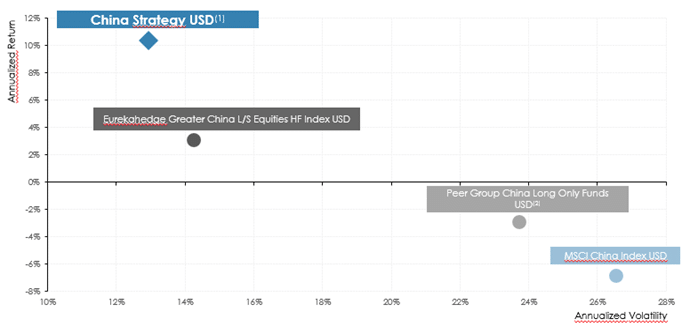
Chart of the Month – China: an interesting risk/return profile to be exposed to the region.

China: an interesting risk/return profile to be exposed to the region.

 
Source: NS Partners, Bloomberg. Data as of 30 April 2024. Performance in USD. Risk statistics against the MSCI China Index USD calculated on a monthly basis, with a risk-free rate of 1.0%.
(1) China B USD = Haussmann China/Asia Equity Long/Short allocation (K USD Share Class, with 1.40% management fees) from 31 December 2017 to 31 March 2021. From 1 April 2021 real track record of Mahjong China Fund B USD, net of fees. (2) Peer Group = long only China equity funds discretionary selected by NS Partners (10 funds), equally-weighted and rebalanced on a monthly basis. This slide includes historic returns and past performance is not a reliable indicator of future results. The value of investments can go down as well as up.

After 3 years of bear market in China, I see structural alpha opportunities emerging this year and managers are starting to gradually re-allocate capital in the region.

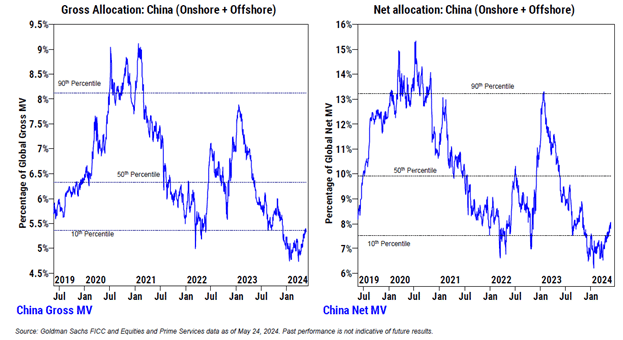
TMT stocks are the most net bought this year, information technology is the most overweight sector in this region. The financial sector remains the most underweight sector in the region, it has seen net inflows YTD but is among the most underweight ones in China.

Chinese equities continue to see slow but steady buying, with net buying flows. H shares have led the recent inflows followed by ADRs. A-shares continue to be net sold. But the most important Gross and Net allocation is gradually increasing.

Our strategy: China equity L/S multi-managers strategy can give the right diversification to investors that are willing to re-allocate capital to the region.

Managers are generating good performance so far this year. Since we started investing in the region, we had the ability to allocate capital with managers that were able to protect the capital in the down market and to generate good results in up market given good asymmetric returns.

The market in the region is structurally changed, moving from beta to alpha opportunities, thus we need to adopt rapidly to new investments regime and we need to be nimble in our approach; managers using Variable Net hedge fund approach can give the right flexibility. Overall, we prefer active investment over passive ones. Passive investments (ETFs) don’t follow the new trends that the economy is generating and active long only funds are less dynamic to move the exposure to the right sectors to capture market opportunities.

The return composition of the Chinese equities market is becoming more Alpha dominant. Stock selection has become a key driver in an environment where bifurcation of stock performance within an industry is a more common occurrence and it has also happed on a greater magnitude. After a period of systematic beta downtrend, markets are settling at a level of relatively strong support. At the same time, further clarity and stability across the economy and policy direction improve conviction level on stock selection, allowing investors to shift focus away from tail-end events and back into fundamentals.

China’s economy pivoted from export-manufacturing driven during 2000-2010, to domestic-consumption driven in 2010-20. It started another major rebalancing 2-3 years ago, amid the geopolitical tensions and its demographic challenges, to focus on self-reliance and advanced manufacturing.

Building a portfolio of local hedge fund managers adopting different strategies is the right approach to generate good risk-return performance. The universe of managers in China is big, there are hundreds of funds, manager selections is a key component.

The last 3 years was a big stress test for the managers, market experienced one of the worst drawdowns in history and I’m really convinced that from this period of bear market that big opportunities can emerge.


Past performance is not indicative of future results. The views, strategies and financial instruments described in this document may not be suitable for all investors. Opinions expressed are current opinions as of date(s) appearing in this material only. References to market or composite indices, benchmarks or other measures of relative market performance over a specified period of time are provided for your information only. NS Partners provides no warranty and makes no representation of any kind whatsoever regarding the accuracy and completeness of any data, including financial market data, quotes, research notes or other financial instrument referred to in this document. This document does not constitute an offer or solicitation to any person in any jurisdiction in which such offer or solicitation is not authorized or to any person to whom it would be unlawful to make such offer or solicitation. Any reference in this document to specific securities and issuers are for illustrative purposes only, and should not be interpreted as recommendations to purchase or sell those securities. References in this document to investment funds that have not been registered with the FINMA cannot be distributed in or from Switzerland except to certain categories of eligible investors. Some of the entities of the NS Partners Group or its clients may hold a position in the financial instruments of any issuer discussed herein, or act as advisor to any such issuer.  Additional information is available on request.
© NS Partners Group

October General Market Comments

October General Market Comments

“Bitter Sweet Symphony” – The Verve, 1997.

Markets have been playing us this bitter sweet symphony this year, to paraphrase The Verve in their 1997 hit.

Sweet to a certain extent, as shown by the +6.4% return for the MSCI World year to date or the +9.2% for the S&P500 or, for the prescient or lucky ones having heavy exposure to the Nasdaq, a fantastic and very sweet +31.7%. These few numbers also highlight the massive polarization in equities this year; the famous Magnificent Seven explain almost the entire performance of these 3 indices, which leaves a bitter taste for many market participants who do not witness these flattering returns in their portfolios.

Bitter for long term USD bond holders, who have seen the value of their capital shrink despite expectations for a slowdown (if not a recession) in the economy that would normally favour this type of investments, not to mention their safe haven attributes in troubled geopolitical times like the ones we’re living through.

Bitter for those having placed bets on the famous China reopening, which has morphed into a money-losing trade (-7.7% for the CSI 300 year to date), and for those who logically expected Value to catch up versus Growth in a rising interest rates environment (the MSCI World Value is now down 3.6% year to date versus +17.2% for its Growth counterpart).

The MSCI World lost 3% in October, the S&P 500 2.2%, the Stoxx 600 3.7%, the Topix 3% and the MSCI Emerging Markets 3.9%. US 10 year yields rose by 36 bps, while German Bunds and Italian BTPs yields stayed more or less flat. The Israel-Palestine tinderbox had its effect on Gold (up 7.3%), but Oil markets ensnared market participants with an eye-popping 10.8% fall for the WTI, quite a flabbergasting move at a moment of severe tensions in the Middle East. Among other things, credit nudged down (-0,27% for the Itraxx Crossover), and the Japanese Yen further slumped versus the greenback (-1.4%) and is now down 15.6% year to date.

That’s it for this month’s Market Comments, stay tuned, markets never skip a beat.


Past performance is not indicative of future results. The views, strategies and financial instruments described in this document may not be suitable for all investors. Opinions expressed are current opinions as of date(s) appearing in this material only. References to market or composite indices, benchmarks or other measures of relative market performance over a specified period of time are provided for your information only. NS PARTNERS SA provides no warranty and makes no representation of any kind whatsoever regarding the accuracy and completeness of any data, including financial market data or other financial instruments referred to in this general comment. This document does not constitute an offer or solicitation to any person in any jurisdiction in which such offer or solicitation is not authorized or to any person to whom it would be unlawful to make such offer or solicitation. Any reference in this document to specific securities and issuers are for illustrative purposes only, and should not be interpreted as recommendations to purchase or sell those securities. References in this document to investment funds that have not been registered with the FINMA cannot be distributed in or from Switzerland except to certain categories of eligible investors. Some of the entities of the NS Partners Group or its clients may hold a position in the financial instruments of any issuer discussed herein, or act as advisor to any such issuer. Additional information is available on request. © NS Partners Group

Protected: NS Investment Conference, 21 June 2023

This content is password-protected. To view it, please enter the password below.