Regulators on both sides of the Atlantic agreed to introduce Contingent Convertible bonds (“CoCos”) following the big financial crisis as a way to strengthen banks’ capital levels and transfer the risk of a bank failing from governments to bondholders, thus preventing taxpayer bailouts. CoCos are securities issued by banks that will absorb losses by automatically converting to equity when the capital of the issuing bank falls below a certain pre-specified level (trigger event), hence building a loss-absorbing financial cushions during periods of financial stress. Since 2009, banks have issued about $380 billion of CoCos, of which $120 billion by European banks; to date, no CoCo has missed a coupon payment or experienced a trigger event.
However, CoCos hit the headlines with the market turmoil at the beginning of the year as debt sold by Europe’s biggest issuers tumbled on concern struggling lenders – including Deutsche Bank – might have trouble making interest payments. Concerns over the real intrinsic risk of these securities were raised by many investors.
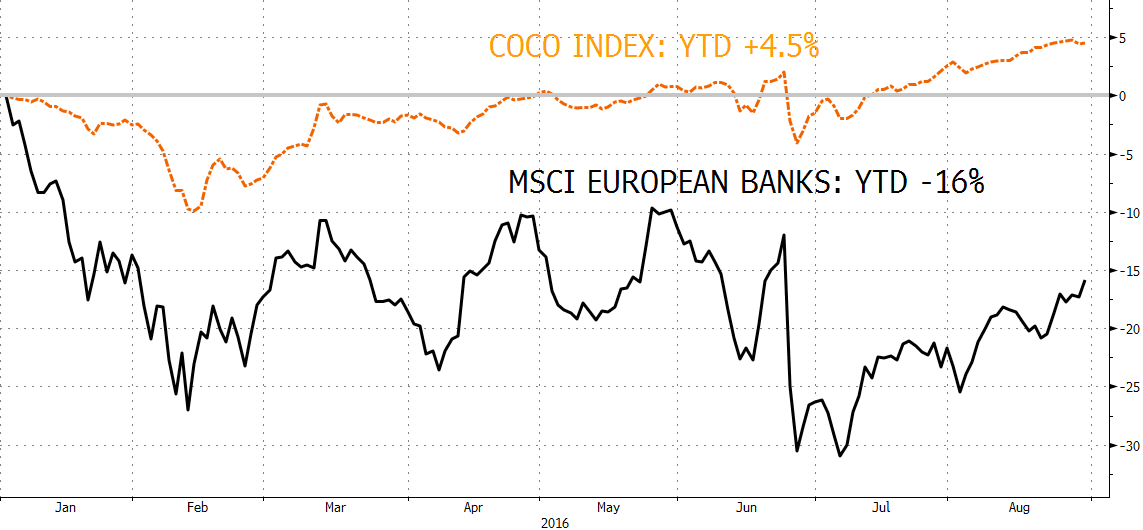
This month’s chart shows the performance of European banking sector versus the CoCo Index so far this year. Bank’s equities are trading at -16%, including a 15% recovery following the Brexit vote. On the opposite side, CoCos have fully recovered from the February loss and are up 4.5% year to date.
Therefore the question is: where is the truth? Is the CoCos’ recovery a consequence of investors’ search for yield at any cost and are now overpriced, or is the banks’ equity undervalued, offering an attractive entry level?
Unfortunately the answer is not unique since the divergence in performance of bank’s equity and CoCo has been driven by different factors. On the equity side, the explanation relies on the current ultra-low rates environment and negative interest policies (i), whereas the recent regulatory developments (ii) as well as the result of the last ECB stress tests (iii) have reassured investors about these bonds and the banks’ capital level.
EU bank revenues continue to come under pressure as rates stay and are expected to remain low following the economic uncertainties triggered by the UK’s Brexit vote, leading to further expected reduction in banks’ net interest income. Furthermore, while the introduction of zero policy rates appears to have had a positive impact on credit creation, there is no evidence that negative policy rates helped credit creation in Denmark and Switzerland.
The steep sell-off of CoCos in the first quarter was provoked by confusion over when exactly diminishing levels of capital would require a lender to halt coupon payments. Since then, regulators have sought to reduce uncertainty:
First, the ECB agreed to include a portion of Pillar 2 in the CBR (“combined buffer requirement”, a measure of the total Common Equity Tier 1 capital), resulting in increased protection for investors from coupon deferrals;
Second, the European Commission has proposed boosting protections for holders of CoCos, allowing banks to pay stock dividends and bonuses to employees only if coupons are paid in full. The coupon-protection plan is currently under study at the ECB.
Finally, the last ECB’s stress test highlights that EU main banks have built up a substantial amount of capital since the financial crisis and are considerably more stable than at the time of the last stress test in 2014. Indeed, an average Capital Tier 1 ratio of 13.2% provides a significant buffer against the adverse scenario stress test assumptions (which include a recession, weak domestic demand, declining property prices and widening of sovereign credit spreads, among others
As a result of the ECB and European Commission interventions, CoCos have experienced a nice and gradual recovery that might continue going forward. For comparison, the CoCo Index is priced with an spread to worst of 443bp with an average rating of BB1, compared to a less attractive European High Yield Index’s spread of 395bp with an average rating two notches lower (BB3). As a practical example, Rabobank 5.5% 01/22/2049 (BBB-, Common Equity Tier 1 at 13.5% and trigger event at 5.13%) is trading with a yield of 5% if called in June 2016 and almost 6% if not called; with the same rating, Repsol 3.63% 10/07/2021 is yielding 0.45%!
Concerns about the European banks’ ability to generate profits will continue to weight on the bank’s stocks as well as the potential, unintended consequences of negative rates policies. On the other side, the willingness of regulators to move forward in the definition of the rules and mechanism of CoCos will support the investors’ appetite for juicy yields.
Coco Puffs
Bank stocks have been falling over growth fears. That eventually started to catch up with additional Tier 1 securities. Deutsche Bank’s are particularly vulnerable because of the firm’s weak profitability, relatively low capital and uncertainty over German AT1 accounting idiosyncrasies. But they’re not the only poster boys for the meltdown. Year to date Credit Suisse equities are down 37%. Their Cocos also took a hit, as did UBS’s and the list goes on. Even JP Morgan’s equity, considered one of the better-capitalized American banks, is down around 20% so far this year.
Source: Thomson Reuters
As the fallout gathered steam, we’ve seen every headline from Coco’s are the devil’s work ready to bring the whole market down (as if they were equivalent to CDOs of subprime mortgages) to the ‘statement of fact that large banks don’t have enough liquidity to cover their coupons. Very little by way of hard analysis of these securities has been offered by the mainstream press and although it’s always quite unfortunate, it may also represent some opportunities.
Clearly, we’re not stating here you should sell the family silver to buy into this correction. As hybrid securities, a Coco’s destiny is tied to both the equity and credit markets and therefore are full of mark to market risk. That being said, fear is a primary emotion seldom rooted in rational thought. Since there’s plenty of fear to go around, it’s always good to get back to the fundamentals, assess if risks are justified and look at the Cocos sector with a cool head.
Firstly, it’s essential to note there has been very little change in the past few weeks in European bank fundamentals to justify the move. Perhaps the market is trying to tell us something we can’t yet forecast (which is always a possibility), but in the absence of hard facts, we’re still inclined to focus on said fundamentals. Aside from growth, what are the markets afraid of? To list but a few, we’ve heard that:
central banks have ‘lost the fight’ as the Fed needs to backtrack on its promises of another 4 hikes and the BOJ turned to imposing negative rates on reserves
the Novo Banco debacle in Portugal is symptomatic of problems in the periphery once again
Italian NPLs (and lack of collateral provisioning) have grown to unsustainable levels
lowered bank profitability due to negative rates on deposits in Europe and Japan will prevent coupon repayment
exposure to oil, mining and metal in their trading books is like sub-prime and
Sovereign Wealth Funds (mainly in GCC countries who own quite a bit of financials) are selling large stakes in European and US banks to meet liquidity needs.
In any event, the combination of the above has led loose hands, who weren’t very comfortable with what they owned, to sell all bank related securities, from AT1, to hybrids to equities….especially in Europe and Japan. These are high beta plays (especially bank equities) and it’s understandable that in a nervous market, always looking over its shoulder for any forms of systemic risk, they would price risk quite aggressively.
“Regarding the profitability of the European banking sector though, a 10bps reduction in December in deposit rates by the ECB was marginal and, at most, will have a 4 to 5% impact on eps over the next 3 to 5 years (assuming no other eps growth or repricing) as it applies only to reserves “claims Davide Serra who runs Algebris Investments in London and runs a dedicated fund on financial hybrids. He then goes on to add “in Japan also, the latest BoJ intervention could lead to a 5% downgrade in eps for the large banks, but not enough to justify a 50% correction in the equities from their highs. By the way, it took banks 4 months to correct 50% post Lehman and we would have to see a 10X larger impact than what is stated above (on current eps) to justify this. A bit overdone in our view at this stage.”
Source Bloomberg. Bank stock corrections in 2008, 2011 and 2016.
The second point worth addressing is the European banking sector’s exposure to oil and energy. Shale gas is a regional US play (and problem for that matter)….not Japanese or European. BNP Paribas just announced a number of $26Bln’s worth of exposure with 60% to the oil majors, 70% IG, and ‘only’ $250MM of which is at risk. On annual profits of $5Bln it isn’t material. If you add gas and metals, there’s another $700MM over 2 years lent to the sector, 75% of which is IG. If you were to take a full 100% hit on these loans (although there’s a 50% recovery value) it would have an impact of 5% on eps. The combination of fear of rates being lower for longer and the correction in energy, is therefore clearly overblown.
Going back to 2009, the equity base of the banking sector has tripled since the crisis with European banks having the same leverage levels as their US counterparts. Socgen has an 8% ROE, a PE ratio of 6.8 and is currently trading at a 50% discount to tangible book (with a 7.5% yield). Their loan book is also growing at 7%. The same applies to the rest of the group where European and Japanese bank stocks were trading at current levels when the SPX stood at 666 (the number of the devil it’s worth pointing out). Banks in Europe have been on a diet for 7 years and certainly haven’t been binging as in the pre-2008 period (loan to deposits stand at 100% vs 140% in 2008 and their balance sheets are 1/3 smaller).
Now to Novo Banco which is the weak link in the periphery. Fraud, bad loans, central bank collusion, you name it, they’ve had it. Investors in local bonds subject to local law were never going to be treated like international bond holders. It was a mistake to think otherwise and investors are paying for this mistake unfortunately.
On the Italian NPL front, there’s also quite a bit of miscommunication from the press that doesn’t seem to fully understand the situation. The amount of NPLs could be around $200Bln which at first glance may seem high, but when peering through the numbers, isn’t as bad. Out of the $200Bln, there’s $90Bln in collateral and another $150Bln in recovery value. Now the bailout of 4 banks has led to investors selling all financials in the FTSE MIB index which is down 23% YTD on the back of this sector’s correction. The government is doing all the right things and has removed the 10% stamp duty on purchasers (and replaced it with a €200 fee) which has had the effect, with the stroke of a pen, of increasing the value of the collateral by 10% on the secured side (i.e. $9Bln). The ECB has also been sending the right signals, especially with Monte de Paschi. It may have to intervene with a few billion here and there to recapitalize the sector, but nothing to justify the current correction. As compared to ‘08/’09, GDPs were much lower then and the market fears of a Euro and European Union breakup were justified.
The average hybrid, stands at 4% of capital for large banks. BNP has almost $20Bln of buffer before it’s prevented from paying coupons. Santander has never had a losing year (on an accounting basis at least) since 1945 and have $16Bln of capital. Bottom line for hybrids, European banks have 1/3 of equity base for coupons to be paid. Deutsche has a large buffer at the group level but coupons can also be paid by the German entity according to German GAP. For ’16, the $350MM in coupon payments can be taken off the entity’s $1Bln in cash and in ’17 it can be taken out of $450MM available liquidity. Let us not forget DB has $250Bln of unencumbered cash. It’s not all available to pay for coupons on hybrids but it’s still a staggering amount. Essentially, what we’re trying to say is that not to be paid on Cocos, the banking sector would have to lose more than in ’08, GDP would have to fall by 7%, there would have to be a Lehman type event and still, investors in Coco’s like Algebris would get 50% recovery on the hybrids they own.
Although valuation alone is never enough of a catalyst to stabilize the markets, on most securities it is nonetheless compelling. ‘When stocks hit these levels, historically, investors double their money in 3 years’ opines Serra and adds ‘On tier one paper, investors can expect capital appreciation on top of the running yield. Secondly, you can expect some type of central bank response in Europe. Don’t forget 70% of lending is done through banks in Europe and money supply has to go through them to
reach the economy. They cannot be ignored and ultimately the systemic components of the market will need to protect if things get worse.’ It’s worth adding, there are many policy responses both the ECB and the BoJ can deploy and any statement they’ve run out of ammunition is met with surprising originality. In the States, deficits were at 13% of GDP when QE started. In Europe our deficits stand at 3% and for every dollar the ECB pumps into the system they can buy up to 3X more bonds than their American counterparts. The BOJ did purchase ETFs on REITS in the past and could extend its purchases to the Nikkei. It’s in both central bank’s mandates to keep inflation at 2%, which could lead to more aggressive buying. Again, deficits in Europe are lower and the ECB’s balance sheet has grown by 7% when the Fed has grown its balance sheet through QE by over 40%. “There’s therefore more they can do to stabilize the banking sector” concludes Serra
The bottom line for banks (and again we might be missing something): it’s hard to justify the recent fall in both equity prices and credit bonds and truth be told, we find more value in hybrid bond securities at present (i.e. Cocos). The asymmetry is too compelling not to take notice: year to date on Credit Suisse whose stock is down 37%, their Cocos are down approximately 3% (including the coupons), for Santander since their Cocos were issued in 2014, a shareholder lost 45% with the Cocos showing a slight gain of 95bps. The bond component very much helps on the downside.
While there isn’t a clear catalyst for the recovery and we have to agree that both Deutsche and Italian banks worries must be dealt with before the confidence comes back, we are starting to look at a few names in the group very closely.
Please note this is not an investment recommendation.