Digital Journey – Toutes les bonnes questions à se poser

Digital Journey

Toutes les bonnes questions à se poser

Avant de s’engager dans un parcours de transformation digitale, il faut d’abord se poser les bonnes questions et se prêter au jeu du « measure twice, cut once » cher aux tailleurs londoniens. Un exercice dans lequel Christophe Verbaere et Amélie Janssens de Bisthoven sont passés maîtres. Avec le temps, ils ont développé un framework très solide qu’ils ont accepté de partager avec leurs pairs. Qu’ils en soient ici remerciés.

Avant de se lancer dans ce « digital journey » si couru en ce moment, il faut d’abord bien se convaincre que la solution idéale – ou ce qui s’en rapproche – n’existe pas. Dans le monde réel, il y a différentes contraintes à gérer que ce soit en termes de temps, de ressources, et bien évidemment de budget. A chacun de développer ses propres solutions en tenant compte de sa situation, de ses acquis, de son environnement. Ce sont des compromis à trouver. Il est certain que le métier du gérant indépen-dant n’est pas de piloter des projets qui se partagent entre nouvelles technologies et informatique. Il a plutôt intérêt à rester concentré sur le patrimoine de ses clients, et sur la façon d’en assurer la conservation.

Pour lancer comme il se doit son « digital journey », la bonne case départ est celle des « pain points », tous ces points d’achoppement qui semblent anecdotiques et qui pourtant plombent le quoti-dien inutilement. Une fois ces « pain points » identifiés, il ne s’agit pas seulement de les résoudre mais de s’assurer que les efforts requis pour y parvenir se justifient, au vu de l’impact sur le client et les services qui lui sont destinés. Au final, c’est le seul instrument de mesure qui mérite d’être pris en considération. Pour prendre un exemple sur lequel nous nous sommes penchés récemment, il n’est pas forcément perspicace d’opter pour un nouveau système CRM qui améliorera l’expérience utilisateur en interne mais demandera en retour huit mois d’attention.
Tout projet doit avoir son cycle de vie, avec ses phases de lancement, de planification et de clôture, chacune d’entre elles rythmées par des choix et des arbitrages. Maîtriser le déroulement d’un projet, c’est savoir se préparer en amont à ces choix et à ces arbitrages. Ils permettent de tenir les budgets autant que les délais et, en cas de dépassement, que des priorités bien fixées au début pardonnent plus facile-ment quelques écarts.

Retrouvez tous les détails ici.


Les performances passées ne garantissent pas les résultats futurs. Les opinions, stratégies et instruments financiers décrits dans le présent document peuvent ne pas convenir à tous les investisseurs. Les opinions énoncées sont celles valables à la date de publication de ce document. Toute référence aux indices de marches ou composites, indices de référence, ou autres mesures de performance relative des marches a une certaine période sont indiquées à titre d’information. NS Partners ne donne aucune garantie et n’est aucunement responsable de l’exactitude et de l’exhaustivité de l’ensemble des informations (données financières de marche, cours de bourse, avis de recherche ou description de tout autre instrument financier) contenus dans ce document. Le présent document n’est pas destiné aux personnes ou entités qui seraient citoyennes ou résidentes d’un lieu, état, pays ou juridiction dans lesquels sa distribution, sa publication, sa mise à disposition ou son utilisation seraient contraires aux lois ou règlements en vigueur. Les informations et données fournies dans le présent document sont communiquées à titre indicatif uniquement et ne constituent ni une offre, ni une incitation à acheter, vendre ou souscrire a des titres ou tout autre instrument financier. Il est fait référence dans ce document a des fonds d’investissement qui n’ont pas été enregistrés auprès de la Finma et ne peuvent donc pas être distribues en ou depuis la suisse sauf à certaines catégories d’investisseurs éligibles. Certaines des sociétés du groupe NS Partners ou ses clients peuvent être détenteurs d’une position dans les instruments financiers de l’un des émetteurs mentionnes dans ce document, ou agir en tant que consultant pour l’un d’eux. Des informations supplémentaires sont disponibles sur demande.

© Groupe NS Partners

SP 10 or SP 500?

SP 10 or SP 500?

This year, 10 tech stocks accounted for 100% of the SP500’s performance. Should we be worried?

The US equity market is particularly polarised in the first half of 2023. In fact, the contribution of just 5 companies (Apple, Microsoft, Nvidia, Alphabet and Amazon) out of the 500 that make up the SP 500 accounts for 77% of the index’s performance. Add Meta, Tesla, Broadcom, AMD and Salesforce and you get 100% of the performance of the world’s largest index. This means that 490 stocks will have been ‘worthless’ so far this year.

What these ten companies have in common is obvious: they all belong, in one way or another, to the technology sector or, more broadly, to the themes of digitalisation and artificial intelligence. While digitisation has been a major performance driver for almost 10 years now, the artificial intelligence craze has given it a considerable boost, notably with the increasingly widespread use of the famous ChatGPT.

PROGRESS IS MORE WIDESPREAD IN EUROPE

By way of comparison, the 10 biggest contributors to the performance of the Stoxx 600 in Europe account for only around a third of the index’s advance at this stage, and belong to sectors as diverse as luxury goods, pharmaceuticals, commodities, technology and consumer staples. This seems much healthier, even if part of the explanation for this eclecticism in Europe is to be found in the absence of information technology mega-caps on the Old Continent.

So is this narrowness of the US market (and of the global indices, which are largely made up of the aforementioned US stars) a bad omen that we should be worried about? Yes and no.

THE MARKET CANNOT DEPEND ON A SINGLE SECTOR

Yes, because, to paraphrase a military adage, defeat is certain if the generals advance and the troops do not follow. There is a clear risk here that the enthusiasm surrounding these great leaders will run out of steam, or that their valuations will simply become too demanding, leaving the market short of leadership and at the mercy of erratic fluctuations linked to interest rates, the economic climate or commodity prices. A single sector or theme cannot be the sole sustainable source of performance in indices as broad as the SP 500 or the MSCI World.

A VERY DIFFERENT SITUATION FROM THE INTERNET BUBBLE

No, because stock market history shows us that this type of situation is nothing new: it has frequently happened in the past that a handful of stocks have taken the whole market with them, without the market subsequently collapsing. What’s more, the major leaders we’re talking about today are formidable profit and cash flow machines. The comparison with the dotcom bubble of 2000 is therefore inappropriate, since at that time the profitability of the best-performing companies was low, if not non-existent. Finally, the economic reality behind the themes of digitalisation and artificial intelligence is more than clear: the related investment cycles are gigantic and far from over.

In conclusion, we will need to keep a close eye on the behaviour of the ‘rest’ of the market over the coming weeks and months. If the underperformance of the laggards increases, we will have to be very careful, as the market would then find itself overly dependent, and therefore dangerous, on a small number of companies. If, on the other hand, participation in the performance of the indices becomes more widespread, then this would confirm the good health of the market and provide an excellent reason to be very optimistic about equity investment.


Past performance is not indicative of future results. The views, strategies and financial instruments described in this document may not be suitable for all investors. Opinions expressed are current opinions as of the date(s) appearing in this material only. References to market or composite indices, benchmarks or other measures of relative market performance over a specified period of time are provided for your information only. NS Partners provides no warranty and makes no representation of any kind whatsoever regarding the accuracy and completeness of any data, including financial market data, quotes, research notes or other financial instruments referred to in this document. This document does not constitute an offer or solicitation to any person in any jurisdiction in which such offer or solicitation is not authorized or to any person to whom it would be unlawful to make such offer or solicitation. Any reference in this document to specific securities and issuers are for illustrative purposes only, and should not be interpreted as recommendations to purchase or sell those securities. References in this document to investment funds that have not been registered with the Finma cannot be distributed in or from Switzerland except to certain categories of eligible investors. Some of the entities of the NS Partners group or its clients may hold a position in the financial instruments of any issuer discussed herein, or act as advisor to any such issuer. Additional information is available on request.

© NS Partners Group

Chart of the Month – Cloudier…… with cleaner skies

Chart of the Month – Cloudier…… with cleaner skies


Source: NS Partners, Bloomberg

A healthy bull market needs an underlying sustainable and massive investment cycle; we should feel lucky to figure out that we happen to live through two of them.

The first, which started when Apple launched its first iPhone in June 2007, had to face very adverse early days as the infamous Great Financial Crisis occurred soon thereafter, but it is still well alive today: DIGITALISATION. It is in everybody’s mind, and it is everywhere. From companies, to individuals, to public organizations, no one escapes the immense investments required to keep up with the unstoppable digitalisation growing footprint. It is best illustrated by Microsoft’s Azure (cloud) business highlighted in the chart of the month, which shows revenues more than doubling for this activity between 2022 and 2027, i.e. a 16.7% CAGR. This impressive growth is supported by ongoing investment expenditures, as well as the new race for Artificial Intelligence, which will require even more Cloud resources going forward. Expect all major Cloud and AI players to maintain a very high level of investments in data centers, software, hardware and semiconductors.

This will inevitably go in sync with steadily increasing demand for electricity; this comes at a time when the world needs to foster its sustainable power production in general in order to move towards carbon neutrality. And that’s precisely the second massive investment cycle: CLEANER ENERGY (which you can derive into greener energy, energy efficiency, sustainable energy, you name it). Electricity demand is expected to grow slightly faster than GDP until 2030, with an unprecedented change in the production mix, as renewables will take very substantial market share. This is the other line of the chart of the month, which shows First Solar’s projected revenues between 2022 and 2027: expected CAGR here is close to 21%!

The beauty of this second investment cycle lies in its eclectism: almost all sectors will be part of it, from materials to semiconductors or industrials. That’s a stock picker’s dream, because as of today, in digitalisation like in cleaner energy, some stocks already trade at lofty levels, while others show super attractive valuations.

We have many good news here: hopefully a solid bull market, and the possibility for active management to deliver superior returns. It gets cloudier, while we should have clearer skies.


Past performance is not indicative of future results. The views, strategies and financial instruments described in this document may not be suitable for all investors. Opinions expressed are current opinions as of date(s) appearing in this material only. References to market or composite indices, benchmarks or other measures of relative market performance over a specified period of time are provided for your information only. NS Partners provides no warranty and makes no representation of any kind whatsoever regarding the accuracy and completeness of any data, including financial market data, quotes, research notes or other financial instrument referred to in this document. This document does not constitute an offer or solicitation to any person in any jurisdiction in which such offer or solicitation is not authorized or to any person to whom it would be unlawful to make such offer or solicitation. Any reference in this document to specific securities and issuers are for illustrative purposes only, and should not be interpreted as recommendations to purchase or sell those securities. References in this document to investment funds that have not been registered with the FINMA cannot be distributed in or from Switzerland except to certain categories of eligible investors. Some of the entities of the NS Partners Group or its clients may hold a position in the financial instruments of any issuer discussed herein, or act as advisor to any such issuer.  Additional information is available on request.
© NS Partners Group

NS Partners joins the Wecan Comply compliance platform

NS Partners joins the Wecan Comply compliance platform

NS Partners joins the Swiss banking compliance platform, Wecan Comply. The solution developed by Swiss fintech Wecan Group uses blockchain technology to facilitate administrative integration with custodian banks.

Ultra-secure thanks to its blockchain-based technology, the platform simplifies data access for custodian banks to access data, thereby accelerating various bank transactions subject to control. Built to work like a smart data vault, the Wecan Comply system enables NS Partners to store required information and legal documents, which custodian banks can access at any time when conducting compliance checks.

Regulatory requirements are continually increasing in our industry, and the ability to meet them efficiently has become a critical factor for success. Based in Switzerland, this solution offers two major advantages: not only does it considerably reduce our administrative burden, but more importantly, it guarantees data integrity and security. But the technology is not the end purpose. It is merely a tool we can use to better serve our clients, said Maya Page-Feuz, who heads the group’s Legal & Compliance department.


Joining the Wecan Comply platform is a key step in our digital transformation process, which we initiated several years ago. Whether it’s in the area of data architecture, information security, business process automation, decision support, risk management or client interface, technological innovation is now critical to ensuring the future growth of an asset management company like ours, added Christophe Verbaere, Group Chief Operating Officer.


Wecan Comply brings banks and independent asset managers new opportunities and is rapidly emerging as a standard in Switzerland, said Vincent Pignon, founder and CEO of Wecan Group. Blockchain technology has the potential to transform the way compliance is managed, with simpler procedures, higher security and real-time auditability.


Read full media release.

Chart of the Month – From carbon to silicon. The case to invest in semiconductors.

From carbon to silicon. The case to invest in semiconductors.

Source : Bloomberg, IBES, Notz Stucki

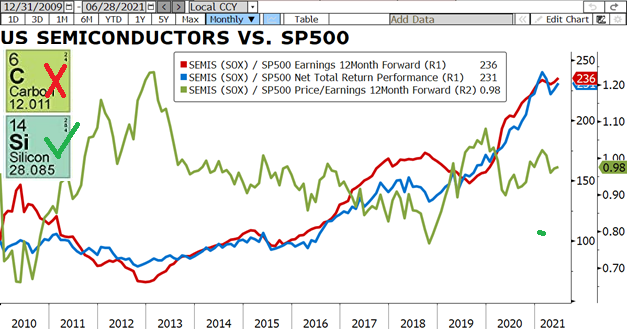
With the climate change, there is a huge trend to decrease the use of fossil fuels, whose main component is carbon. By chance, in the famous periodic table, silicon is just below carbon, and silicon is the main component of the semiconductor chips, which are the foundations of the digital economy. These small chips are the essential technology that makes anything computerised or digital work.

The chart above (blue line) shows the relative performance of the Philadelphia Semiconductor Index (SOX) compared to the performance of the SP500. During the last 11.5 years, this index has outperformed the SP500 by 7.8% per year!!!

What a coincidence that the profits (red line) of semiconductors have also been 7.8% higher per year!!! Once in a while the market seems to be efficient.

Where did the growth come from?

  • Communications (33% of demand), which had a phenomenal growth
  • Computers (29%). Growth has decreased but it is a main component of all computers.
  • Consumer (13%). Consumer electronic products rely on semiconductors
  • Automotive (12%). Cars are increasingly using semiconductors for many functions
  • Industrial (12%). Microcontrollers, power devices, sensors, etc, all need semiconductors

The important question is: Where will the future demand come from?

  • OLD: Communications, computers, consumers, industrials will continue to use more and more chips as the economy continues to “digitalise”.
  • NEW: Electric and Hybrid vehicles need between 3.0 and 3.3 times more chips than a traditional vehicle, and the new economy is going to migrate at an accelerated rate to electric vehicles.
  • NEW: 5G will enable the wide use of the Internet of Things and self-driven cars, which are going to be reliant on chips.
  • NEW: Artificial Intelligence, gaming devices, quantum computers, will all use powerful microprocessors to fulfill their requirements.

With all this use of chips, the demand of semiconductors has outstripped supply to a level such that auto makers cannot deliver enough cars due to chip shortages. Video cards are not fully available either nor video game consoles.

How much do we have to pay to get exposure to semiconductors? the green line in the chart shows the relative PE of semis at 0.98 versus the SP500, more or less in line with the average since 2009. Today, the investor pays the same earnings multiple for semis as he does for the SP500!!!

CONCLUSION

Interesting sector: it grows faster than the market; it is highly exposed to the “digital” economy; it will profit from the migration to electric vehicles; it will profit from the 5G deployment… and all of these without paying a premium!!


Past performance is not indicative of future results. The views, strategies and financial instruments described in this document may not be suitable for all investors. Opinions expressed are current opinions as of date(s) appearing in this material only.

References to market or composite indices, benchmarks or other measures of relative market performance over a specified period of time are provided for your information only. Notz, Stucki provides no warranty and makes no representation of any kind whatsoever regarding the accuracy and completeness of any data, including financial market data, quotes, research notes or other financial instrument referred to in this document.

This document does not constitute an offer or solicitation to any person in any jurisdiction in which such offer or solicitation is not authorized or to any person to whom it would be unlawful to make such offer or solicitation. Any reference in this document to specific securities and issuers are for illustrative purposes only, and should not be interpreted as recommendations to purchase or sell those securities. References in this document to investment funds that have not been registered with the FINMA cannot be distributed in or from Switzerland except to certain categories of eligible investors. Some of the entities of the Notz Stucki Group or its clients may hold a position in the financial instruments of any issuer discussed herein, or act as advisor to any such issuer.

 Additional information is available on request.

© Notz Stucki Group

Chart of the Month – From carbon to silicon. The case to invest in semiconductors.

From carbon to silicon. The case to invest in semiconductors.

Source : Bloomberg, IBES, Notz Stucki

With the climate change, there is a huge trend to decrease the use of fossil fuels, whose main component is carbon. By chance, in the famous periodic table, silicon is just below carbon, and silicon is the main component of the semiconductor chips, which are the foundations of the digital economy. These small chips are the essential technology that makes anything computerised or digital work.

The chart above (blue line) shows the relative performance of the Philadelphia Semiconductor Index (SOX) compared to the performance of the SP500. During the last 11.5 years, this index has outperformed the SP500 by 7.8% per year!!!

What a coincidence that the profits (red line) of semiconductors have also been 7.8% higher per year!!! Once in a while the market seems to be efficient.

Where did the growth come from?

  • Communications (33% of demand), which had a phenomenal growth
  • Computers (29%). Growth has decreased but it is a main component of all computers.
  • Consumer (13%). Consumer electronic products rely on semiconductors
  • Automotive (12%). Cars are increasingly using semiconductors for many functions
  • Industrial (12%). Microcontrollers, power devices, sensors, etc, all need semiconductors

The important question is: Where will the future demand come from?

  • OLD: Communications, computers, consumers, industrials will continue to use more and more chips as the economy continues to “digitalise”.
  • NEW: Electric and Hybrid vehicles need between 3.0 and 3.3 times more chips than a traditional vehicle, and the new economy is going to migrate at an accelerated rate to electric vehicles.
  • NEW: 5G will enable the wide use of the Internet of Things and self-driven cars, which are going to be reliant on chips.
  • NEW: Artificial Intelligence, gaming devices, quantum computers, will all use powerful microprocessors to fulfill their requirements.

With all this use of chips, the demand of semiconductors has outstripped supply to a level such that auto makers cannot deliver enough cars due to chip shortages. Video cards are not fully available either nor video game consoles.

How much do we have to pay to get exposure to semiconductors? the green line in the chart shows the relative PE of semis at 0.98 versus the SP500, more or less in line with the average since 2009. Today, the investor pays the same earnings multiple for semis as he does for the SP500!!!

CONCLUSION

Interesting sector: it grows faster than the market; it is highly exposed to the “digital” economy; it will profit from the migration to electric vehicles; it will profit from the 5G deployment… and all of these without paying a premium!!


Past performance is not indicative of future results. The views, strategies and financial instruments described in this document may not be suitable for all investors. Opinions expressed are current opinions as of date(s) appearing in this material only.

References to market or composite indices, benchmarks or other measures of relative market performance over a specified period of time are provided for your information only. Notz, Stucki provides no warranty and makes no representation of any kind whatsoever regarding the accuracy and completeness of any data, including financial market data, quotes, research notes or other financial instrument referred to in this document.

This document does not constitute an offer or solicitation to any person in any jurisdiction in which such offer or solicitation is not authorized or to any person to whom it would be unlawful to make such offer or solicitation. Any reference in this document to specific securities and issuers are for illustrative purposes only, and should not be interpreted as recommendations to purchase or sell those securities. References in this document to investment funds that have not been registered with the FINMA cannot be distributed in or from Switzerland except to certain categories of eligible investors. Some of the entities of the Notz Stucki Group or its clients may hold a position in the financial instruments of any issuer discussed herein, or act as advisor to any such issuer.

 Additional information is available on request.

© Notz Stucki Group

Le graphique du mois – Sauter dans le train de la digitalisation

Sauter dans le train de la digitalisation

Source: Bloomberg, Notz Stucki

La crise sanitaire a accéléré la tendance déjà en plein essor de la digitalisation. Celle-ci manifeste déjà sa capacité à transformer l’économie mondiale et constitue aujourd’hui un investissement prometteur.

Mais qu’entendons-nous par «digitalisation»? Dans sa forme la plus simple, il s’agit sans doute de l’élimination des barrières spatiales et temporelles, avec un objectif de performance et, en définitive, elle est une conséquence logique de l’évolution technologique. De plus en plus d’objets et de processus sont améliorés et transformés pour devenir plus efficaces grâce aux technologies digitales. De plus en plus de tâches peuvent être effectuées en ligne. La digitalisation est portée par un éventail assez large d’entreprises qui relèvent, entre autres, des technologies de l’information, d’internet, des nouveaux médias, du commerce électronique, de l’internet des objets (IdO), des semi-conducteurs, de la 5G ou encore du cloud. Elle est directement concernée par les problèmes récents de pénurie de semi-conducteurs ou de protection des données, etc.

Le premier trimestre de 2021 est désormais derrière nous et les grandes entreprises du secteur de la technologie ont annoncé de très bons chiffres. Mais comment s’y retrouver dans cet univers ? Les investisseurs sont séduits par les nouveaux «chouchous» des marchés. Ceux-ci sont toutefois volatils et leurs valorisations ont de quoi donner le vertige. Les acheter exige une vigilance de chaque instant.

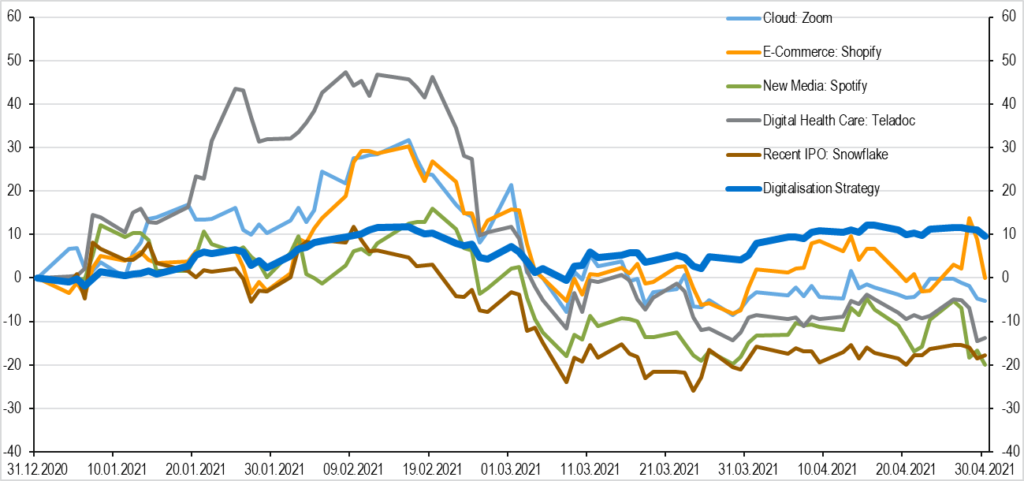
Compte tenu de l’engouement pour l’investissement dans la digitalisation, nous avons décidé en avril de lancer un certificat géré de manière active sur cette thématique. Notre devise est «la sélection des titres est essentielle» et «il ne faut pas céder à la tentation», si l’on souhaite se positionner sur le moyen ou le long terme. Les entreprises liées à la technologie peuvent avoir des valorisations très élevées, et cette année, il valait mieux éviter les nouveaux «chouchous», qui au final ont été très volatils, avec des valorisations très élevées et affichent, à fin avril, une performance négative sur l’année en cours.

Pour notre stratégie digitalisation, nous n’avons pas de contraintes géographiques, nous ne pouvons pas faire l’impasse sur l’ensemble des fameuses FANG et nous avons décidé de considérer certaines entreprises de taille moyenne avec des valorisations pas trop élevées, un PER sur taux de croissance anticipé (PEG) faible, un chiffre d’affaires en croissance, une rentabilité des fonds propres (RoE) intéressante, une trésorerie confortable ou même une croissance des bénéfices par action. La stratégie permet d’assurer une volatilité moindre que les compagnies actuellement à la mode appartenant au cloud, commerce électronique et nouveaux médias, et ce, avec une meilleure performance à la fin.

La digitalisation, et en particulier les technologies numériques, sont en mesure d’accélérer et de soutenir le développement et d’aider chaque être humain. De nouvelles opportunités se présenteront. Le secteur du digital est sans doute devenu aujourd’hui un atout et un acteur majeur dans la réduction globale des émissions de carbone.


Les performances passées ne garantissent pas les résultats futurs. Les opinions, stratégies et instruments financiers décrits dans le présent document peuvent ne pas convenir à tous les investisseurs. Les opinions énoncées sont celles valables à la date de publication de ce document.

Toute référence aux indices de marches ou composites, indices de référence, ou autres mesures de performance relative des marches a une certaine période sont indiquées à titre d’information. Notz Stucki ne donne aucune garantie et n’est aucunement responsable de l’exactitude et de l’exhaustivité de l’ensemble des informations (données financières de marche, cours de bourse, avis de recherche ou description de tout autre instrument financier) contenus dans ce document.

Le présent document n’est pas destiné aux personnes ou entités qui seraient citoyennes ou résidentes d’un lieu, état, pays ou juridiction dans lesquels sa distribution, sa publication, sa mise à disposition ou son utilisation seraient contraires aux lois ou règlements en vigueur. Les informations et données fournies dans le présent document sont communiquées à titre indicatif uniquement et ne constituent ni une offre, ni une incitation à acheter, vendre ou souscrire a des titres ou tout autre instrument financier. Il est fait référence dans ce document a des fonds d’investissement qui n’ont pas été enregistrés auprès de la Finma et ne peuvent donc pas être distribues en ou depuis la suisse sauf à certaines catégories d’investisseurs éligibles. Certaines des sociétés du groupe Notz Stucki ou ses clients peuvent être détenteurs d’une position dans les instruments financiers de l’un des émetteurs mentionnes dans ce document, ou agir en tant que consultant pour l’un d’eux.

Des informations supplémentaires sont disponibles sur demande.

© Groupe Notz Stucki

Chart of the Month – Jump on the bandwagon of digitalisation

Jump on the bandwagon of digitalisation

Source: Bloomberg, Notz Stucki

The health crisis has led to the acceleration of an already fast-growing trend: digitalisation. It is already demonstrating its ability to transform the global economy and is now a promising investment.

But what does “digitalisation” mean? In its most basic form, it is probably the elimination of spacial and temporal barriers, there is a performance goal and it is ultimately a logical consequence of technological evolution. More and more objects and processes are improved and transformed to become more efficient through digital technologies. More and more actions can be carried out online. Digitalisation covers a fairly wide range of companies in the market that pertain to information technology, Internet, new media, e-commerce, Internet of Things (IoT), semiconductors, 5G, cloud, among others. And it directly confronts the recent issues of semiconductor shortage, data protection…

The first quarter of 2021 is behind us, the big tech companies have reported extremely good numbers. But how to find your way in this world? Investors are seduced by the new « darling » companies that attract attention. But these are volatile and when it comes to their valuation, it’s enough to make one’s head spin. If you decide to invest in them, you have to be on your toes.

Investment in digitalisation is gaining traction and in April we decided to launch an actively managed certificate on this theme. Our approach is “the stock selection is key” and “don’t give in to temptation “, if you want to invest for medium to long term. Technology-related companies can have very high valuations, and this year it was better to avoid the new « darlings », which were ultimately very volatile, have very high valuations and are negative from the beginning of the year to the end of April.

In our digitalisation strategy, we have no constraints in terms of regions, we cannot do without some of the famous FANG, and we decided to take into account some mid-sized companies with not-so-high valuations, low PEG, revenue growth, interesting ROE level, comfortable cash generation or even growth in the earnings per share. The strategy brings less volatility than a “hot” topic in cloud, e-commerce and new media, with a better performance at the end.

Digitalisation, and especially digital technologies, can accelerate and support development and help every human being. New opportunities will emerge. The digital sector is probably today a major argument and actor in the global reduction of carbon emissions.


Past performance is not indicative of future results. The views, strategies and financial instruments described in this document may not be suitable for all investors. Opinions expressed are current opinions as of date(s) appearing in this material only.

References to market or composite indices, benchmarks or other measures of relative market performance over a specified period of time are provided for your information only. Notz, Stucki provides no warranty and makes no representation of any kind whatsoever regarding the accuracy and completeness of any data, including financial market data, quotes, research notes or other financial instrument referred to in this document.

This document does not constitute an offer or solicitation to any person in any jurisdiction in which such offer or solicitation is not authorized or to any person to whom it would be unlawful to make such offer or solicitation. Any reference in this document to specific securities and issuers are for illustrative purposes only, and should not be interpreted as recommendations to purchase or sell those securities. References in this document to investment funds that have not been registered with the FINMA cannot be distributed in or from Switzerland except to certain categories of eligible investors. Some of the entities of the Notz Stucki Group or its clients may hold a position in the financial instruments of any issuer discussed herein, or act as advisor to any such issuer.

 Additional information is available on request.

© Notz Stucki Group

FORWARD, le forum de l’innovation

FORWARD, le forum de l’innovation

Journée très inspirante à l’EPFL , dans le cadre du Forum pour l’innovation des PMEs qui s’est tenue le 19 avril, avec plus de 900 participants. Un vrai succès ! Bravo aux organisateurs d’avoir réussi le pari d’un événement interactif permettant l’échange et le partage. Ce forum a été une belle vitrine, montrant la richesse des initiatives en cours et la profondeur des solutions très concrètes qui se dessinent dans le canton de Vaud et en Suisse romande.

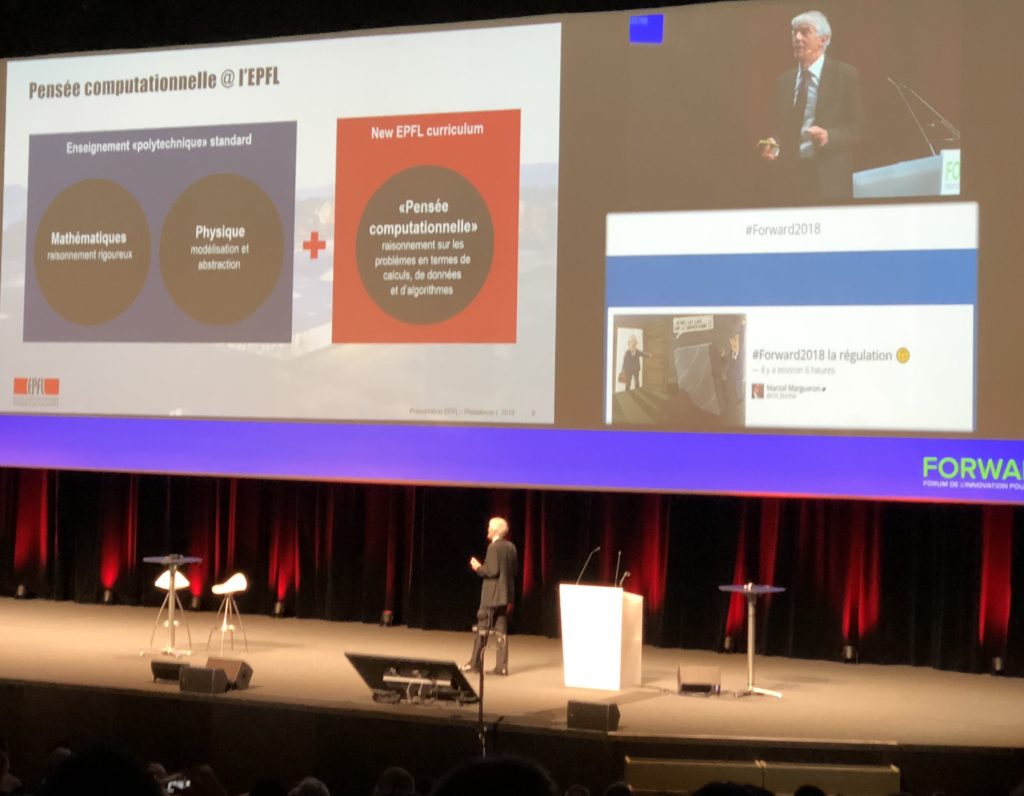
Le Président de l’EPFL n’aura pas manqué de rappeler que la souris, outil d’interaction entre l’homme et la machine, sort des laboratoires de son institution soulignant même non sans humour son origine vaudoise du côté d’Apples, ponctuée d’un s.

Si la pensée computationnelle semble être sur toutes les lèvres et ambitionne d’être la mère de toutes les disciplines scientifiques (après les mathématiques et la physique), notre école polytechnique fédérale séduit par sa vision académique, le nombre de projets qui y naissent et s’y développent. L’EFPL s’engage aussi clairement à créer des ponts et passerelles avec le secteur privé, offrant ainsi tout l’éventail des compétences de ses chercheurs et étudiants dans ce qui ne peut qu’être un partenariat gagnant. Il suffit de consulter ce site pour s’en convaincre : VPI – EPFL.

Martin Vetterli, président de l’EPFL

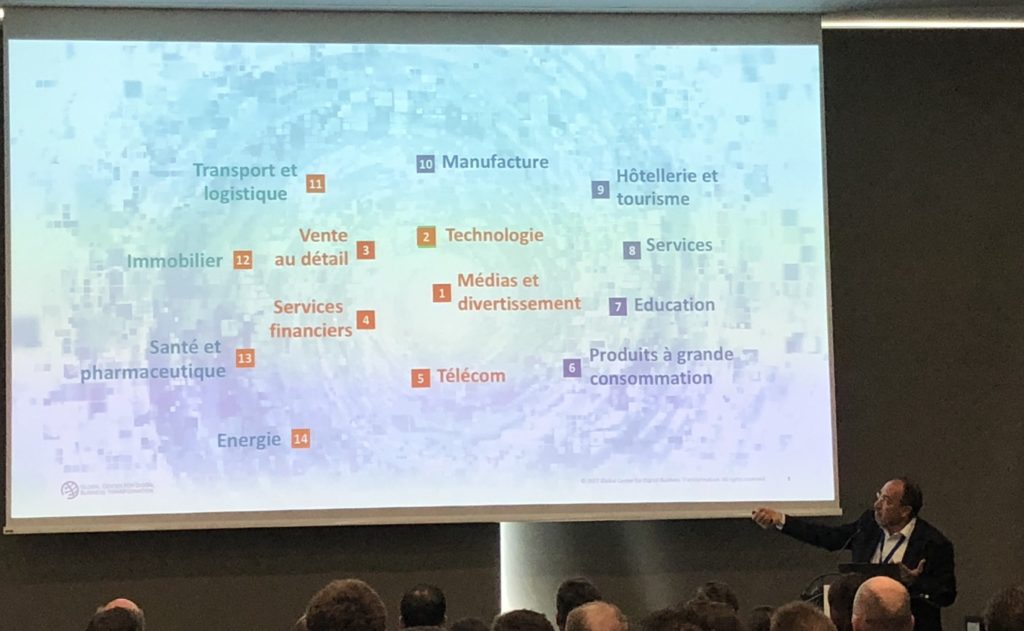
On le sait, la digitalisation changera nos vies et nos habitudes. Le professeur Tawfik Jelassi de l’IMD à Lausanne a imagé ce changement sous forme d’un cyclone, en désignant les industries qui se trouvent en son centre :

Le cyclone du professeur Tawfik Jelassi

Cette journée aura surtout permis de découvrir comment les PMEs prises dans ce tourbillon organisent la bataille autour de projets et solutions très concrètes, permettant ainsi de profiter des opportunités créées par la digitialisation. On trouve des entreprises locales ayant réussi cette transition comme Laura Star, l’école Moser, Aeschbach, senseFly, Sensile Technologies ou encore JMC Lutherie (compte-rendu complet disponible ici).

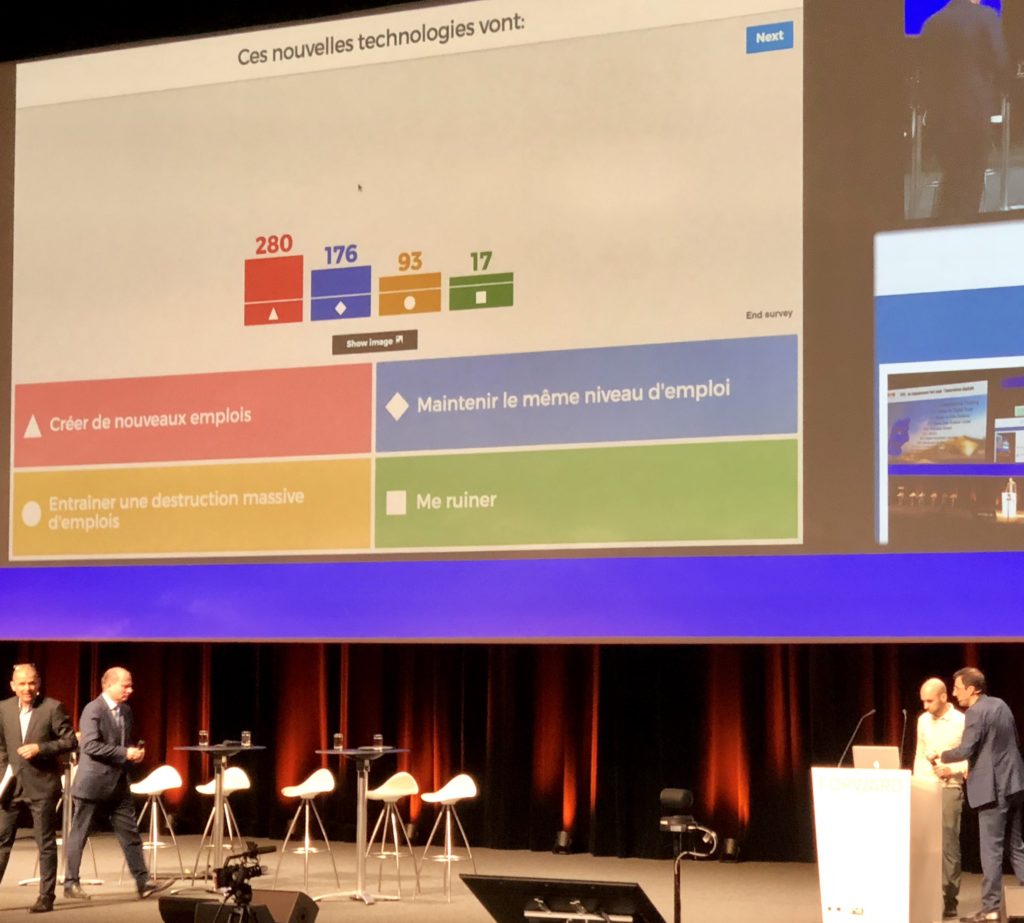
Il est ainsi intéressant de constater que l’auditoire – en majorité des PMEs – s’est montré optimiste, comme un sondage interactif l’a montré en temps réel :

Sondage en temps réel

En guise de conclusion, Bruno Bonnell, député français de La République en Marche, qui se présente comme un “multi-entrepreneur robolutionnaire”, a commenté et confirmé cette tendance de création d’emplois – et rassuré peut-être les plus anxieux. Il prédit certes un boom de la croissance autour de l’utilisation des nouveaux outils numériques, mais insiste aussi sur la redéfinition du travail et de la valeur ajoutée des métiers. Il nous plonge dans l’ère de l’humain augmenté en insistant sur l’apport de la technologie dans nos vies privées et professionnelles, au point d’ailleurs de qualifier d’ “handicapé numérique” les personnes qui en seraient privées.  Il ne s’agit donc pas, pour l’homme, de vouloir entrer en compétition avec la technologie, mais bien de composer avec son aide.

Nous voilà donc en homo sapiens numeris avec une question à résoudre qui est plus que jamais d’actualité : Qui a l’autorité sur nos données et comment on en définit la propriété?

Rendez-vous est déjà pris pour l’édition 2019 !