Last one standing – Reconsider European equity long short funds – NS Insights

European equity long short funds have suffered from Europe’s lack of appeal. But now might be the time to reconsider them.

At the beginning of the 2000s, most private banks and asset management firms based in Geneva managed their own funds of funds that invested in a new generation of young alternative managers specialising in European equity long/short strategies. At the time, these multi-manager funds delivered double-digit annualised returns, net of management and performance fees. After starting their careers as equity managers within large traditional investment companies, most of these talents left in the 1990s to establish their own independent asset management firms. Many of them were backed by alternative investment legends such as George Soros and Michael Steinhardt, to run portfolios of long/short equity ideas in Europe, a strategy that had already proven its worth in the United States since the 1950s.

An endangered species?

Today, all European funds of funds specialising in long/short equity have disappeared, with one exception. The main reason: the 2008 global financial crisis wiped out many hedge funds in Europe, partly because they offered more attractive liquidity terms than their American counterparts. Added to this, the US equity market has significantly outperformed Europe since 2009 (thanks to the tech sector), following a similar trend from 1989 to 2009, which further reduced the appeal of European equities. Moreover, Europe has been weakened by geopolitical challenges, making it even less attractive to international investors.

Investors have short memories

Yet it is well known that every crisis also presents significant opportunities for long/short managers. Many have already forgotten the Greek debt crisis at the end of 2009 and, more importantly, the country’s remarkable recovery after the 2018 bailout! This year, Greece ranks among the best-performing equity markets in the world, alongside other so-called peripheral markets like Poland, the Czech Republic, Spain and Italy, while Switzerland has lagged, moving similarly to France since the start of the year.

Make Europe Great Again

Published at the end of 2024, the Draghi report provided European leaders with a roadmap to “make Europe great again” by boosting investment and productivity. The report highlighted the need to invest EUR900 billion annually (around 4.5% of EU GDP) to address the continent’s structural competitiveness gap. This year, Germany announced a EUR500 billion plan over ten years to modernize its infrastructure. More recently, Blackstone unveiled plans to invest USD500 billion in Europe over the next decade. And this is just the tip of the iceberg, with many other initiatives underway across the continent to strengthen its competitiveness.

Europe is home to some of the world’s best companies

While Europe certainly has its share of struggling companies, it is also home to some of the most successful firms globally in luxury, pharmaceuticals, chemicals, energy, defense, and aerospace, all ideal playing fields for long/short strategies. Despite this, the universe of European long/short managers has been shrinking every year since the 2008 financial crisis, due to a lack of interest or liquidity compared to the US. Nevertheless, on a regional basis, managers focused on Europe have been among the top performers since the start of the year.

High potential but hard to access

History shows that the US has long produced some of the best long/short managers. However, over the past five years, some of the brightest talents in this space are found in Europe. They have managed to generate positive alpha on both their long and short positions, while skillfully adjusting their net exposure, an advantage often linked to the smaller size of their funds. Still, the capacity of these strategies remains limited due to low scalability tied to liquidity, restricting access to these opportunities. The best way to tap this potential is to invest in a collective vehicle specialising in Europe, with strong expertise in selecting and monitoring the top European managers. However, access to these funds often remains limited to a select circle, as they are frequently closed to new investors.

Notably, the GRANOLAS (Europe’s equivalent of America’s “Magnificent Seven”) have started to underperform the Stoxx 600 since early April, creating greater dispersion and a more favorable environment for selecting long and short positions. With Europe once again facing geopolitical tensions and the persistent risk of deglobalisation, it might just be time to reconsider European long/short strategies.
Les stratégies hedge funds gagnantes pour 2023

Les stratégies hedge funds gagnantes pour 2023

Alors que le calme des marchés semble précaire, quelles stratégies alternatives choisir pour éviter l’orage ?

Une sérénité apparente

Si l’on considère la performance des indices actions depuis le début de l’année, dans l’ensemble les marchés financiers se portent bien. En effet, l’indice mondial MSCI World est en hausse de +13%, le S&P 500 de +15%, le MSCI Europe de +10% et le SMI de +7%. En Asie, le constat est plus contrasté. De fait, tandis que le Topix a repris des couleurs en affichant une hausse de +23%, la Chine éprouve plus de difficultés avec une baisse de -6% pour l’indice MSCI China. De leur côté, après une année compliquée en 2022 marquée par une hausse des taux d’intérêt de grande ampleur, les indices obligataires sont dans le vert. Malgré une restriction significative des conditions de liquidité, un niveau de coût de financement pour les Etats et les entreprises inédit depuis 15 ans et une crise bancaire pas si anodine que cela, les spreads de crédit ne se sont pas envolés… pour l’instant.

Long/short Equity : un positionnement qui pourrait s’avérer payant

Dans ce contexte, quelles sont les stratégies hedge funds qui ont su tirer leur épingle du jeu ? Alors que les gérants long/short equity ont particulièrement mal géré l’année 2022, en n’ayant pas réussi à revenir en territoire positif après leur baisse du 1er trimestre, ils affichent en 2023 à nouveau des performances plus en ligne avec leurs objectifs. Ainsi, après avoir reculé de -10% en 2022, l’indice HFRI Equity Hedge affiche une progression de +3% cette année, avec des nombreux gérants ayant enregistré des hausses aux alentours de +6%. La situation est donc bien différente, dans la mesure où les gérants ont des positions plus diversifiées en termes d’allocation sectorielle et une exposition aux marchés plutôt faible dans l’ensemble. Ce résultat est d’autant plus intéressant que le marché US est tiré par quelques méga-sociétés technologiques liées à l’AI, qui masquent une réalité sous-jacente bien plus contrastée. Ce positionnement permet ainsi d’être un peu plus sereins si le marché actions venait à perdre des couleurs pendant l’été. Sous-performer légèrement les indices de marchés est le prix à payer pour ne pas avoir à se soucier de devoir vendre ou d’essayer de rattraper le temps perdu.

La concurrence fait rage chez les plateformes multi-gérants

Dans la quête d’une alternative à la poche obligataire, les fonds multi-stratégies relative value ont été les grands gagnants de l’année dernière. Le sous-indice HFRI des fonds Relative Value Multi-Strategy n’a ainsi reculé « que » de -1% en 2022 (avec une bonne partie des gérants ayant généré une performance autour de +5%) et grimpe de +2% sur l’année en cours. Faisant preuve d’une robustesse à toute épreuve, ils montrent un ratio de Sharpe à faire pâlir le fameux composite 60% actions/40% obligations sur les 3 dernières années. En conséquence, ces plateformes ont attiré beaucoup d’argent et se livrent à une guerre des talents sans merci, qui n’est pas sans impact sur les frais payés par l’investisseur. Toutefois, même si elles restent positives, les performances affichées cette année sont pour l’instant en deçà des attentes, ce qui correspond probablement à une phase de digestion. Malgré ce constat, suite à la hausse des taux d’intérêt, les performances espérées sur le moyen-terme ont également été revues à la hausse. Il faut dire que cette catégorie de gérants représente probablement la meilleure assurance en cas de choc exogène ou d’une hausse soudaine de la volatilité. Encore faut-il dénicher les fonds de plus petites taille capables de générer un alpha intéressant ou avoir accès aux meilleures plateformes dont les minimums d’investissement ont pris l’ascenseur.

Global Macro : des risques payants

Si les gérants global macro ont été les grandes stars de l’année 2022 (+9% pour le sous-indice HFRI Macro), ils ont toutefois souffert depuis le début de l’année (-2%), ce qui ne constitue pas nécessairement une surprise étant donné le massif retournement de tendance que nous avons connu. Le phénomène le plus marquant s’est produit en mars avec les faillites bancaires aux Etats-Unis, qui ont fait passer le taux US 2 ans de 5.2% à 3.8% en 48 heures, un mouvement d’une amplitude jamais vue depuis 1987. Et pendant ce temps-là, le marché action n’a même pas froncé un sourcil ! Dans cette catégorie, l’un des gérants les plus emblématiques est probablement Chris Rokos, qui a fait couler beaucoup d’encre dans les médias en raison de sa baisse de près de 15% en mars. Mais quand on prend des risques, ce genre de drawdown ne peut être évité de temps à autre. Et notons surtout qu’il est en passe de repasser en territoire positif et qu’il avait généré pour ses investisseurs une performance de +51% l’année dernière. Dans cet environnement de marché incertain, nous restons persuadés que les gérants global macro constituent une offre d’investissement très intéressante. Parmi les thématiques qui ont retenu notre attention récemment, on trouve celle de la possibilité d’un enlisement économique de la Chine. Alors que tout le monde regarde vers le haut, c’est peut-être bien vers le bas qu’il faudrait regarder.

En résumé, il nous semble aujourd’hui opportun de considérer les 3 grandes catégories de stratégies de hedge funds que sont equity long/short, multi-strategy relative value et global macro. Mais l’élément prédominant pour obtenir une performance de son portefeuille hedge funds satisfaisante tient dans la sélection et l’accès aux meilleurs gérants. Une autre variable souvent moins considérée est la gestion dynamique du portefeuille. Ainsi, dans la mesure du possible, il est souvent payant d’avoir une approche contrariante et ne pas hésiter à prendre des bénéfices lorsqu’un gérant qui a très bien performé et surtout ne pas avoir peur de rajouter de l’argent à un gérant qui a connu un trou d’air. Si le travail de sélection en amont a été bon, c’est ce qui va vous permettre de faire la différence.


Les performances passées ne garantissent pas les résultats futurs. Les opinions, stratégies et instruments financiers décrits dans le présent document peuvent ne pas convenir à tous les investisseurs. Les opinions énoncées sont celles valables à la date de publication de ce document. Toute référence aux indices de marches ou composites, indices de référence, ou autres mesures de performance relative des marches a une certaine période sont indiquées à titre d’information. NS Partners ne donne aucune garantie et n’est aucunement responsable de l’exactitude et de l’exhaustivité de l’ensemble des informations (données financières de marche, cours de bourse, avis de recherche ou description de tout autre instrument financier) contenus dans ce document. Le présent document n’est pas destiné aux personnes ou entités qui seraient citoyennes ou résidentes d’un lieu, état, pays ou juridiction dans lesquels sa distribution, sa publication, sa mise à disposition ou son utilisation seraient contraires aux lois ou règlements en vigueur. Les informations et données fournies dans le présent document sont communiquées à titre indicatif uniquement et ne constituent ni une offre, ni une incitation à acheter, vendre ou souscrire a des titres ou tout autre instrument financier. Il est fait référence dans ce document a des fonds d’investissement qui n’ont pas été enregistrés auprès de la Finma et ne peuvent donc pas être distribues en ou depuis la suisse sauf à certaines catégories d’investisseurs éligibles. Certaines des sociétés du groupe NS Partners ou ses clients peuvent être détenteurs d’une position dans les instruments financiers de l’un des émetteurs mentionnes dans ce document, ou agir en tant que consultant pour l’un d’eux. Des informations supplémentaires sont disponibles sur demande.

© Groupe NS Partners

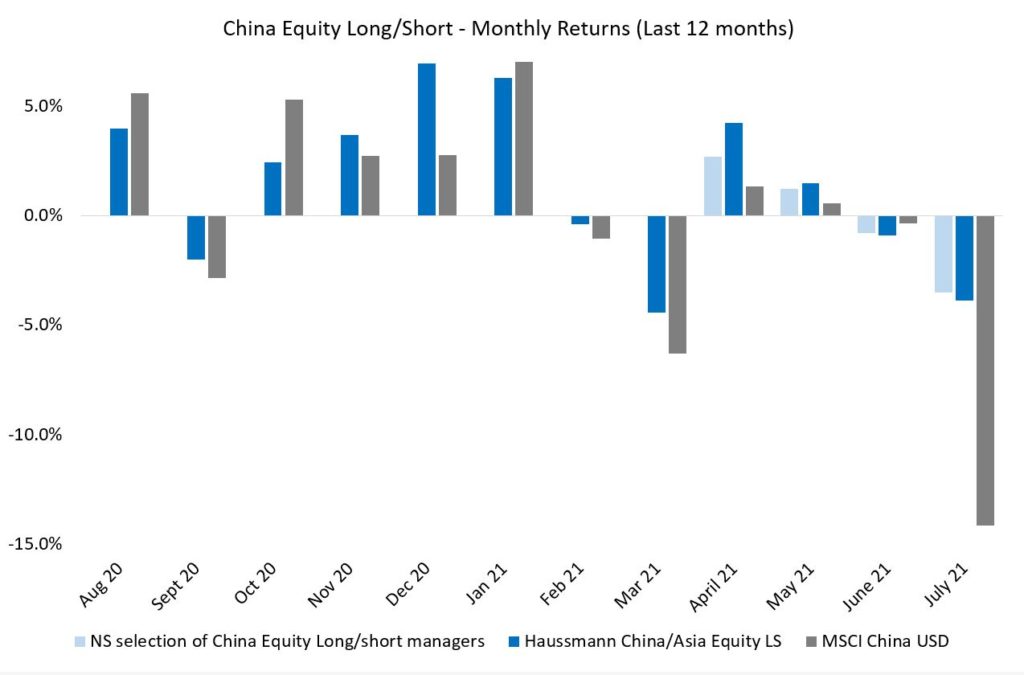
Chart of the Month – An interesting way to play China.

An interesting way to play China.

Source: Bloomberg, Notz Stucki

Since the emergence of the COVID-19 we are talking less about yellow fever. But during July, Chinese markets were at the epicenter of the attention of investors. Because of the Chinese government’s regulation crackdown, the MSCI China Index lost -14.3%. Some sectors were materially negatively impacted whereas others were almost immune, depending on the regulatory overhang: on a pick to through stock performance basis, new energy lost 1%, semiconductors 2%, healthcare 24%, consumer 27% and internet 52%. When looking at the 12-month trailing returns, the underperformance of China Internet versus the Nasdaq has reached unprecedented levels, closed to -65%.

The main objective of the Chinese Government is to have a stable society and this goes with wealth creation being relatively well distributed amongst people. This is why they target industries that are adding significant burden to ordinary people’s life, such as privatized education, property or online gaming. However, wealth creation is being driven by innovation lead by the private sector and the authorities will continue to support technology development such as artificial intelligence, semiconductors, automation and new energy.

Such a market move is not without consequences on investor sentiment. It will take time for some investors to regain confidence to invest in certain sectors but the Chinese economy remains vibrant with growth in many different sectors.

According to us, an interesting way to benefit from investment opportunities in Chinese equity markets is through experienced equity long/short managers able to understand and adapt to the dynamics of the markets, and with the ability to seize investment opportunities both on the long and short side which arise in the current environment. July was a real stress test and our selection of managers managed to limit the downside to one third of the market drawdown. Over the last 12 months, our selection of managers have captured 123% of the market upside and 42% of the market downside. More importantly our strategy delivered a cumulative return of 25.0% when the market lost 1.1% over the period, with a volatility of only 13.8% vs 20.4% for the Index.


Past performance is not indicative of future results. The views, strategies and financial instruments described in this document may not be suitable for all investors. Opinions expressed are current opinions as of date(s) appearing in this material only.

References to market or composite indices, benchmarks or other measures of relative market performance over a specified period of time are provided for your information only. Notz, Stucki provides no warranty and makes no representation of any kind whatsoever regarding the accuracy and completeness of any data, including financial market data, quotes, research notes or other financial instrument referred to in this document.

This document does not constitute an offer or solicitation to any person in any jurisdiction in which such offer or solicitation is not authorized or to any person to whom it would be unlawful to make such offer or solicitation. Any reference in this document to specific securities and issuers are for illustrative purposes only, and should not be interpreted as recommendations to purchase or sell those securities. References in this document to investment funds that have not been registered with the FINMA cannot be distributed in or from Switzerland except to certain categories of eligible investors. Some of the entities of the Notz Stucki Group or its clients may hold a position in the financial instruments of any issuer discussed herein, or act as advisor to any such issuer.

 Additional information is available on request.

© Notz Stucki Group

Investissement alternatif : Notz Stucki, pionnier et expert reconnu

Quels sont nos atouts sur le marché des investissements alternatifs?

Sur le marché de l’investissement alternatif, la différenciation repose avant tout sur l’expertise, la sélection rigoureuse des gérants et la capacité à identifier des opportunités décorrélées des marchés traditionnels. Chez Notz Stucki, notre approche repose sur une analyse approfondie des stratégies, une gestion active des risques et un accès privilégié à des gérants de hedge funds reconnus pour leur talent et leur discipline.
Des éléments de réponse de notre Responsable des Investissements Alternatifs, Cédric Dingens, dans une courte vidéo: “Hedge Funds – Des gérants hors du commun”.


Les performances passées ne garantissent pas les résultats futurs. Les opinions, stratégies et instruments financiers décrits dans le présent document peuvent ne pas convenir à tous les investisseurs. Les opinions énoncées sont celles valables à la date de publication de ce document.

Toute référence aux indices de marches ou composites, indices de référence, ou autres mesures de performance relative des marches a une certaine période sont indiquées à titre d’information. Notz Stucki ne donne aucune garantie et n’est aucunement responsable de l’exactitude et de l’exhaustivité de l’ensemble des informations (données financières de marche, cours de bourse, avis de recherche ou description de tout autre instrument financier) contenus dans ce document.

Le présent document n’est pas destiné aux personnes ou entités qui seraient citoyennes ou résidentes d’un lieu, état, pays ou juridiction dans lesquels sa distribution, sa publication, sa mise à disposition ou son utilisation seraient contraires aux lois ou règlements en vigueur. Les informations et données fournies dans le présent document sont communiquées à titre indicatif uniquement et ne constituent ni une offre, ni une incitation à acheter, vendre ou souscrire a des titres ou tout autre instrument financier. Il est fait référence dans ce document a des fonds d’investissement qui n’ont pas été enregistrés auprès de la Finma et ne peuvent donc pas être distribues en ou depuis la suisse sauf à certaines catégories d’investisseurs éligibles. Certaines des sociétés du groupe Notz Stucki ou ses clients peuvent être détenteurs d’une position dans les instruments financiers de l’un des émetteurs mentionnes dans ce document, ou agir en tant que consultant pour l’un d’eux.

Des informations supplémentaires sont disponibles sur demande.

© Notz Stucki Group


Notz Stucki – An alternative investment pioneer.

What are our strengths in the alternative investment market?

Some answers from our Head of Alternative Investments, Cédric Dingens, in a short video: “Hedge funds – Managers that stand out from the crowd”.


Past performance is not indicative of future results. The views, strategies and financial instruments described in this document may not be suitable for all investors. Opinions expressed are current opinions as of date(s) appearing in this material only.

References to market or composite indices, benchmarks or other measures of relative market performance over a specified period of time are provided for your information only. Notz, Stucki provides no warranty and makes no representation of any kind whatsoever regarding the accuracy and completeness of any data, including financial market data, quotes, research notes or other financial instrument referred to in this document.

This document does not constitute an offer or solicitation to any person in any jurisdiction in which such offer or solicitation is not authorized or to any person to whom it would be unlawful to make such offer or solicitation. Any reference in this document to specific securities and issuers are for illustrative purposes only, and should not be interpreted as recommendations to purchase or sell those securities. References in this document to investment funds that have not been registered with the FINMA cannot be distributed in or from Switzerland except to certain categories of eligible investors. Some of the entities of the Notz Stucki Group or its clients may hold a position in the financial instruments of any issuer discussed herein, or act as advisor to any such issuer.

 Additional information is available on request.

© Notz Stucki Group


Le graphique du mois – Arguments en faveur de la gestion active en Chine!

Arguments en faveur de la gestion active en Chine!

Source: Notz Stucki

La Chine semble être l’un des grands gagnants de la pandémie de covid-19. En effet, l’économie du pays a enregistré une croissance de près de +3% en 2020 et celle-ci devrait atteindre entre +8% et +9% en 2021. L’appréciation continue du RMB par rapport à l’USD en est une illustration parfaite. Contrairement à ce que l’on observe dans les autres grandes économies mondiales, la politique macroéconomique chinoise devrait, cette année, être équilibrée et se concentrer sur les réformes de la demande avec pour objectif de stimuler la consommation par l’emploi, la sécurité sociale et la répartition des revenus.

Une forte croissance du PIB réel en 2021 et une éventuelle dose de reflation sont susceptibles de dynamiser la rentabilité des entreprises, notamment dans les secteurs de la consommation et de l’industrie. Les bénéfices seront le principal vecteur de performance des actions chinoises et même si leurs valorisations sont assez élevées en termes absolus, elles paraissent raisonnables par rapport à celles des autres marchés mondiaux et notamment celles des actions américaines.

Bien qu’il soit encore sous-représenté dans les indices mondiaux, le marché des actions A chinoises est le deuxième plus grand marché actions au monde et regorge d’opportunités de croissance structurelle. Les principaux champions sont à chercher parmi les leaders industriels, les entreprises qui surfent sur les grandes tendances post-pandémiques et les secteurs qui devraient bénéficier du plan quinquennal en termes de soutien politique et de dynamique des réformes (la Chine entend devenir autonome!) à savoir, la technologie, l’innovation, la numérisation, les nouvelles infrastructures, les investissements verts et la demande intérieure.

La combinaison de ce contexte macroéconomique solide et des réformes du marché financier pourrait entraîner une réallocation importante des flux vers les actions A chinoises. Or, compte tenu des inefficiences plus importantes du marché et de la présence d’un grand nombre d’investisseurs particuliers, les actions chinoises constituent un environnement riche en opportunités d’alpha. Le graphique ci-dessus présente les performances sur trois ans glissants, au cours de la dernière décennie, de l’indice MSCI China, de l’indice EurekaHedge China Equity Long/Short et de notre sélection de gérants d’actions chinoises Long/Short regroupés dans un fonds multi-gérants monde depuis 2015 (la pondération de chacun des gérants a été maintenue au même niveau pour éviter les biais).

Conclusions:

  1. l’investissement en actions chinoises long/short constitue une source d’alpha durable dans le temps
  2. une sélection efficace de gérants talentueux dans cette catégorie apporte une réelle valeur ajoutée

Notre nouveau fonds multi-gérants d’actions chinoises, dont le lancement est prévu fin mars, s’inspirera largement de cette sélection de gérants d’actions long/short et devrait permettre la diversification de portefeuilles classiques d’actions mondiales.


Les performances passées ne garantissent pas les résultats futurs. Les opinions, stratégies et instruments financiers décrits dans le présent document peuvent ne pas convenir à tous les investisseurs. Les opinions énoncées sont celles valables à la date de publication de ce document. Toute référence aux indices de marches ou composites, indices de référence, ou autres mesures de performance relative des marches a une certaine période sont indiquées à titre d’information. Notz Stucki ne donne aucune garantie et n’est aucunement responsable de l’exactitude et de l’exhaustivité de l’ensemble des informations (données financières de marche, cours de bourse, avis de recherche ou description de tout autre instrument financier) contenus dans ce document. Le présent document n’est pas destiné aux personnes ou entités qui seraient citoyennes ou résidentes d’un lieu, état, pays ou juridiction dans lesquels sa distribution, sa publication, sa mise à disposition ou son utilisation seraient contraires aux lois ou règlements en vigueur. Les informations et données fournies dans le présent document sont communiquées à titre indicatif uniquement et ne constituent ni une offre, ni une incitation à acheter, vendre ou souscrire a des titres ou tout autre instrument financier. Il est fait référence dans ce document a des fonds d’investissement qui n’ont pas été enregistrés auprès de la Finma et ne peuvent donc pas être distribues en ou depuis la suisse sauf à certaines catégories d’investisseurs éligibles. Certaines des sociétés du groupe Notz Stucki ou ses clients peuvent être détenteurs d’une position dans les instruments financiers de l’un des émetteurs mentionnes dans ce document, ou agir en tant que consultant pour l’un d’eux. Des informations supplémentaires sont disponibles sur demande.

© Groupe Notz Stucki

Chart of the Month – The case for good active management in China!

The case for good active management in China!

Source: Notz Stucki

One of the big winners of the COVID-19 pandemic appears to be China, which has seen its economy grow by almost +3% in 2020 and is expected to grow between +8% and +9% in 2021. The continued appreciation of the RMB versus the USD is the best evidence of it. Contrary to what is happening in the other world large economies, this year’s Chinese macro policy should be balanced with a focus on demand-side reforms and an objective to boost consumption through employment, social security and income distribution.

Strong real GDP growth in 2021 and the possibility to see some reflation pickup would be beneficial to corporate profitability, particularly in the consumer and industrial sectors. Earnings will be the key driver for equity returns and even if equity valuations are quite high on an absolute basis, they look reasonable compared to global peers and particularly to the US.

The China A-Shares market, which is the 2nd largest equity market globally but still under-represented in global indexes, is the place for structural growth opportunities. Expected winners are to be found among industry leaders, companies surfing on the mega trends of the post-pandemic world and sectors which should benefit from the 5-year plan in terms of policy support and reform push (China wants to become self-dependent!): technology, innovation, digitalization, new infrastructure, green investments and domestic demand.

The combination of this strong macroeconomic backdrop and financial market reforms could bring significant reallocation flows to China A-Shares. With higher market inefficiencies and a high retail investor participation, Chinese equities are a fertile environment for alpha opportunities. The chart above shows the rolling 3-year performance of the MSCI China Index, the EurekaHedge China Equity Long/Short Index and of our selection of China Equity Long/Short managers within a global multi-manager fund since 2015 (each manager is kept at the same weight to avoid biases) over the last decade.

Conclusions:

  1. equity long/short investing in China is a sustainable source of alpha over time.
  2. a good selection of talented manager in this category provides real added value.

With an expected launch date for the end of March, our new China Multi-Manager Fund will be largely inspired by this selection of equity long/short managers and should offer diversification benefits to a typical global equity portfolio.


Past performance is not indicative of future results. The views, strategies and financial instruments described in this document may not be suitable for all investors. Opinions expressed are current opinions as of date(s) appearing in this material only.

References to market or composite indices, benchmarks or other measures of relative market performance over a specified period of time are provided for your information only. Notz, Stucki provides no warranty and makes no representation of any kind whatsoever regarding the accuracy and completeness of any data, including financial market data, quotes, research notes or other financial instrument referred to in this document.

This document does not constitute an offer or solicitation to any person in any jurisdiction in which such offer or solicitation is not authorized or to any person to whom it would be unlawful to make such offer or solicitation. Any reference in this document to specific securities and issuers are for illustrative purposes only, and should not be interpreted as recommendations to purchase or sell those securities. References in this document to investment funds that have not been registered with the FINMA cannot be distributed in or from Switzerland except to certain categories of eligible investors. Some of the entities of the Notz Stucki Group or its clients may hold a position in the financial instruments of any issuer discussed herein, or act as advisor to any such issuer.

 Additional information is available on request.

© Notz Stucki Group