Markets Are Not Pricing a Bubble. They Are Pricing an Earnings Revolution.

Record highs may look uncomfortable, but the earnings revolution currently underway tells a very different story. The more important question is whether today’s extraordinary earnings growth can last.

Wall Street’s relentless march to new highs has reignited a familiar debate. Investors, policymakers and commentators increasingly question whether equity markets have become detached from reality. A handful of mega-cap technology companies now account for a growing share of market returns, while enthusiasm surrounding artificial intelligence continues to dominate headlines. To many observers, the ingredients of a speculative bubble appear obvious.

Yet the data suggest a more nuanced picture.

Markets are trading at record highs. More importantly, so are corporate earnings.

That distinction matters.

Historically, periods of genuine market excess have been characterised by valuations rising much faster than profitability. During the dot-com bubble, investors paid increasingly higher multiples for businesses whose earnings often failed to materialise. Prices were driven by optimism rather than results.

An Earnings Revolution, Not a Market Bubble

Today’s environment looks very different.

Recent earnings seasons have produced some of the largest upward revisions to profit expectations seen in years. After first-quarter results significantly exceeded forecasts, analysts were forced to revise expectations sharply higher. The same pattern has continued during the second-quarter reporting season.

The result is an unusually powerful acceleration in earnings growth.

Current consensus forecasts anticipate S&P 500 earnings growth of approximately 30% in 2026, followed by a further 13% in 2027 and 14% in 2028. Taken together, that represents cumulative earnings growth of roughly 67.5% over the next three years.

This is where the narrative surrounding valuations becomes more complicated.

Even if the S&P 500 were to deliver a relatively ordinary annual return over the same period, corporate profits would be growing substantially faster than share prices. Under such a scenario, investors could be paying lower valuation multiples in three years’ time despite positive market returns. Rising markets do not necessarily imply rising valuations.

One of the most overlooked developments of recent years is precisely this phenomenon. While index levels have reached new highs, valuation multiples have remained relatively stable. In parts of the technology sector, valuations have even declined as earnings growth has outpaced share price appreciation. In many cases, fundamentals have caught up with enthusiasm.

This observation complements another theme we recently explored in Angel’s CHART OF THE MONTH: AI AND MARKET RETURNS: LESSONS FROM PAST TECHNOLOGICAL REVOLUTIONS.Technological breakthroughs can transform economies without necessarily transforming long-term market returns. What makes the current environment unique is not just the technology itself, but the scale of the earnings growth currently emerging from it.

The AI Investment Cycle Behind the Earnings Revolution

The obvious question is what is driving such extraordinary earnings growth.

The answer lies largely in an investment cycle of historic proportions. Artificial intelligence has triggered what may become one of the largest capital expenditure booms in modern corporate history. Hyperscalers, semiconductor manufacturers and digital infrastructure providers are collectively investing hundreds of billions of dollars to build the computational capacity required to support the next generation of AI applications.

Importantly, the beneficiaries extend far beyond the most visible names. From networking equipment and cloud infrastructure to software and enterprise applications, a broad ecosystem is experiencing a level of demand that would have appeared unrealistic only a few years ago.

This is why today’s market may be better understood as an earnings story rather than a valuation story.

Investors are not merely paying higher prices for the same pool of profits. They are responding to a materially improved earnings outlook.

The Real Risk Is Not Valuation Multiples

That does not mean risks are absent.

In fact, investors may be focusing on the wrong risk entirely.

The question is not necessarily whether equity markets are experiencing a bubble. It may be whether they are experiencing an earnings bubble.

The distinction is subtle but critical.

If current profit growth proves sustainable, many valuation concerns could gradually disappear. If, however, earnings growth depends on an exceptionally high and ultimately unsustainable level of AI-related capital expenditure, today’s optimism may face a more meaningful test.

For now, there is little evidence of an imminent slowdown. Most major technology companies continue to signal substantial spending commitments, while demand for computing infrastructure remains well above available supply. Industry forecasts generally suggest that the current investment cycle has several years left to run.

History, however, offers a note of caution.

Railways, telecommunications networks and the internet all experienced extraordinary investment booms before eventually entering periods of normalisation. Artificial intelligence is unlikely to prove entirely different. At some point, expansion will give way to optimisation, and markets will need a new source of earnings acceleration.

Looking Beyond the Headlines

The lesson from today’s market environment is straightforward.

Record highs should not automatically be interpreted as evidence of speculation or excess. Prices considered in isolation can appear expensive while becoming increasingly reasonable when measured against a rapidly improving earnings outlook.

The more important challenge for investors is therefore not assessing where valuations stand today, but determining how long the current earnings revolution can endure.

As discussed in MAXIMILIEN’S RECENT ARTICLE, the key challenge for investors is increasingly about identifying which expectations are already embedded in prices and which opportunities remain underestimated by the market. What matters is not simply where valuations look cheap, but where future earnings power is still being mispriced.

As the gap between market narratives and corporate profitability widens, opportunities are likely to emerge for investors capable of distinguishing durable earnings growth from temporary enthusiasm. Ultimately, if earnings drive markets, the ability to identify businesses capable of sustaining that earnings growth may matter more than ever.

Further Analysis

This article is based on a broader research note exploring the relationship between earnings growth, valuations and the current AI investment cycle and prepared by our marketing team.

Download Document (PDF)

Past performance is not indicative of future results. The views, strategies and financial instruments described in this document may not be suitable for all investors. Opinions expressed are current opinions as of the date(s) appearing in this material only. References to market or composite indices, benchmarks or other measures of relative market performance over a specified period of time are provided for your information only.

NS Partners provides no warranty and makes no representation of any kind whatsoever regarding the accuracy and completeness of any data, including financial market data, quotes, research notes or other financial instruments referred to in this document. 

This document does not constitute an offer or solicitation to any person in any jurisdiction in which such offer or solicitation is not authorized or to any person to whom it would be unlawful to make such offer or solicitation. Any reference in this document to specific securities and issuers are for illustrative purposes only, and should not be interpreted as recommendations to purchase or sell those securities.

References in this document to investment funds that have not been registered with the Finma cannot be distributed in or from Switzerland except to certain categories of eligible investors. Some of the entities of the NS Partners group or its clients may hold a position in the financial instruments of any issuer discussed herein, or act as advisor to any such issuer.

Additional information is available on request. 

© NS Partners Group

Markets Are Not Pricing a Bubble. They Are Pricing an Earnings Revolution.

Record highs may look uncomfortable, but the earnings revolution currently underway tells a very different story. The more important question is whether today’s extraordinary earnings growth can last.

Wall Street’s relentless march to new highs has reignited a familiar debate. Investors, policymakers and commentators increasingly question whether equity markets have become detached from reality. A handful of mega-cap technology companies now account for a growing share of market returns, while enthusiasm surrounding artificial intelligence continues to dominate headlines. To many observers, the ingredients of a speculative bubble appear obvious.

Yet the data suggest a more nuanced picture.

Markets are trading at record highs. More importantly, so are corporate earnings.

That distinction matters.

Historically, periods of genuine market excess have been characterised by valuations rising much faster than profitability. During the dot-com bubble, investors paid increasingly higher multiples for businesses whose earnings often failed to materialise. Prices were driven by optimism rather than results.

An Earnings Revolution, Not a Market Bubble

Today’s environment looks very different.

Recent earnings seasons have produced some of the largest upward revisions to profit expectations seen in years. After first-quarter results significantly exceeded forecasts, analysts were forced to revise expectations sharply higher. The same pattern has continued during the second-quarter reporting season.

The result is an unusually powerful acceleration in earnings growth.

Current consensus forecasts anticipate S&P 500 earnings growth of approximately 30% in 2026, followed by a further 13% in 2027 and 14% in 2028. Taken together, that represents cumulative earnings growth of roughly 67.5% over the next three years.

This is where the narrative surrounding valuations becomes more complicated.

Even if the S&P 500 were to deliver a relatively ordinary annual return over the same period, corporate profits would be growing substantially faster than share prices. Under such a scenario, investors could be paying lower valuation multiples in three years’ time despite positive market returns. Rising markets do not necessarily imply rising valuations.

One of the most overlooked developments of recent years is precisely this phenomenon. While index levels have reached new highs, valuation multiples have remained relatively stable. In parts of the technology sector, valuations have even declined as earnings growth has outpaced share price appreciation. In many cases, fundamentals have caught up with enthusiasm.

This observation complements another theme we recently explored in Angel’s CHART OF THE MONTH: AI AND MARKET RETURNS: LESSONS FROM PAST TECHNOLOGICAL REVOLUTIONS.Technological breakthroughs can transform economies without necessarily transforming long-term market returns. What makes the current environment unique is not just the technology itself, but the scale of the earnings growth currently emerging from it.

The AI Investment Cycle Behind the Earnings Revolution

The obvious question is what is driving such extraordinary earnings growth.

The answer lies largely in an investment cycle of historic proportions. Artificial intelligence has triggered what may become one of the largest capital expenditure booms in modern corporate history. Hyperscalers, semiconductor manufacturers and digital infrastructure providers are collectively investing hundreds of billions of dollars to build the computational capacity required to support the next generation of AI applications.

Importantly, the beneficiaries extend far beyond the most visible names. From networking equipment and cloud infrastructure to software and enterprise applications, a broad ecosystem is experiencing a level of demand that would have appeared unrealistic only a few years ago.

This is why today’s market may be better understood as an earnings story rather than a valuation story.

Investors are not merely paying higher prices for the same pool of profits. They are responding to a materially improved earnings outlook.

The Real Risk Is Not Valuation Multiples

That does not mean risks are absent.

In fact, investors may be focusing on the wrong risk entirely.

The question is not necessarily whether equity markets are experiencing a bubble. It may be whether they are experiencing an earnings bubble.

The distinction is subtle but critical.

If current profit growth proves sustainable, many valuation concerns could gradually disappear. If, however, earnings growth depends on an exceptionally high and ultimately unsustainable level of AI-related capital expenditure, today’s optimism may face a more meaningful test.

For now, there is little evidence of an imminent slowdown. Most major technology companies continue to signal substantial spending commitments, while demand for computing infrastructure remains well above available supply. Industry forecasts generally suggest that the current investment cycle has several years left to run.

History, however, offers a note of caution.

Railways, telecommunications networks and the internet all experienced extraordinary investment booms before eventually entering periods of normalisation. Artificial intelligence is unlikely to prove entirely different. At some point, expansion will give way to optimisation, and markets will need a new source of earnings acceleration.

Looking Beyond the Headlines

The lesson from today’s market environment is straightforward.

Record highs should not automatically be interpreted as evidence of speculation or excess. Prices considered in isolation can appear expensive while becoming increasingly reasonable when measured against a rapidly improving earnings outlook.

The more important challenge for investors is therefore not assessing where valuations stand today, but determining how long the current earnings revolution can endure.

As discussed in MAXIMILIEN’S RECENT ARTICLE, the key challenge for investors is increasingly about identifying which expectations are already embedded in prices and which opportunities remain underestimated by the market. What matters is not simply where valuations look cheap, but where future earnings power is still being mispriced.

As the gap between market narratives and corporate profitability widens, opportunities are likely to emerge for investors capable of distinguishing durable earnings growth from temporary enthusiasm. Ultimately, if earnings drive markets, the ability to identify businesses capable of sustaining that earnings growth may matter more than ever.

Further Analysis

This article is based on a broader research note exploring the relationship between earnings growth, valuations and the current AI investment cycle and prepared by our marketing team.

Download Document (PDF)

Past performance is not indicative of future results. The views, strategies and financial instruments described in this document may not be suitable for all investors. Opinions expressed are current opinions as of the date(s) appearing in this material only. References to market or composite indices, benchmarks or other measures of relative market performance over a specified period of time are provided for your information only.

NS Partners provides no warranty and makes no representation of any kind whatsoever regarding the accuracy and completeness of any data, including financial market data, quotes, research notes or other financial instruments referred to in this document. 

This document does not constitute an offer or solicitation to any person in any jurisdiction in which such offer or solicitation is not authorized or to any person to whom it would be unlawful to make such offer or solicitation. Any reference in this document to specific securities and issuers are for illustrative purposes only, and should not be interpreted as recommendations to purchase or sell those securities.

References in this document to investment funds that have not been registered with the Finma cannot be distributed in or from Switzerland except to certain categories of eligible investors. Some of the entities of the NS Partners group or its clients may hold a position in the financial instruments of any issuer discussed herein, or act as advisor to any such issuer.

Additional information is available on request. 

© NS Partners Group
Is Value Making a Comeback, or Is It Becoming Harder to Find?

Investors are rediscovering Value, but genuine Value Investing opportunities are not always found in the market’s cheapest stocks.

Since peaking in October 2025, the MSCI World Growth / MSCI World Value ratio has gradually shifted in favour of Value. Capital is flowing back into discounted strategies, while several sectors that had long been overlooked are once again attracting investors’ attention.

A Rebalancing Towards Value, Not a Regime Change

Calling this a genuine regime shift, however, still feels premature. Market conversations remain dominated by artificial intelligence, digital infrastructure and the major US technology platforms. Even discussions around Value often circle back to the same question: who stands to benefit most from the next wave of AI-related investment?

That is precisely what makes the current environment so interesting.

The data point to a rebalancing, not an abandonment of Growth. Earnings, meanwhile, continue to tell a very different story from the one typically associated with a classic style rotation.

Across the United States, as well as in several regions that had previously lagged behind, earnings expectations continue to improve. Behind markets trading near record highs, investors find not only elevated valuations but also profits that are still being revised upward.

Much has been said about a potential artificial intelligence bubble. Yet a significant part of the recent market rally appears to reflect a steady improvement in earnings expectations rather than an uncontrolled expansion of valuation multiples. What markets may be rewarding today is not simply the promise of a technological revolution, but the reality of an earnings revolution.

Looking Beyond the Headlines

This distinction becomes clearer when looking beneath the surface of the indices.

Financials provide perhaps the most compelling example of a sector whose performance is rooted in a genuine improvement in fundamentals. Rising share prices have been accompanied by robust earnings growth, suggesting that the market is gradually correcting an overly pessimistic view of the sector.

Energy and several defensive sectors tell a different story. Their performance has been driven more by multiple expansion than by a comparable improvement in earnings. Returns in these areas reflect changing perceptions more than strengthening fundamentals.

The situation therefore becomes somewhat paradoxical.

Some sectors traditionally associated with Value are increasingly benefiting from higher valuation multiples. At the same time, several areas commonly classified as Growth continue to deliver strong earnings growth, even as valuations gradually normalise.

Technology provides perhaps the clearest illustration of this trend. Despite still demanding valuations, an increasing share of the sector’s performance is now supported by realised earnings growth. Investments linked to artificial intelligence are benefiting an ecosystem far broader than the mega-cap technology companies alone.

In other words, the debate is probably no longer about Value versus Growth. The more relevant question is: what expectations are already reflected in market prices?

Value Factor vs Value Investing

This is where the distinction between the Value Factor and Value Investing becomes particularly important.

The Value Factor systematically targets stocks that appear inexpensive according to a range of standardised valuation metrics. Value Investing, by contrast, seeks businesses whose intrinsic value exceeds their market price. The distinction may appear subtle, but it is critical. A bank trading at nine times earnings is not necessarily a bargain if those earnings represent the peak of the cycle. Conversely, a company trading at twenty-five times earnings may still be undervalued if the market underestimates its long-term ability to generate cash flows.

A stock can look cheap without actually being undervalued.

Why Value Investing Is Becoming More Challenging

This is perhaps the most interesting paradox in today’s market. Early signs of renewed interest in Value make the search for value more demanding, not less. As capital concentrates in the same sectors and the same securities, part of the available discount inevitably disappears.

The risk is therefore no longer simply missing a relative comeback in Value. It is assuming that everything labelled “Value” still represents a genuine Value Investing opportunity.

If the years ahead are driven more by earnings growth than by multiple expansion, investors may no longer need to choose between Growth and Value. The real challenge will be identifying which expectations are already reflected in prices and which remain underestimated. If that assessment is correct, the most compelling Value Investing opportunities may no longer be found within the Value factor itself, but in areas where the market continues to misjudge future earnings power.

Written by MAXIMILIEN MESTELAN

Read the original French article published in AllNews:
Le value revient-il… ou devient-il plus difficile à trouver?

Past performance is not indicative of future results. The views, strategies and financial instruments described in this document may not be suitable for all investors. Opinions expressed are current opinions as of the date(s) appearing in this material only. References to market or composite indices, benchmarks or other measures of relative market performance over a specified period of time are provided for your information only. NS Partners provides no warranty and makes no representation of any kind whatsoever regarding the accuracy and completeness of any data, including financial market data, quotes, research notes or other financial instruments referred to in this document. 

This document does not constitute an offer or solicitation to any person in any jurisdiction in which such offer or solicitation is not authorized or to any person to whom it would be unlawful to make such offer or solicitation. Any reference in this document to specific securities and issuers are for illustrative purposes only, and should not be interpreted as recommendations to purchase or sell those securities.

References in this document to investment funds that have not been registered with the Finma cannot be distributed in or from Switzerland except to certain categories of eligible investors. Some of the entities of the NS Partners group or its clients may hold a position in the financial instruments of any issuer discussed herein, or act as advisor to any such issuer.

Additional information is available on request. 

© NS Partners Group
Is Value Making a Comeback, or Is It Becoming Harder to Find?

Investors are rediscovering Value, but genuine Value Investing opportunities are not always found in the market’s cheapest stocks.

Since peaking in October 2025, the MSCI World Growth / MSCI World Value ratio has gradually shifted in favour of Value. Capital is flowing back into discounted strategies, while several sectors that had long been overlooked are once again attracting investors’ attention.

A Rebalancing Towards Value, Not a Regime Change

Calling this a genuine regime shift, however, still feels premature. Market conversations remain dominated by artificial intelligence, digital infrastructure and the major US technology platforms. Even discussions around Value often circle back to the same question: who stands to benefit most from the next wave of AI-related investment?

That is precisely what makes the current environment so interesting.

The data point to a rebalancing, not an abandonment of Growth. Earnings, meanwhile, continue to tell a very different story from the one typically associated with a classic style rotation.

Across the United States, as well as in several regions that had previously lagged behind, earnings expectations continue to improve. Behind markets trading near record highs, investors find not only elevated valuations but also profits that are still being revised upward.

Much has been said about a potential artificial intelligence bubble. Yet a significant part of the recent market rally appears to reflect a steady improvement in earnings expectations rather than an uncontrolled expansion of valuation multiples. What markets may be rewarding today is not simply the promise of a technological revolution, but the reality of an earnings revolution.

Looking Beyond the Headlines

This distinction becomes clearer when looking beneath the surface of the indices.

Financials provide perhaps the most compelling example of a sector whose performance is rooted in a genuine improvement in fundamentals. Rising share prices have been accompanied by robust earnings growth, suggesting that the market is gradually correcting an overly pessimistic view of the sector.

Energy and several defensive sectors tell a different story. Their performance has been driven more by multiple expansion than by a comparable improvement in earnings. Returns in these areas reflect changing perceptions more than strengthening fundamentals.

The situation therefore becomes somewhat paradoxical.

Some sectors traditionally associated with Value are increasingly benefiting from higher valuation multiples. At the same time, several areas commonly classified as Growth continue to deliver strong earnings growth, even as valuations gradually normalise.

Technology provides perhaps the clearest illustration of this trend. Despite still demanding valuations, an increasing share of the sector’s performance is now supported by realised earnings growth. Investments linked to artificial intelligence are benefiting an ecosystem far broader than the mega-cap technology companies alone.

In other words, the debate is probably no longer about Value versus Growth. The more relevant question is: what expectations are already reflected in market prices?

Value Factor vs Value Investing

This is where the distinction between the Value Factor and Value Investing becomes particularly important.

The Value Factor systematically targets stocks that appear inexpensive according to a range of standardised valuation metrics. Value Investing, by contrast, seeks businesses whose intrinsic value exceeds their market price. The distinction may appear subtle, but it is critical. A bank trading at nine times earnings is not necessarily a bargain if those earnings represent the peak of the cycle. Conversely, a company trading at twenty-five times earnings may still be undervalued if the market underestimates its long-term ability to generate cash flows.

A stock can look cheap without actually being undervalued.

Why Value Investing Is Becoming More Challenging

This is perhaps the most interesting paradox in today’s market. Early signs of renewed interest in Value make the search for value more demanding, not less. As capital concentrates in the same sectors and the same securities, part of the available discount inevitably disappears.

The risk is therefore no longer simply missing a relative comeback in Value. It is assuming that everything labelled “Value” still represents a genuine Value Investing opportunity.

If the years ahead are driven more by earnings growth than by multiple expansion, investors may no longer need to choose between Growth and Value. The real challenge will be identifying which expectations are already reflected in prices and which remain underestimated. If that assessment is correct, the most compelling Value Investing opportunities may no longer be found within the Value factor itself, but in areas where the market continues to misjudge future earnings power.

Written by MAXIMILIEN MESTELAN

Read the original French article published in AllNews:
Le value revient-il… ou devient-il plus difficile à trouver?

Past performance is not indicative of future results. The views, strategies and financial instruments described in this document may not be suitable for all investors. Opinions expressed are current opinions as of the date(s) appearing in this material only. References to market or composite indices, benchmarks or other measures of relative market performance over a specified period of time are provided for your information only. NS Partners provides no warranty and makes no representation of any kind whatsoever regarding the accuracy and completeness of any data, including financial market data, quotes, research notes or other financial instruments referred to in this document. 

This document does not constitute an offer or solicitation to any person in any jurisdiction in which such offer or solicitation is not authorized or to any person to whom it would be unlawful to make such offer or solicitation. Any reference in this document to specific securities and issuers are for illustrative purposes only, and should not be interpreted as recommendations to purchase or sell those securities.

References in this document to investment funds that have not been registered with the Finma cannot be distributed in or from Switzerland except to certain categories of eligible investors. Some of the entities of the NS Partners group or its clients may hold a position in the financial instruments of any issuer discussed herein, or act as advisor to any such issuer.

Additional information is available on request. 

© NS Partners Group
Mid-Year Market Outlook: Looking Beyond the AI Trade

Mid-Year Market Outlook: Looking Beyond the AI Trade

By Angel Sanz, CIO, NS Partners

The first half of the year was marked by significant geopolitical events, evolving inflation expectations and continued enthusiasm for artificial intelligence. Despite periods of uncertainty, global equity markets remained remarkably resilient.
With oil prices now back to pre-crisis levels, we believe investors should focus once again on the key drivers of long-term returns: economic growth, inflation and corporate earnings.

Inflation Should Remain Under Control

Provided the geopolitical situation remains stable and energy prices remain around current levels, inflation should continue to trend lower across developed economies.
Our central scenario is one of moderate but healthy growth, accompanied by inflation that gradually returns towards central bank targets. In this environment, we do not expect major monetary tightening from either the Federal Reserve or the European Central Bank in the coming months.

The AI Opportunity Remains Intact, But Valuations Matter

Artificial intelligence continues to be one of the most powerful structural themes in global markets. As discussed in our most recent chart of the month, Will Artificial Intelligence Change Equity Market Returns?, AI has the potential to reshape productivity, profitability and long-term market returns. While we remain constructive on these long-term opportunities, investors should distinguish between the structural impact of AI and the valuation risks that can emerge when enthusiasm becomes concentrated in a narrow group of stocks.

At NS Partners, we therefore believe portfolio construction should remain disciplined. We have reduced exposure to selected AI and semiconductor-related investments and reallocated capital towards areas where valuations remain more compelling.

Beyond the AI Trade: Where Opportunities May Emerge

Market leadership rarely remains concentrated indefinitely.
While AI-related businesses continue to attract substantial investor attention, many high-quality companies in other sectors have experienced limited share-price appreciation or have even declined despite solid fundamentals.
We have increased exposure to selected defensive businesses, including companies operating in:

  • Medical technology

  • Industrial innovation

  • Electrification and infrastructure

  • Essential service providers

These businesses offer attractive long-term growth potential while currently trading at valuations that we believe better reflect the underlying fundamentals.

Diversification Remains Essential

One of the key investment risks today is assuming that current market trends will continue forever.
Technology giants continue to announce substantial AI-related capital expenditure programmes. While we do not question the importance of these investments, it remains uncertain whether spending can continue at the same pace indefinitely.
Even a modest reduction in future investment plans could significantly affect the companies that have benefited most from the AI boom.
For this reason, diversification remains a central pillar of our approach. We seek balanced exposure to a broad range of quality businesses rather than relying excessively on a single investment theme.

Constructive on Equities

Despite elevated valuations in parts of the market, we remain constructive on global equities over the next twelve months.
Corporate earnings growth remains positive and should continue to support equity markets. Our investment process remains fundamentally driven, focusing on quality companies, attractive valuations and sustainable earnings growth rather than geographic preferences alone.
The United States continues to offer numerous opportunities thanks to its innovation leadership, energy independence and entrepreneurial culture. At the same time, attractive opportunities exist in other markets and sectors that have received far less investor attention over recent years.

Preserving and Growing Capital

Our clients expect disciplined investing rather than speculative bets.
The objective is not simply to participate in the market’s strongest trends, but to build portfolios capable of generating attractive long-term returns while preserving capital through changing market conditions.
As markets evolve, we remain committed to identifying durable businesses, maintaining valuation discipline and adapting portfolios when opportunities shift.
In investing, as in nature, adaptability remains one of the most valuable qualities.

Source

This article is adapted from an interview with Angel Sanz, Chief Investment Officer of NS Partners, originally published by Allnews in French.

Read the original French interview:
NOUS AVONS DIMINUÉ L’EXPOSITION À L’IA ET AUX SEMI-CONDUCTEURS 


Past performance is not indicative of future results. The views, strategies and financial instruments described in this document may not be suitable for all investors. Opinions expressed are current opinions as of the date(s) appearing in this material only. References to market or composite indices, benchmarks or other measures of relative market performance over a specified period of time are provided for your information only. NS Partners provides no warranty and makes no representation of any kind whatsoever regarding the accuracy and completeness of any data, including financial market data, quotes, research notes or other financial instruments referred to in this document. 

This document does not constitute an offer or solicitation to any person in any jurisdiction in which such offer or solicitation is not authorized or to any person to whom it would be unlawful to make such offer or solicitation. Any reference in this document to specific securities and issuers are for illustrative purposes only, and should not be interpreted as recommendations to purchase or sell those securities. References in this document to investment funds that have not been registered with the Finma cannot be distributed in or from Switzerland except to certain categories of eligible investors. Some of the entities of the NS Partners group or its clients may hold a position in the financial instruments of any issuer discussed herein, or act as advisor to any such issuer.

Additional information is available on request. 

© NS Partners Group

Global equities: fundamental shift or temporary setback?

Global Equities: Fundamental Shift or Temporary Setback?

Since January, equity markets have shown signs of weakness and, more importantly, have seen a change in leadership.

The contrast between the global equity market dynamics of 2024 and the first four months of 2025 is striking: performance in USD for major indices such as the S&P 500 and MSCI World is negative or near zero. Moreover, due to the marked weakness of the US dollar this year, returns turn clearly negative when measured in EUR or CHF. This is the first observation. But beneath the surface, the changes are even more profound.

The decline of former leaders

Indeed, the major winners of previous years, most notably the so-called “Magnificent 7,” are now struggling. As of April 30 2025, all of them have posted negative returns in USD year-to-date, placing them deeply in the red when measured in EUR or CHF.

The investment plans announced by the Magnificent 7 for the 2024 – 2029 period are of unprecedented scale.

Why the reversal?

Certainly, uncertainties surrounding Donald Trump’s proposed tariff policies or his intentions to influence Federal Reserve decisions may have had an impact. However, it’s important to note that the weakness in the Magnificent 7 predates these announcements. In fact, by the end of April, much of the market losses linked to the U.S. President’s statements had already been recouped. This challenges the notion that recent market turbulence is solely attributable to political or trade-related tensions.

Early warning signs as of late 2024

While the Magnificent 7 are not a homogeneous group, each with distinct business models, two key observations were already evident by the end of 2024:

  • Stretched, sometimes very high valuations. Enthusiasm and perhaps exaggerated optimism surrounding Artificial Intelligence contributed to a valuation premium for these leaders, particularly as they collectively displayed enviable levels of profitability and dominant market positions.
  • Sharply rising capital intensity. Since 2014, the gross value of property, plant and equipment at these firms has often increased more than tenfold. This reflects massive investments in cloud infrastructure and AI.

Massive Capex: a structural shift

On this second point, it is noteworthy that the ratio of Fixed Assets to Revenue has frequently tripled over the past decade, in some cases rising from 35% to 100%. In other words, whereas it took 35 cents of “industrial tooling” to generate 1 dollar of revenue in 2014, it now requires 1 dollar.

This trend shows no signs of slowing. The investment plans announced by the Magnificent 7 for the 2024 – 2029 period are historically large. At the same time, maintenance capex will also weigh on free cash flows.

This is why financial analysis typically does not award high valuation premiums to companies with high capital intensity, extreme examples being sectors such as steelmaking or automobile manufacturing, which are also highly sensitive to economic cycles.

Solid fundamentals, but a logical reassessment

Of course, the business outlook for the Magnificent 7 remains robust and upcoming earnings should remain strong. However, this year’s relatively disappointing market performance is more likely the result of a reassessment of their valuations than a questioning of their fundamentals.

Toward thoughtful diversification

An international equity portfolio can hardly afford to exclude all these companies. However, their relative weight deserves to be reconsidered in light of the evolution of their balance sheets and investment outlook.

There are numerous investment opportunities in global equities beyond the Magnificent 7, whether in Europe or the United States. In today’s context of high valuations and uncertainty around global economic growth, rigorous analysis of business models, margin sustainability, valuations and balance sheet quality is more essential than ever.


Past performance is not indicative of future results. The views, strategies and financial instruments described in this document may not be suitable for all investors. Opinions expressed are current opinions as of the date(s) appearing in this material only. References to market or composite indices, benchmarks or other measures of relative market performance over a specified period of time are provided for your information only. NS Partners provides no warranty and makes no representation of any kind whatsoever regarding the accuracy and completeness of any data, including financial market data, quotes, research notes or other financial instruments referred to in this document. This document does not constitute an offer or solicitation to any person in any jurisdiction in which such offer or solicitation is not authorized or to any person to whom it would be unlawful to make such offer or solicitation. Any reference in this document to specific securities and issuers are for illustrative purposes only, and should not be interpreted as recommendations to purchase or sell those securities. References in this document to investment funds that have not been registered with the Finma cannot be distributed in or from Switzerland except to certain categories of eligible investors. Some of the entities of the NS Partners group or its clients may hold a position in the financial instruments of any issuer discussed herein, or act as advisor to any such issuer. Additional information is available on request.  © NS Partners Group

Protected: NS Macro Outlook & Investment Opportunities – October 2021

This content is password-protected. To view it, please enter the password below.

Quarterly Investment Outlook

The performance and current level of the world bond markets are extraordinary.
President Emmanuel Macron

The French example illustrates the bizarreness of this situation. French government debt reached €2.3 trillion at the end of 2018 and is estimated to expand by a further €80 billion this year, largely as a result of President Macron’s concessions to the gilet jaunes protestors. This puts its debt to GDP ratio at close to 100%, not as large as Italy’s but France’s debt is growing more quickly. France has not run a budget surplus since 1974 (before the current President was born), state spending is the highest of any country in the developed world at 56% of GDP, and it will be hard to raise taxes further as they are already the highest in the developed world at 46% of GDP having just overtaken Denmark, and the gilet jaunes movement indicates that the limits have been reached. It will also be challenging to grow out of this problem as economic growth has been lacklustre for several years. Most concerning of all is that France owes its debt in a currency that it does not control and cannot print, and most of it is borrowed from outside France (unlike say Italy where most of the debt is held internally). France has an outstanding credit record, not having defaulted since 1812, but it stands out among the negative yielding sovereign issuers for the combination of the poor profile of its finances and its inability to print money independently. It is irrational that such an issuer is paid for the debt it issues. For context, in the depths of the Great Depression of the early 1930’s when industrial production fell by a quarter the US ten year bond bottomed at a yield of 2.31%. Japan and a number of European countries’ debt markets are suggesting depression conditions, even though their economies are still growing.

Click here to download the full document.

Chart of the Month – CAPE–ability in question

CAPE–ability in question

« In theory there’s not much difference between practice and theory – but in practice, there is. » Yogi Berra.

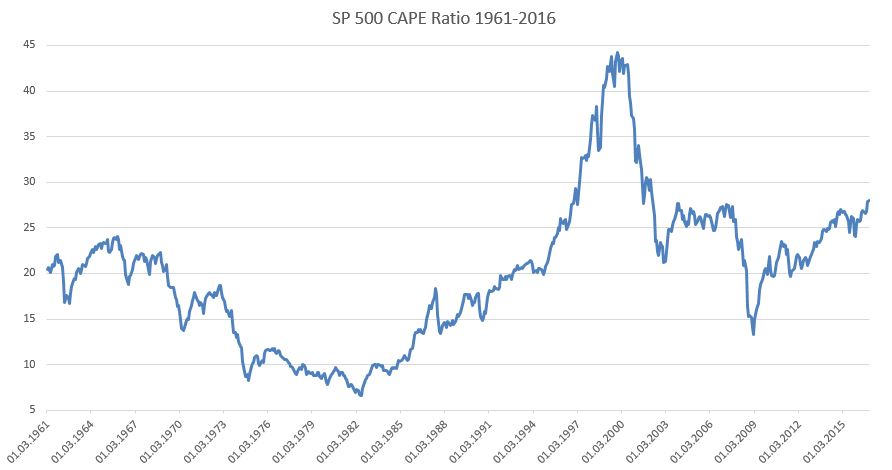
Source: Bloomberg, Notz Stucki

More and more warnings are being sent about the unsustainability of the current CAPE ratio for the SP500 and that a correction should occur, based on the very high level of the famous CAPE – the Cyclically Adjusted Price Earnings ratio.

This valuation measure of the equity market, brought by John Campbell and Robert Shiller in 1988, consists in taking a long term (typically 10 years) average of real earnings to calculate the Price Earnings ratio of a given equity index in order to smooth out short term profits’ volatility.

The economists did not set an absolute level of cheapness or expensiveness for their ratio, but the frequently mentioned levels are 20 (expensive) and 12 (cheap). Based on these numbers, investors should be wary of buying stocks when the CAPE stands above 20 (currently it is close to 28), and should on the contrary increase their exposure when the CAPE hovers below 12.

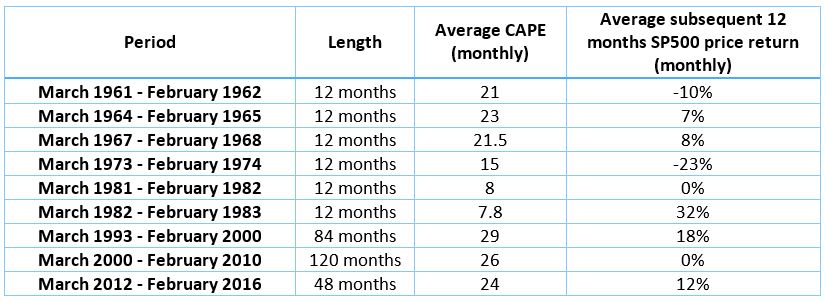
Our friend Jeffrey Saut, chief strategist at Raymond James Associates, has repeatedly questioned the accuracy of this measure during the last few years, so we’ve decided to crunch the numbers and simply look at some historical data to assess the relevance of the current warnings about the CAPE. The table here below recapitulates some periods with their associated CAPE and the monthly average of the subsequent 12 month price return on the SP500.

CAPE ratio

Based on these numbers, the conclusion is pretty straightforward: the predicting power of the CAPE for future returns is extremely poor if you set the 20 and 12 levels for dearness or attractiveness. Maybe the most striking example is between 1993-2000 when the average CAPE was 29, a record, but the average SP500 return of any given 12 month period during this time frame was a whopping 18%!

Even though CAPE is high today we think it has to be mitigated by a few factors:

  1. Interest rates ar still at historical lows, propping up valuations.
  2. Today’s CAPE includes the terrible 2008-2009 period when earnings were decimated, which should correct after 2019 CAPE calculations.
  3. The SP500 today is less cyclical than it used to be. There’s dominant group of sector like non -cyclical Information Technology, Healthcare, Consumer Staples which were not so highly represented in the past, when Industrials, Energy and Consumer Discretionary had much higher weightings.
  4. History seems to tell us that, as shown in the table, there’s no golden rule for assessing an alarming level for the CAPE.

The well-known CAPE theory would incite us to step away from US equities today, but we beg to differ.

Practice, as Yogi Berra said, does not necessarily go in sync with theory!


Perception vs. Reality: Are (more business friendly) Republican Presidents better for the Equity Market?

Daniel Kahneman, the Nobel Prize in Economic Sciences in 2002, wrote a best-selling book entitled “Thinking, Fast and Slow”. The central thesis of the book is that human beings have two modes of thought: System 1: Fast, instinctive and emotional;  System 2: Slow, deliberative and logical. We can say that System 1 resembles  the PERCEPTION, whereas,  System 2 is closer to the REALITY. Being so fast and so emotional, sometimes the PERCEPTIONS may distort or exaggerate the news delivered by the market, whereas REALITY gives the investor a medium-long term framework to better assess the market situation.

Discover our monthly series “Perception vs. Reality”!

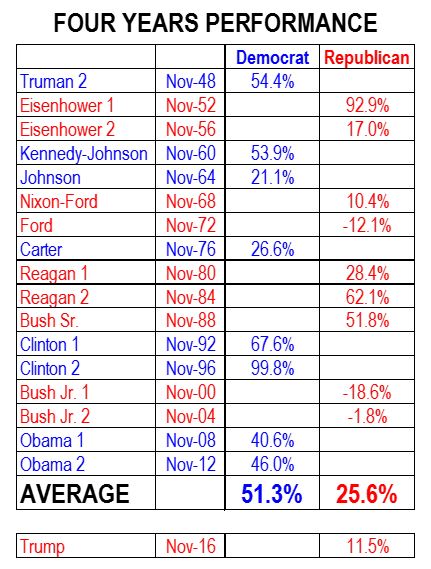
Source: Bloomberg. Performance: S&P500 Price Only.

PERCEPTION

Republican led administrations in the US are typically more business friendly than Democrat ones. Republicans are more likely to decrease taxes, to deregulate markets, to better control the budget deficit, to decrease the Government size and generally speaking to create a better environment for companies. Looking at history, Republican Presidents have had in their cabinet more business people to lead the country. As a dramatic example, Trump’s cabinet has about 50% of its members with a business background, the highest proportion since WWII, whereas Obama’s administration had only 10% on a comparable basis, which was the lowest proportion since WWII. With these hard data, investors can infer that US stock markets should have performed better while a Republican President was in office, and also will expect a good equity market during Trump’s government.

REALITY

The table shows the performances of the S&P500 (price only) since WWII, and… surprise, surprise! the S&P500 has performed much better when a Democrat was in the White House. The 4 year average mandate of a Democrat presidency has seen a 51.3% performance whereas a Republic presidency has delivered only 25.6%, just half of the performance of a Democrat administration. We are counting only 17 periods with 8 Democrats and 9 Republicans, but in any case, it sounds quite counterintuitive.“It is the economy stupid”, was the sentence used by Bill Clinton to explain why he beat Bush Sr. in the Nov-92 elections. We may also say that the economy, market valuation, luck and other factors may explain this reality. For instance:

  • Clinton took office after the 1991 US recession, so his first mandate took place during an economic recovery that was due after the recession, and so the market made 67.6% in 4 years.
  • The second Clinton administration enjoyed the technology bubble, so the market gained 99.8%
  • Bush Jr. was elected President when the S&P500 was quoted at 19.5 times 12M forward earnings, so his first mandate was overseeing the burst of the TMT bubble and the market fell 18.6%
  • Ford was unlucky to be President when the OPEC started to push oil prices up.
  • Obama was lucky to start his presidency when the SP500 had just collapsed and was quoted at 11.8 times 12M forward earnings.

Besides all these specific situations, it is very important to remember that the US is a very strong democracy with many checks and balances, with powerful House, Senate and Governors who have a big influence in politics and in the economy. Likewise, US corporates are very strong and well managed and have a profit cycle that might be independent of the political party of the President.

CONCLUSION

In the US (and in most developed economies), politics are much less influential on the performance of equity market than what people think, whereas the most typical financial and economic factors remain the best indicators for expected equity performance: FED hiking rates is not good news; lower corporate taxes will be good news; deregulation will be good news; a high PE ratio (17.9 today) is not good news, etc. The market will switch from a Trump led market to an economic led market.