Les entreprises du SMI se distinguent par un engagement ESG remarquable

Les entreprises du SMI se distinguent par un engagement ESG remarquable

Le SMI se voit conféré une note de AAA, la plus élevée, selon MSCI ESG Ratings. Les 20 composantes de l’indice obtiennent des notes variant de A à AAA.

Les investisseurs portent une attention croissante aux critères environnementaux, sociaux et de gouvernance (ESG) lorsqu’ils prennent des décisions d’investissement. Ils sont également motivés par les différentes réglementations en vigueur et les enjeux pressants tels que les questions climatiques. De leur côté, les entreprises reconnaissent désormais l’importance fondamentale de la durabilité et émettent des rapports pour démontrer leur engagement en la matière.

QUELLE EST LA SITUATION EN SUISSE?
La Suisse est engagée pleinement dans l’Accord de Paris, dont l’objectif central est de limiter le réchauffement climatique mondial à moins de 2°C par rapport aux niveaux préindustriels, avec une aspiration à limiter l’augmentation à 1.5°C. Notre pays affiche une volonté déterminée de réduire ses émissions de gaz à effet de serre, tout en renforçant sa résilience face aux conséquences du changement climatique. L’ambition suisse est de parvenir à la neutralité carbone d’ici 2050. La Suisse tire sa principale source d’énergie renouvelable de la force hydraulique, qui est favorisée par son relief montagneux et la présence de nombreux cours d’eau. De fait, en 2022, 53% de notre production totale d’électricité provenait de l’hydroélectricité. Ceci contribue de manière significative à la production d’électricité sans émissions de gaz à effet de serre. Toutefois, la croissance de cette source atteint aujourd’hui une limite, incitant la Suisse à promouvoir l’utilisation d’autres formes d’énergies renouvelables telles que l’énergie solaire et éolienne, qui sont en constante expansion.

INTÉGRATION DES CRITÈRES ESG PAR LES ENTREPRISES SUISSES
Les questions de durabilité et de responsabilité sociale des entreprises sont de plus en plus importantes dans la gouvernance des sociétés du SMI (Swiss Market Index), qui sont encouragées à adopter des pratiques commerciales durables. Par ailleurs, la Suisse jouit généralement d’une excellente réputation en matière de gouvernance d’entreprise.

L’intégration des critères ESG revêt ainsi une importance croissante en Suisse. Les entreprises reconnaissent de plus en plus l’importance de communiquer des données ESG, non seulement pour répondre aux attentes des investisseurs, mais aussi pour assurer une gestion durable et responsable.

En se penchant sur les 20 plus grandes entreprises du SMI, soit les fleurons de la cote, il est notable que chacune d’entre elles fournit un rapport détaillé sur la durabilité, soit intégré dans leur rapport annuel, soit indépendant. Ces entreprises ont établi des objectifs, notamment en matière de neutralité carbone, avec des échéances s’étalant de 2025 à 2050. De plus, la plupart d’entre elles se sont engagées envers les 17 Objectifs de Développement Durables des Nations Unies (SDGs) et ont adhéré aux 10 Principes du Pacte Mondial des Nations Unies (UN Global Compact), qui encourage les entreprises à adopter des pratiques commerciales responsables et durables.

L’approche en matière de durabilité est transparente et propriétaire au sein de ces entreprises, avec un accent sur l’égalité des genres et la réduction de leur impact environnemental.

EVALUATION ESG DES ENTREPRISES SUISSES
La composition du SMI lui confère une note de AAA, la plus élevée, selon MSCI ESG Ratings. Les 20 composantes de l’indice obtiennent des notes variant de A à AAA, plaçant ainsi l’indice en tête de l’univers de MSCI. Ces entreprises figurent pour la plupart en tant que leaders en ce qui concerne les critères ESG dans leurs industries respectives. Du côté des émissions de carbone, celles-ci dépendent du secteur, les plus gros émetteurs étant Holcim et Nestlé, tandis que les moins importants sont Sonova et Partners Group. Pour la grande majorité des entreprises du SMI, on observe par ailleurs une amélioration significative de la gouvernance ou de sa solidité. Si l’on élargit notre analyse pour inclure des critères tels que les controverses, les évolutions récentes et la capacité à se classer dans le quartile supérieur de leur industrie en ce qui concerne les trois piliers E, S et G, on peut noter que Novartis, Givaudan, Kuehne + Nagel et Zurich Insurance semblent se distinguer particulièrement.

En conséquence, on peut conclure que les entreprises suisses du SMI se distinguent par leur engagement remarquable en matière de durabilité et de responsabilité sociale des entreprises. Cette approche renforce la réputation de la Suisse en tant que destination d’investissement de choix. D’ailleurs, dans les performances réalisées, sur les 5 dernières années, le SMI a surperformé le marché mondial (MSCI World Index in CHF) de 543 points de base.


Les performances passées ne garantissent pas les résultats futurs. Les opinions, stratégies et instruments financiers décrits dans le présent document peuvent ne pas convenir à tous les investisseurs. Les opinions énoncées sont celles valables à la date de publication de ce document. Toute référence aux indices de marches ou composites, indices de référence, ou autres mesures de performance relative des marches a une certaine période sont indiquées à titre d’information. NS Partners ne donne aucune garantie et n’est aucunement responsable de l’exactitude et de l’exhaustivité de l’ensemble des informations (données financières de marche, cours de bourse, avis de recherche ou description de tout autre instrument financier) contenus dans ce document. Le présent document n’est pas destiné aux personnes ou entités qui seraient citoyennes ou résidentes d’un lieu, état, pays ou juridiction dans lesquels sa distribution, sa publication, sa mise à disposition ou son utilisation seraient contraires aux lois ou règlements en vigueur. Les informations et données fournies dans le présent document sont communiquées à titre indicatif uniquement et ne constituent ni une offre, ni une incitation à acheter, vendre ou souscrire a des titres ou tout autre instrument financier. Il est fait référence dans ce document a des fonds d’investissement qui n’ont pas été enregistrés auprès de la Finma et ne peuvent donc pas être distribues en ou depuis la suisse sauf à certaines catégories d’investisseurs éligibles. Certaines des sociétés du groupe NS Partners ou ses clients peuvent être détenteurs d’une position dans les instruments financiers de l’un des émetteurs mentionnes dans ce document, ou agir en tant que consultant pour l’un d’eux. Des informations supplémentaires sont disponibles sur demande.

© Groupe NS Partners

SMI companies stand out for their ESG commitment

SMI companies stand out for their ESG commitment

The SMI has been awarded the highest rating of AAA by MSCI ESG Ratings. The 20 components of the index have ratings ranging from A to AAA.

Investors are paying increasing attention to environmental, social and governance (ESG) criteria when making investment decisions. They are also motivated by the various regulations in force and pressing issues such as climate change. For their part, companies now recognise the fundamental importance of sustainability and issue reports to demonstrate their commitment to it.

WHAT IS THE SITUATION IN SWITZERLAND?
Switzerland is fully committed to the Paris Agreement, whose central objective is to limit global warming to less than 2°C above pre-industrial levels, with the aspiration of limiting the increase to 1.5°C. Our country is determined to reduce its greenhouse gas emissions, while strengthening its resilience to the consequences of climate change. Switzerland’s ambition is to achieve carbon neutrality by 2050. Switzerland’s main source of renewable energy is hydropower, which is favoured by its mountainous terrain and the presence of numerous rivers. In fact, in 2022, 53% of our total electricity production will come from hydropower. This makes a significant contribution to the production of electricity without greenhouse gas emissions. However, the growth of this source is now reaching a limit, prompting Switzerland to promote the use of other forms of renewable energy such as solar and wind power, which are constantly expanding.

INTEGRATION OF ESG CRITERIA BY SWISS COMPANIES
Sustainability and corporate social responsibility issues are increasingly important in the governance of SMI (Swiss Market Index) companies, which are encouraged to adopt sustainable business practices. At the same time, Switzerland generally enjoys an excellent reputation for corporate governance.

The integration of ESG criteria is therefore becoming increasingly important in Switzerland. Companies are increasingly recognising the importance of disclosing ESG data, not only to meet investor expectations, but also to ensure sustainable and responsible management.

Looking at the 20 largest companies on the SMI, the flagships of the stock market, it is notable that each of them provides a detailed sustainability report, either as part of their annual report or independently. These companies have set targets, particularly for carbon neutrality, with deadlines ranging from 2025 to 2050. In addition, most of them are committed to the 17 United Nations Sustainable Development Goals (SDGs) and have signed up to the 10 Principles of the UN Global Compact, which encourages companies to adopt responsible and sustainable business practices.

The approach to sustainability is transparent and proprietary within these companies, with a focus on gender equality and reducing their environmental impact.

ESG ASSESSMENT OF SWISS COMPANIES
The composition of the SMI gives it a rating of AAA, the highest according to MSCI ESG Ratings. The 20 components of the index have ratings ranging from A to AAA, putting the index at the top of the MSCI universe. Most of these companies are leaders in terms of ESG criteria in their respective industries. As for carbon emissions, these depend on the sector, with Holcim and Nestlé the biggest emitters, and Sonova and Partners Group the smallest. For the vast majority of SMI companies, there has also been a significant improvement in governance or solidity. If we broaden our analysis to include criteria such as controversies, recent developments and the ability to rank in the top quartile of their industry in terms of the three pillars E, S and G, we can see that Novartis, Givaudan, Kuehne + Nagel and Zurich Insurance seem to stand out in particular.

We can therefore conclude that the Swiss companies in the SMI stand out for their remarkable commitment to sustainability and corporate social responsibility. This approach reinforces Switzerland’s reputation as an investment destination of choice. Over the last 5 years, the SMI has outperformed the global market (MSCI World Index in CHF) by 543 basis points.


Past performance is not indicative of future results. The views, strategies and financial instruments described in this document may not be suitable for all investors. Opinions expressed are current opinions as of the date(s) appearing in this material only. References to market or composite indices, benchmarks or other measures of relative market performance over a specified period of time are provided for your information only. NS Partners provides no warranty and makes no representation of any kind whatsoever regarding the accuracy and completeness of any data, including financial market data, quotes, research notes or other financial instruments referred to in this document. This document does not constitute an offer or solicitation to any person in any jurisdiction in which such offer or solicitation is not authorized or to any person to whom it would be unlawful to make such offer or solicitation. Any reference in this document to specific securities and issuers are for illustrative purposes only, and should not be interpreted as recommendations to purchase or sell those securities. References in this document to investment funds that have not been registered with the Finma cannot be distributed in or from Switzerland except to certain categories of eligible investors. Some of the entities of the NS Partners group or its clients may hold a position in the financial instruments of any issuer discussed herein, or act as advisor to any such issuer. Additional information is available on request.

© NS Partners Group

Energy Transition: What can you do during this particularly hot summer?

Energy Transition

What can you do during this particularly hot summer?

Even if growth slows down, the theme of energy transition has plenty to appeal to investors.

Squaring the circle

Growth in the global economy remains modest and, with rising interest rates, is set to slow in the US, Europe and Asia. Against this backdrop, equities in growth sectors should be good investments, but their valuations are already demanding. Admittedly, there are some value sectors that benefit from very attractive valuations, such as oil companies and banks, but these two sectors are experiencing structural problems over the long term.

What’s more, although most investors support responsible investment, the world is still very polarised on the subject, and not everyone agrees to subject their investments to sustainability constraints.

So is it possible to find an investment theme that combines growth with reasonable valuations? Can we find investments that will be attractive to both ESG and non-ESG supporters? The answer is YES, with companies involved in the much-touted energy transition.

A topic on which everyone agrees

This is a very cross-cutting theme, bringing together the main companies involved in the energy transition. It is not replicable through a specific index, which requires good active management. Let’s summarise the most important sub-themes that will be present over the next 30 years:

  • Solar panel manufacturing, for large-scale operations or small rooftop installations. These investments include solar panels, inverters and batteries to store excess energy.
  • Manufacture of wind turbines for onshore and offshore installations. In conjunction with these, rare earth metals and copper will be widely used.
  • Nuclear power: Although nuclear power has its detractors, the fact remains that it is a continuous source of energy that compensates for the intermittent nature of solar and wind power generation and emits no CO2. A new group of mini-reactors should be available for industrial use by the end of the decade, which will increase demand for uranium.
  • Electric vehicles and their value chain: car manufacturers, chargers, battery manufacturers, rare earth metal miners, copper miners.
  • Energy savings, thanks to the use of better insulating materials and electrical equipment that optimises the energy consumed in households and businesses.
  • Producers of hydrogen, which will be used to produce green steel, cement and ammonia. We need electrolysers and fuel cells. Hydrogen will also be used to produce ammonia for fertilisers and as fuel for ships.
  • Carbon sequestration. In cases where it will be impossible to do without CO2-emitting fuels, carbon sequestration techniques will have to be used.
  • Companies that invest more and more money in non-CO2 emitting energies, whether for new investments or to replace existing installations that pollute, will be favoured.

United we stand

This summer, the film “Oppenheimer” was one of the box-office hits. It shows how, when the scientific community works together towards a very specific goal, it manages to achieve it quickly. More recently, this was also the case with the “Warp Speed” project, which succeeded in obtaining 2 vaccines against Covid-19 in less than 9 months. Meeting the “energy transition” challenge will be possible thanks to the efforts of the global scientific community, supported by public and private investment.

In the meantime, we as investors have a wide range of themes and companies that make good investments at reasonable valuations and are capable of appealing to all groups of investors.


Past performance is not indicative of future results. The views, strategies and financial instruments described in this document may not be suitable for all investors. Opinions expressed are current opinions as of the date(s) appearing in this material only. References to market or composite indices, benchmarks or other measures of relative market performance over a specified period of time are provided for your information only. NS Partners provides no warranty and makes no representation of any kind whatsoever regarding the accuracy and completeness of any data, including financial market data, quotes, research notes or other financial instruments referred to in this document. This document does not constitute an offer or solicitation to any person in any jurisdiction in which such offer or solicitation is not authorized or to any person to whom it would be unlawful to make such offer or solicitation. Any reference in this document to specific securities and issuers are for illustrative purposes only, and should not be interpreted as recommendations to purchase or sell those securities. References in this document to investment funds that have not been registered with the Finma cannot be distributed in or from Switzerland except to certain categories of eligible investors. Some of the entities of the NS Partners group or its clients may hold a position in the financial instruments of any issuer discussed herein, or act as advisor to any such issuer. Additional information is available on request.

© NS Partners Group

Chart of the Summer – A USD3 trillion investment opportunity for the energy transition

Chart of the Summer – A USD3 trillion investment opportunity for the energy transition


This economic shift is being referred to by many economists as “The New Industrial Revolution”. A glance at the chart presented by the International Energy Agency (IEA) clearly highlights the massive investment effort needed worldwide to decarbonize the economy. To visualize this investment opportunity, we embark on an imaginary journey where our guest will discover an array of interesting ideas and companies to invest in.

Mary turned on her Tesla, a marvel of electric car technology known for its eco-friendly design. The digital dashboard lit up, indicating a battery power level of seventy-five percent. Mary admired her vehicle, not just for its quick, quiet ride but also for what it symbolized – a step towards environmental stewardship.

She was accompanied by her co-pilot, a recent chemistry graduate. Together, they admired the sight of towering windmills dotting the landscape. These were Vestas windmills, renowned for their effectiveness in transforming wind power into clean electricity. The co-pilot noted that the motors and rotors of these windmills, much like those of their Tesla, relied on rare earth elements due to their unique magnetic properties.

Their journey took them past fields glittering with solar panels from First Solar, Canadian Solar and other manufacturers. These solar farms, managed by Iberdrola, captured sunlight and transformed it into energy. Amidst these farms were electrolysers, which used electricity to separate water into hydrogen and oxygen. This hydrogen was stored and later used to create ammonia, a clean and potent fuel. Some of this hydrogen was sent to a steel manufacturing company that use it to produce clean steel.

Nearby was a plant that used the ammonia to manufacture fertilizers, enriching soil to produce good crops. The ammonia was also loaded into ships, fueling their voyages across the globe without leaving behind a trail of pollution.

As the Tesla signaled the need for a recharge, Mary pulled into a nearby charging station. The station derived its power from a compact yet potent 200 MW mini-reactor nuclear power plant. The co-pilot explained how uranium, despite its contentious history, was critical for these nuclear reactors due to its immense energy-producing capability.

Upon reaching her modern, eco-conscious house in the countryside, Mary could see the solar panels adorning the roof. Connected to efficient Enphase inverters, these panels harnessed sunlight and converted it into electricity. Excess energy was stored in reliable Samsung SDI batteries, a crucial component requiring significant amounts of lithium, a light, yet energy-dense metal.

The house was also equipped with a state-of-the-art Johnson Controls heat pump system and a Schneider smart home system, providing not only comfort but also efficient energy usage.

This journey demonstrated several ideas to profit from this USD3 trillion investment opportunity. These opportunities will appeal to ESG investors, non-ESG investors, growth investors and value investors. Both developed and emerging countries are investing in these technologies, and current valuations do not yet reflect the expected growth.

Embark on a USD3 trillion investment journey, happy investing!


Past performance is not indicative of future results. The views, strategies and financial instruments described in this document may not be suitable for all investors. Opinions expressed are current opinions as of date(s) appearing in this material only. References to market or composite indices, benchmarks or other measures of relative market performance over a specified period of time are provided for your information only. NS Partners provides no warranty and makes no representation of any kind whatsoever regarding the accuracy and completeness of any data, including financial market data, quotes, research notes or other financial instrument referred to in this document. This document does not constitute an offer or solicitation to any person in any jurisdiction in which such offer or solicitation is not authorized or to any person to whom it would be unlawful to make such offer or solicitation. Any reference in this document to specific securities and issuers are for illustrative purposes only, and should not be interpreted as recommendations to purchase or sell those securities. References in this document to investment funds that have not been registered with the FINMA cannot be distributed in or from Switzerland except to certain categories of eligible investors. Some of the entities of the NS Partners Group or its clients may hold a position in the financial instruments of any issuer discussed herein, or act as advisor to any such issuer.  Additional information is available on request.
© NS Partners Group

Graphique du mois – Attention au greenwashing

Attention au greenwashing


Le greenwashings’est largement répandu ces derniers temps. Mais qu’entendons-nous vraiment par greenwashing? Investopedia le définit ainsi: «le greenwashing ou écoblanchiment est le fait de fournir au public ou aux investisseurs des informations trompeuses ou complètement  fausses quant à l’impact environnemental des produits et activités d’une entreprise. Il peut en outre être question d’écoblanchiment lorsqu’une entreprise tente de mettre en avant les aspects durables d’un produit afin d’occulter son implication dans des pratiques préjudiciables à l’environnement».

On retrouve le greenwashing un peu partout: dans l’industrie automobile ou la fast fashion, mais aussi, à en croire l’activiste Greta Thunberg, à la COP27 et, en ce qui nous concerne, dans la finance. Le monde de la finance a bien changé au cours des dernières années. Les exigences sociales et environnementales de la jeune génération guident les choix des investisseurs. Il y a aussi les urgences climatiques. Les régulateurs et les gouvernements agissent. Plus besoin de démonstration: nous devons tous participer à notre niveau.

Selon les estimations de Bloomberg Intelligence, les actifs du marché en plein essor de l’ESG devraient dépasser 53 000 milliards de dollars d’ici 2025. En Europe, le règlement SFDR (Sustainable Finance Disclosure Regulation) vise à éradiquer le greenwashing  en imposant plus de transparence.

Si l’on considère la collecte des fonds durables, elle a augmenté depuis 2020. Cette année, dans un contexte de hausse des taux d’intérêt, de pressions inflationnistes et de conflit en Ukraine, la collecte des fonds durables en Europe reste supérieure à celle des fonds conventionnels. On notera que les gestionnaires d’actifs ont considérablement réduit le nombre de lancements de nouveaux fonds ESG en raison du durcissement de l’environnement réglementaire, qui rend plus difficiles les revendications environnementales, sociales et de gouvernance.

Les acteurs du marché doivent sans cesse s’adapter et relever de nouveaux défis. Les gestionnaires de fortune doivent sélectionner des produits financiers environnementaux, sociaux et de gouvernance (ESG) compatibles avec les préférences de leurs clients. Malgré la confusion qui règne, ils se doivent également de rester au fait des différentes terminologies et stratégies (exclusion, intégration, filtrage négatif, filtrage positif, impact…).

Les gestionnaires d’actifs, quant à eux, sont soumis à des exigences de divulgation contraignantes liées à la classification de leurs produits. Leurs produits tiennent-ils compte des risques ESG, promeuvent-ils des critères ESG, ont-ils un objectif environnemental ou social? Le manque d’homogénéité au niveau mondial des réglementations et des définitions est un handicap, tandis qu’au niveau européen, les réglementations et les exigences de publication d’informations sont source de confusion. Les investisseurs aspirent donc à plus de précision en termes de cadres et de limites et réclament des critères standardisés.

Les données ESG et l’accès à celles-ci constituent un autre problème. En annonçant suivre une démarche ESG, les gestionnaires s’exposent, ainsi que leur entreprise, à un risque de réputation. Une solution plus simple, plutôt que de lancer de nouveaux produits, semble être d’adapter les produits existants aux nouvelles exigences réglementaires. Un processus qui demande de l’humilité.

Les investisseurs, les analystes et les gestionnaires d’actifs ont un rôle clé à jouer, non seulement en termes de transparence des données, mais aussi par la pression qu’ils peuvent exercer sur les entreprises, notamment sur l’importance du Scope 3 dans le calcul des émissions de gaz à effet de serre.

Reste une certitude, lors de la sélection d’une entreprise ou d’un fonds qui communique sur sa démarche ESG: «fais confiance, mais vérifie».


Les performances passées ne garantissent pas les résultats futurs. Les opinions, stratégies et instruments financiers décrits dans le présent document peuvent ne pas convenir à tous les investisseurs. Les opinions énoncées sont celles valables à la date de publication de ce document. Toute référence aux indices de marches ou composites, indices de référence, ou autres mesures de performance relative des marches a une certaine période sont indiquées à titre d’information. NS Partners ne donne aucune garantie et n’est aucunement responsable de l’exactitude et de l’exhaustivité de l’ensemble des informations (données financières de marche, cours de bourse, avis de recherche ou description de tout autre instrument financier) contenus dans ce document. Le présent document n’est pas destiné aux personnes ou entités qui seraient citoyennes ou résidentes d’un lieu, état, pays ou juridiction dans lesquels sa distribution, sa publication, sa mise à disposition ou son utilisation seraient contraires aux lois ou règlements en vigueur. Les informations et données fournies dans le présent document sont communiquées à titre indicatif uniquement et ne constituent ni une offre, ni une incitation à acheter, vendre ou souscrire a des titres ou tout autre instrument financier. Il est fait référence dans ce document a des fonds d’investissement qui n’ont pas été enregistrés auprès de la Finma et ne peuvent donc pas être distribues en ou depuis la suisse sauf à certaines catégories d’investisseurs éligibles. Certaines des sociétés du groupe NS Partners ou ses clients peuvent être détenteurs d’une position dans les instruments financiers de l’un des émetteurs mentionnes dans ce document, ou agir en tant que consultant pour l’un d’eux. Des informations supplémentaires sont disponibles sur demande.

© Groupe NS Partners

Chart of the Month – Stay away from greenwashing!

Stay away from greenwashing!


European Sustainable Fund Flows Compared with Conventional Fund Flows ($ Billion)

Greenwashing is quite popular lately. But, what does it really mean? Here is a definition from Investopedia: “Greenwashing is the act of providing the public or investors with misleading or outright false information about the environmental impact of a company’s products and operations. In addition, greenwashing may occur when a company attempts to emphasize sustainable aspects of a product to overshadow the company’s involvement in environmentally-damaging practices”.

Greenwashing is everywhere: in the automotive industry, in fast fashion, at the next COP27 meeting according to activist Greta Thunberg and, as far as we are concerned, in finance. The world of finance has evolved over the last few years. The social and environmental requirements of the younger generation are guiding investor’s choices. We also have climate emergencies. Regulations and governments are acting. There is no need to demonstrate it anymore, we all have to participate at our level.

According to Bloomberg Intelligence Regulations estimates, in the booming ESG market, assets are expected to exceed $53 trillion by 2025. In Europe, the Sustainable Finance Disclosure Regulation (SFDR) aims to eradicate greenwashing by mandating greater disclosure.

Looking at inflows into sustainable funds, they have increased since 2020. This year, against a backdrop of rising interest rates, inflationary pressures and conflict in Ukraine, sustainable fund flows in Europe remain higher than those of conventional funds. Interestingly, asset managers have significantly reduced the number of new ESG funds they are launching. The reason is the tightening of the regulatory environment, which makes it more difficult to pursue environmental, social and governance claims.

Market participants have to adapt constantly and face certain challenges. Wealth managers need to select Environmental, Social, Governance (ESG) financial products that are compatible with their clients’ preferences. In this blur, they also need to be aware of the different terminologies and strategies (Exclusion, Integration, Negative screening, positive screening, impact…).

Asset Managers are subject to mandatory disclosure requirements as a result of product classification. Do these products integrate ESG risks, promote ESG criteria, have an environmental or social objective? At the global level, the non-homogeneity of regulations and definitions is a handicap. At the European level, the regulations and obligations in terms of disclosures are a source of confusion. Investors seek more precision in terms of frameworks and limits and want standardized criteria.

Another issue is ESG data and its access. By announcing an ESG approach, managers expose themselves and their company to a reputational risk. An apparent solution, beyond launching new products, is to adapt current products to new regulatory requirements. In this process, it is important to remain humble.

Investors, financial analysts and asset managers have a key role to play in the transparency of the data but also through the pressure they can put on companies, for example, on the importance of Scope 3 for the calculation of greenhouse gas emissions.

One thing is certain today when selecting a company or a fund that communicates on its ESG approach, one must: “Trust but verify”.


Past performance is not indicative of future results. The views, strategies and financial instruments described in this document may not be suitable for all investors. Opinions expressed are current opinions as of date(s) appearing in this material only. References to market or composite indices, benchmarks or other measures of relative market performance over a specified period of time are provided for your information only. NS Partners provides no warranty and makes no representation of any kind whatsoever regarding the accuracy and completeness of any data, including financial market data, quotes, research notes or other financial instrument referred to in this document. This document does not constitute an offer or solicitation to any person in any jurisdiction in which such offer or solicitation is not authorized or to any person to whom it would be unlawful to make such offer or solicitation. Any reference in this document to specific securities and issuers are for illustrative purposes only, and should not be interpreted as recommendations to purchase or sell those securities. References in this document to investment funds that have not been registered with the FINMA cannot be distributed in or from Switzerland except to certain categories of eligible investors. Some of the entities of the NS Partners Group or its clients may hold a position in the financial instruments of any issuer discussed herein, or act as advisor to any such issuer.  Additional information is available on request.

© NS Partners Group

Gráfico del mes – No se deje engañar por el greenwashing.

No se deje engañar por el greenwashing.


Últimamente, el greenwashing se ha vuelto muy popular. Pero, ¿qué significa realmente? Esta es la definición de Investopedia: “El greenwashing es el acto de transmitir al público o a los inversores información engañosa o directamente falsa sobre el impacto medioambiental de los productos y las operaciones de una empresa. También podemos hablar de greenwashing cuando una empresa intenta destacar los aspectos sostenibles de un producto para encubrir su participación en prácticas nocivas para el medio ambiente”.

El greenwashing está en todas partes: en la industria del automóvil, en la fast fashion, en reunión de la COP27 según la activista Greta Thunberg y, en lo que a nosotros respecta, en el sector financiero. El mundo de las finanzas ha evolucionado en los últimos años. Las exigencias sociales y medioambientales de las nuevas generaciones están influyendo en las decisiones de los inversores. También tenemos emergencias climáticas. Las normativas y los gobiernos están actuando. Ya no es necesario demostrarlo, todos tenemos que participar a nuestro nivel.

Según las estimaciones de Bloomberg Intelligence Regulations, en el floreciente mercado ESG, se espera que los activos superen los 53 billones de dólares en 2025. En Europa, el Reglamento sobre la Sustainable Finance Disclosure Regulation (SFDR) tiene como objetivo erradicar el greenwashing exigiendo una mayor divulgación de información.

Examinando las entradas en fondos sostenibles, se observa que han aumentado desde 2020. Este año, en un contexto de subida de los tipos de interés, presiones inflacionistas y conflicto en Ucrania, los flujos hacia los fondos sostenibles en Europa siguen siendo superiores a los registrados por los fondos convencionales. Curiosamente, los gestores de activos han reducido considerablemente el número de nuevos fondos ESG que están lanzando. Esto se debe al endurecimiento del entorno normativo, que dificulta la presentación de propuestas medioambientales, sociales y de gobernanza.

Los participantes en el mercado tienen que adaptarse constantemente y afrontar ciertos retos. Los gestores de patrimonios han de seleccionar productos financieros ambientales, sociales y de gobernanza (ESG) que sean compatibles con las preferencias de sus clientes. En este sentido, también es necesario que conozcan las diferentes terminologías y estrategias (exclusión, integración, filtrado negativo, escrutinio positivo, impacto, etc.).

Los gestores de activos están sujetos a requisitos normativos de divulgación como resultado de la clasificación de los productos. ¿Integran estos productos los riesgos ESG, promueven los criterios ESG, tienen un objetivo medioambiental o social? A escala mundial, la falta de homogeneidad de las normativas y de las definiciones es un obstáculo. En el ámbito europeo, la regulación y las obligaciones en materia de divulgación son una fuente de confusión. Los inversores exigen más precisión en cuanto a marcos y límites y quieren criterios normalizados.

Otra cuestión es la de los datos ESG y el acceso a los mismos. Al anunciar un enfoque ESG, los gestores se exponen a sí mismos y a su entidad a un riesgo de reputación. Una solución obvia, aparte del lanzamiento de nuevos productos, es adaptar los productos actuales a los nuevos requisitos normativos. En este proceso, es importante mostrarse humilde.

Los inversores, los analistas financieros y los gestores de activos desempeñan un rol clave en la transparencia de los datos, pero también a través de la presión que pueden ejercer sobre las empresas, por ejemplo, sobre la importancia de Scope 3 para el cálculo del volumen de gases de efecto invernadero emitidos.

A día de hoy, una cosa es segura a la hora de seleccionar una empresa o un fondo que comunique su enfoque ESG: “confiar pero verificar”.


Los resultados pasados no implican resultados futuros. Las opiniones, estrategias e instrumentos financieros que se describen en el presente documento pueden no ser convenientes para todos los inversores. Las opiniones expresadas son sólo las del momento en la(s) fecha(s) que aparece(n) en este material. Las referencias a índices de mercado o compuestos, índices de referencia u otras medidas de resultados relativos de los mercados durante un período específico sólo se proveen a título informativo. NS Partners no garantiza ni es responsable de la exactitud o la integridad de las informaciones (datos financieros de mercado, precios de bolsa, resultados de investigación u otros instrumentos financieros) que se mencionan en este documento. El presente documento no constituye una oferta ni solicitud a ninguna persona ni jurisdicción donde tal oferta o solicitud no esté autorizada ni a ninguna persona a quien sería ilegal hacer dicha oferta o solicitud. Toda referencia en este documento a instrumentos específicos o a emisores sólo tiene una finalidad ilustrativa y no debe ser interpretada como una recomendación para la compra o venta de dicho instrumento. Las referencias en este documento a fondos de inversión se aplican a fondos que no han sido registrados por la Finma y que por lo tanto no pueden ser distribuidos en o desde suiza excepto a ciertas categorías de inversores. Algunas de las empresas del grupo NS Partners o sus clientes pueden tener posiciones en los instrumentos financieros de alguno de los emisores mencionados en este documento, o ser asesor de uno de ellos. Hay información adicional disponible a solicitud.

© Grupo NS Partners

Chart of the Month – Green? Supergreen!

Chart of the month

Green? Supergreen!

Notz Stucki Research

For the past three years, we generally haven’t gone a week without a mention of responsible investment. There is a real awareness of the situation in which we find ourselves, particularly from the point of view of climate change. We have to align our thoughts and our investments: from exclusion of companies to real impact, the range of sustainable investments is wide. Sustainable investments, either directly or through funds or ETFs, are expected to represent between $15 and $20 trillion of all assets under management over the next two to three decades. Since 2016, this approach has grown by 25% in Europe. In all industries, at corporate level, the notion of energy efficiency is increasing; all companies have to cut their carbon emissions. A large number of the world’s biggest companies have improved their energy consumption over the last five years. But there is still a long way to go!

Performance is also a very important factor when deciding to invest in this trend. We are now aware that sustainable investment is not detrimental to returns, and it has been shown that a company’s successful implementation of sustainability enhances its financial performance.

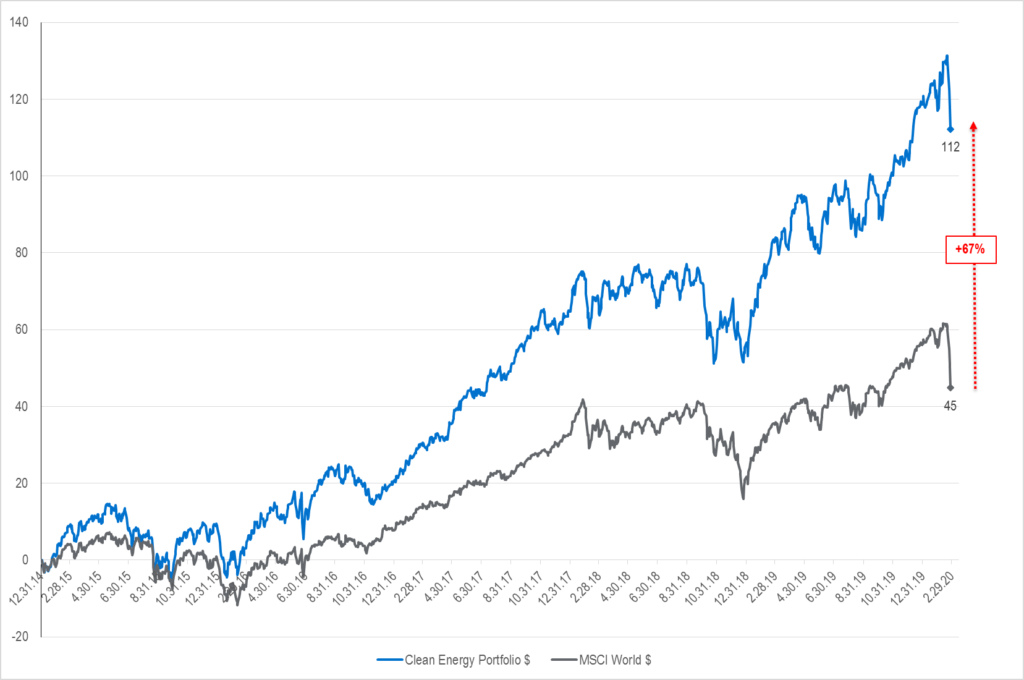
We did the exercise with a Clean Energy portfolio. A global dollar equity portfolio composed of 42 equally-weighted companies in Power, Energy Efficiency and Transport, (automotive, industrial, semiconductors, software, hardware, materials…).  We selected the most popular stocks and excluded extreme points from our analysis. Over the last 5 years, the portfolio’s performance is 112% vs 44% for the MSCI World. We clearly notice an outperformance and an explosion in the portfolio’s performance over the last 3 years.  The performance differential is mainly due to the stock selection and to the theme. The portfolio offers a dividend yield of 1.87% and is trading at 24.1x next year earnings  (PE: 19.1x for the MSCI World) with a correlation of 0.89 to its benchmark. On a YTD basis, the portfolio has demonstrated better resilience than the market.

Where do we stand at Notz Stucki? In Geneva, at corporate level, we launched in December 2017 our philanthropic initiative NS Impact, which supports local and concrete projects involving our employees. In the Asset Management department, we have gradually increased our exposure to sustainable funds in our three asset allocation funds. This ESG-SRI allocation represents between 14.4% and 24.6% of our current exposure, and was built up by investing directly in funds that focus on this specific theme or by switching to sustainable class of the funds we hold if the latter perform better. For our Long Only equity funds, we are in the process of integrating ESG analysis and rating in our stock selection process and are already compliant with the Norges Bank’s exclusion list. From traditional investing to philanthropy, the scope is huge, but taking a few steps in this direction seems to be standard in finance nowadays.

As Korben Dallas asked Ruby Rhod in the 1997 film the 5th element “Green?”, “Supergreen!.”

Chart of the Month – Sustainability practices gained traction in luxury

Sustainability practices gained traction in luxury

Source: Bloomberg, RobecoSAM, Notz Stucki

Environmental, Social and Governance (ESG) are today on many people’s lips. This scatter chart shows an interesting attribute of Luxury. When it comes to deep analysis of those ESG criteria, we find a lot of specialists, and we have selected the RobecoSAM Total Sustainability rank(1) to illustrate our purpose.

To compose our Luxury portfolio, European, American and Swiss Luxury conglomerates have been selected. First, in Euro zone, the now very famous KHOL (Kering, Hermès, l’Oréal, and LVMH), Cie Financière Richemont for Switzerland and Estée Lauder, Tiffany and Tapestry (Coach, Kate Spade, Stuart Weitzman) composed our American Luxury leaders. We compare this portfolio and all its components to the MSCI World Index, in abscise the RobecoSAM Total Sustainability Rank, higher score is the better, and on the y-axis, last 5Y performance in USD.
This Luxury portfolio (equally weighted positions) outperformed the MSCI World Index both in last 5Y performance and Sustainable issues.

GOOD NEWS

The Luxury sector is resilient, enjoys exceptional fundamentals, strong balance sheets, and growth potential. Companies pursue restructuring. After falling into disgrace with some sales issues and economic slowdown, Hard Luxury (Watches and Jewelry) subsector is now in better shape and Swiss watch exports are now positive for the 15th month in a row. A new wind blows on Luxury. Companies have to adapt to younger customers who are more demanding, more sensitive to the world in which they are growing, evolving, building their future. Respectability, Traceability, Equality, Impact are now common sense. The number of people dedicated to sustainable development in Luxury companies is increasing and radiates in each business, product and strategy.

Luxury looks like a good investment, offers growth and sustainability. There is no reason not to put more effort in Sustainable, ESG factors that are real contributors to the performance.


(1) RobecoSAM is an investment specialist focused exclusively on Sustainability Investing. A company’s Total Sustainability Score encompasses three dimensions (Economic, Environmental and Social). Scores are ranged from 0 to100.
RobecoSAM Total Sustainability Rank for MSCI World Index is weighted average of scores of all companies.