August general market comments

“(Everybody Wanna Get Rich) Rite Away” – Dr John, 1974.

As August 2025 draws to a close, the financial markets are dancing to the frenetic beat of Dr. John’s “(Everybody Wanna Get Rich) Rite Away,” a funky anthem that captures the universal itch for quick wealth. This month, that rhythm pulsed through global equities, with the Shanghai Composite Index surging nearly 20% from its early August low, adding almost a trillion dollars in market value despite China’s economic headwinds, tariffs, a property slump and persistent deflation.

The S&P 500, meanwhile, pushed past 6,400, riding a 60%+ rally since October 2022, fueled by AI hype and Fed rate cut optimism. It’s a bull market on steroids, but the lyrics’ warning – “If you wanna be rich and you wanna be wealthy, I believe I’d rather be poor and healthy”- echo a growing unease. The rush to riches is evident in China’s 2.1 trillion yuan in margin debt, nearing the 2015 bubble peak and US tech stocks’ outsized gains, reminiscent of the dot-com frenzy. Volatility spiked early in the month, with the VIX jumping to 30 on August 5, reflecting investor jitters beneath the rally’s surface.

Central banks and policymakers tout stimulus and soft landings, but the relative disconnect from fundamentals, flat consumer prices in China, slowing US earnings growth -suggests a speculative bubble inflating alongside this bull run. Dr. John’s swampy groove reminds us that chasing instant wealth can lead to a “racka tacka tacka rum-dum game,” where very few win if sentiment sours. Caution, not just celebration, is the order of the day as September looms.

In a month marked by the end of the Q2 earnings season, which was good but not upbeat, the MSCI World added 2.5%, the S&P 500 1.9% and the MSCI Europe 0.7%. Big advances were recorded in Japan (+4.5%) and China (+10.3%). With looming rate cuts from the Fed, the dollar lost 2.3% versus the euro, US 10 year yields hovered 15 bps lower, and Gold, Bitcoin and Oil soared 4.8%, 8.3% and 6.4% respectively. The renewed political uncertainties linked to France’s very poor budget and debt situation probably limited the euro’s rise, but no panic visible so far: year to date, French 10 year yield is up 33 bps, similar to Germany (+35 bps). Still, France borrows more expensively than Greece now, which was unthinkable some years ago.

Credit fared well, but spreads are ultra-low all across fixed-income credit instruments, leaving little room for further tightening.


Past performance is not indicative of future results. The views, strategies and financial instruments described in this document may not be suitable for all investors. Opinions expressed are current opinions as of date(s) appearing in this material only. References to market or composite indices, benchmarks or other measures of relative market performance over a specified period of time are provided for your information only. NS PARTNERS SA provides no warranty and makes no representation of any kind whatsoever regarding the accuracy and completeness of any data, including financial market data or other financial instruments referred to in this general comment. This document does not constitute an offer or solicitation to any person in any jurisdiction in which such offer or solicitation is not authorized or to any person to whom it would be unlawful to make such offer or solicitation. Any reference in this document to specific securities and issuers are for illustrative purposes only, and should not be interpreted as recommendations to purchase or sell those securities. References in this document to investment funds that have not been registered with the FINMA cannot be distributed in or from Switzerland except to certain categories of eligible investors. Some of the entities of the NS Partners Group or its clients may hold a position in the financial instruments of any issuer discussed herein, or act as advisor to any such issuer. Additional information is available on request. © NS Partners Group

March general market comments

“Say No Go” – De La Soul, 1989.

March 2025 was a wild ride for financial markets, a bit like De La Soul’s “Say No Go”: trying to reject bad vibes, even when it gets shaky. Caution prevailed at the beginning of the month, but investors were hoping for a smooth jam with deregulation and AI-driven growth to keep the party going; unfortunately, like De La Soul warns about dodging the wrong crowd, trade tensions flared up fast with a 25% tariff hit on Canada and Mexico and a 10% tariff hike on Chinese goods, which triggered retaliation from Canada (25% on US exports) and from China (15% on US agricultural products). Markets went in a “Say No Go” mode, with the S&P500 dipping into correction territory, while the Nasdaq and the dollar cratered.

The Fed maintained its rates steady, with Powell playing cool as he said that the economy was still “plugging in the sunshine”, mentioning solid labor conditions, but inflation refusing to significantly tame led Jerome to rebuff flipping the script.

The S&P500 lost 5.75% in March, the Nasdaq 7.69% and the Stoxx 600 Europe 4.18%. It wasn’t all doom though, as the Japanese Topix resisted somewhat (-0.87%), like China (-0.07%) while the MSCI Emerging Markets rose (+0.38%). In this context, the MSCI World Value outpaced – again – the MSCI World Growth, with a -1.56% return for the former and -7.59% for the latter.

On the fixed income side, Germany’s possibly more relaxed stance on budget deficit, added to looming better prospects for the Old Continent’s economy, pushed yields higher (+33 bps for the German or Italian 10 year yields) on this side of the pond, while they stayed unscathed in the US. After two convincing months, Credit took a hit (-1.3% for the Itraxx Crossover), weakened by a steepening yield curve and increased recession risks in the US. The dollar tumbled 4.21% versus the euro and almost all commodities rose (Oil added 2.47%); Gold is the shining star of the year, hitting record highs above “The Magic Number” $ 3’000 per ounce (+9.3% in March), showing that investors are “Keepin’ the Faith”, even if at these levels “Stakes Is High”. So far it’s “All Good”, but “Watch Out”!

That’s it for this month’s Market Comments, stay tuned, markets never skip a beat.


Past performance is not indicative of future results. The views, strategies and financial instruments described in this document may not be suitable for all investors. Opinions expressed are current opinions as of date(s) appearing in this material only. References to market or composite indices, benchmarks or other measures of relative market performance over a specified period of time are provided for your information only. NS PARTNERS SA provides no warranty and makes no representation of any kind whatsoever regarding the accuracy and completeness of any data, including financial market data or other financial instruments referred to in this general comment. This document does not constitute an offer or solicitation to any person in any jurisdiction in which such offer or solicitation is not authorized or to any person to whom it would be unlawful to make such offer or solicitation. Any reference in this document to specific securities and issuers are for illustrative purposes only, and should not be interpreted as recommendations to purchase or sell those securities. References in this document to investment funds that have not been registered with the FINMA cannot be distributed in or from Switzerland except to certain categories of eligible investors. Some of the entities of the NS Partners Group or its clients may hold a position in the financial instruments of any issuer discussed herein, or act as advisor to any such issuer. Additional information is available on request. © NS Partners Group

Chart of the Month – Lessons from the past

Chart of the Month – Lessons from the past

lessons from the pastWhich answer would you give to that question: “what is the most important event of the last 3 years for financial markets?”.

Many come to mind, like Covid, the war between Russia and Ukraine, the recent events in the Middle East, the hype around artificial intelligence, or the fake-start in the Chinese reopening expected boom, among other things.

I would personally give one and only one response: the 450+ basis points increase in US 10 year yields. Why so? Because this yield is the most important variable for all financial markets worldwide, as it is generally considered as the universal discounting factor.

This universal attribute makes sense: this is the yield you can obtain by investing in one of the most liquid and accessible assets, issued by the prevailing economic and military power, which is a democracy with an independent Central Bank.

The Chart of the Month illustrates the US 10 year yield evolution over a 55 years time frame. Shaded areas correspond to recessions.

What immediately strikes is the almost 40 years downtrend in yields, from 1982 to 2020, with a 0.30% historical low being touched during Covid. Another eye-popping fact is the very quick rise observed since then, as yields have nearly moved straightforward from 0.3% to 4.5-5%. Only twice in 55 years have US 10 year yields shot up by this magnitude, the previous occurrence being at the end of the 70s with the second oil shock.

Another easy conclusion is that the immense majority of market participants have always, at least until the end of 2020, acted in a falling yields environment, me included. This is not without consequences: falling yields provide a support to all financial assets and magnify valuations. They also help the economy by facilitating credit access and limiting debt servicing costs, hence less recessions. Incidentally, the chart shows that there were many more recessions when yields were rising or, at least, were much higher than during the post GFC era.

The big question is now the direction of this US 10 year yield; it seems highly unlikely that it will come back to the unprecedented lows of the past 5 years for many reasons, massive supply from the US Treasury being one of them. And this means that we are set to live in a completely different investment landscape going forward. If past is prologue, we should have a more volatile economy and assets valuations should feel the pressure of a higher discounting factor. It has started already: real estate is somewhat struggling; zombie companies are going underwater and credit accessibility is getting more challenging.

Contrarily to what prevailed during the last few years, interest rates should not provide the usual rescue to prop up asset prices for unprofitable or overvalued businesses. That is a big change, which should favour active management, and certainly jostle many investment habits.


Past performance is not indicative of future results. The views, strategies and financial instruments described in this document may not be suitable for all investors. Opinions expressed are current opinions as of date(s) appearing in this material only. References to market or composite indices, benchmarks or other measures of relative market performance over a specified period of time are provided for your information only. NS Partners provides no warranty and makes no representation of any kind whatsoever regarding the accuracy and completeness of any data, including financial market data, quotes, research notes or other financial instrument referred to in this document. This document does not constitute an offer or solicitation to any person in any jurisdiction in which such offer or solicitation is not authorized or to any person to whom it would be unlawful to make such offer or solicitation. Any reference in this document to specific securities and issuers are for illustrative purposes only, and should not be interpreted as recommendations to purchase or sell those securities. References in this document to investment funds that have not been registered with the FINMA cannot be distributed in or from Switzerland except to certain categories of eligible investors. Some of the entities of the NS Partners Group or its clients may hold a position in the financial instruments of any issuer discussed herein, or act as advisor to any such issuer.  Additional information is available on request.
© NS Partners Group

April General Market Comments

April General Market Comments

“Jump around” – House of Pain, 1992.

Should we “Jump Around” as the classic House of Pain’s song recommends? Perhaps, because looking at most financial markets’ year to date returns gives many reasons to jump around, especially in the highly uncertain economic and geopolitical environment investors have to face in 2023; even more if we go back at the end of 2022 when the investment community looked forlorn after such a poor year.

At the end of April 2023, the MSCI World is up 8.96%, the S&P500 8.59%, the MSCI Europe 10.08% and the Topix 8.76% (the only laggard in equities being the MSCI Emerging Markets but it’s still up 2.16% year to date); Credit also glows, with the Itraxx Crossover up 4.79% for the year so far; Government bonds have their say, with US 10 year yields down 45 basis points in 2023, German 10 year 26 bps and Italian 10 year 70 bps. What about Commodities? It’s not as straightforward: some rise, like Gold (+9.1% year to date), some fall, like Oil (down 4.34%).

With these numbers we can draw a logical chain of events: economic activity is expected to slow down, hence a probable peak in Central Banks’ hawkishness quite soon, with long term yields coming down. The latter have a huge impact on valuations, which, unsurprisingly, are on the rise again; to wit, the more expensive MSCI World Growth humiliates the cheaper MSCI World Value in 2023 so far (+16.58% for the former, +1.94% for the latter). Slowing economic activity and lower yields favours Gold, at the expense of Oil, which explains the opposite fate of the two commodities.

Finally, the market seems to selectively worry about a possible banking crisis in the US and its ripple effects across the globe. Financials underperform but don’t collapse overall.

“Jump up, jump up and get down” says the song; we hope markets don’t drive us down too much anytime soon!

That’s it for this month’s Market Comments, stay tuned, markets never skip a beat.


Past performance is not indicative of future results. The views, strategies and financial instruments described in this document may not be suitable for all investors. Opinions expressed are current opinions as of date(s) appearing in this material only. References to market or composite indices, benchmarks or other measures of relative market performance over a specified period of time are provided for your information only. NS PARTNERS SA provides no warranty and makes no representation of any kind whatsoever regarding the accuracy and completeness of any data, including financial market data or other financial instruments referred to in this general comment. This document does not constitute an offer or solicitation to any person in any jurisdiction in which such offer or solicitation is not authorized or to any person to whom it would be unlawful to make such offer or solicitation. Any reference in this document to specific securities and issuers are for illustrative purposes only, and should not be interpreted as recommendations to purchase or sell those securities. References in this document to investment funds that have not been registered with the FINMA cannot be distributed in or from Switzerland except to certain categories of eligible investors. Some of the entities of the NS Partners Group or its clients may hold a position in the financial instruments of any issuer discussed herein, or act as advisor to any such issuer. Additional information is available on request. © NS Partners Group

General Market Comments – March

March 2022 Market Comments: Solid as a Rock?

Solid, soild as a rock ?

Someone being told in December 2021 that the subsequent month of an invasion of Ukraine by Russia, with its cortege of implications, and notably on commodities, would see markets going up significantly, would have taken this assertion as a joke.
But this is no joke: in a month of extremely high geopolitical risks and possible escalation, soaring commodity prices and inflation expectations on top of surging Covid cases and increased supply-chain issues, markets have decided to walk on the sunny side of the street and post surprisingly good returns.

To wit, the MSCI World added +2.52% and is “only” down 5.53% year to date, while Credit also performed well (the Itraxx Crossover rose +1.25%) while Gold, although on the rise with a positive +1.49% performance in March, did not seem to reflect the extreme fear that most investors perceive.

The main financial victims of this situation are, so far, Emerging Markets, and in particular China: the Chinese CSI300 Index lost 7.84% in March and is now down 13.44% year to date.
With the first 2022 earnings releases looming, all eyes and ears will be focused on outlook and guidance. It is impossible that companies do not mention the geopolitical events’ consequences on their businesses, while they also will have to give a proper view on the implications of record-high commodity prices and supply-chain issues on margins and pricing. We can expect a very cautious tone, barring the obvious beneficiaries of the current mess, namely resources companies essentially.

To add to the unexpected set of observations in March, the upsurge in Government bond yields (US and German 10 years respectively up 51 and 41 bps) did not prevent Growth from outperforming Value, which is quite counterintuitive. The MSCI World Growth rose +3.14%, versus a +1.96% positive return for the MSCI World Value. And finally, the Japanese Yen, often seen as a safe haven currency in troubled times, fell 5.6% against the dollar, mitigating the relative resistance of the Japanese equity market, which is only down 2.41% this year when measured in local currency.


Past performance is not indicative of future results. The views, strategies and financial instruments described in this document may not be suitable for all investors. Opinions expressed are current opinions as of date(s) appearing in this material only. References to market or composite indices, benchmarks or other measures of relative market performance over a specified period of time are provided for your information only. NS PARTNERS SA provides no warranty and makes no representation of any kind whatsoever regarding the accuracy and completeness of any data, including financial market data or other financial instruments referred to in this general comment. This document does not constitute an offer or solicitation to any person in any jurisdiction in which such offer or solicitation is not authorized or to any person to whom it would be unlawful to make such offer or solicitation. Any reference in this document to specific securities and issuers are for illustrative purposes only, and should not be interpreted as recommendations to purchase or sell those securities. References in this document to investment funds that have not been registered with the FINMA cannot be distributed in or from Switzerland except to certain categories of eligible investors. Some of the entities of the NS Partners Group or its clients may hold a position in the financial instruments of any issuer discussed herein, or act as advisor to any such issuer. Additional information is available on request. © NS Partners Group

General Market Comments – February

February General Markets Comments

War, what is it good for? Absolutely Nothing. It ain’t nothing but a heart-breaker, Friend only to The Undertaker. Oh, war it’s an enemy to all mankind Edwin Starr, 1969

It is a heart-breaker to talk about markets in the current environment when we know what’s happening in Ukraine, with consequences far beyond financial markets.

In this highly frightening context, it should come as no surprise to witness weakness overall for most assets, barring some of the traditional safe havens like Gold (up 6.2% in February, but only 4.4% year to date), the US dollar or the Swiss Franc.

Equities fell, but so did Government bonds, which is quite amazing in such an environment, even though they ended up stronger this month than they had started. The US 10 year saw its yield rise by 5 basis points, the German Bund by 12 basis points, and to highlight the risk-off attitude adopted by investors, the Italian 10 year yield jumped by 40 basis points. Credit suffered its second consecutive month of significant drawdown with a -2.4% return for the Itraxx Crossover in February (-4.4% year to date).

On the equity side, despite encouraging earnings publications, there were no places to hide: the MSCI World abandoned 2.7%, the S&P 500 3.1%, the MSCI Europe 3.2% and the MSCI Emerging Markets 3.1%; Japan showed some resistance with a limited 47 basis points retreat for the Topix.

Heightened tensions in commodity producing regions, added to the perspective of severe sanctions against Russia, propelled most commodity prices to the upside: Oil surged by 8.6% and is now up 27.3% in 2022, while the broad CRB Commodity Index added 5.5% in February (+15.8% year to date).

Such a strong performance from Commodities, coupled with steady levels of interest rates, clearly favoured Value sectors in equity markets: although the MSCI World Value was down 1.8% for the month, it fared much better than the MSCI World Growth which fell 3.6%; on a year-to-date basis, the former is only down 3.1% while the latter largely lags with a negative 12.6% return.


Past performance is not indicative of future results. The views, strategies and financial instruments described in this document may not be suitable for all investors. Opinions expressed are current opinions as of date(s) appearing in this material only. References to market or composite indices, benchmarks or other measures of relative market performance over a specified period of time are provided for your information only. NS PARTNERS SA provides no warranty and makes no representation of any kind whatsoever regarding the accuracy and completeness of any data, including financial market data or other financial instruments referred to in this general comment. This document does not constitute an offer or solicitation to any person in any jurisdiction in which such offer or solicitation is not authorized or to any person to whom it would be unlawful to make such offer or solicitation. Any reference in this document to specific securities and issuers are for illustrative purposes only, and should not be interpreted as recommendations to purchase or sell those securities. References in this document to investment funds that have not been registered with the FINMA cannot be distributed in or from Switzerland except to certain categories of eligible investors. Some of the entities of the NS Partners Group or its clients may hold a position in the financial instruments of any issuer discussed herein, or act as advisor to any such issuer. Additional information is available on request. © NS Partners Group

Chart of the Month – “Who you trying to get crazy with this thing? Don’t you know I’m loco?”

Chart of the month

“Who you trying to get crazy with this thing? Don’t you know I’m loco?”(*)

Hip-hop does not have a lot in common with financial markets and this 1993 song from Cypress Hill was obviously not aimed at giving any reference to any asset class whatsoever.

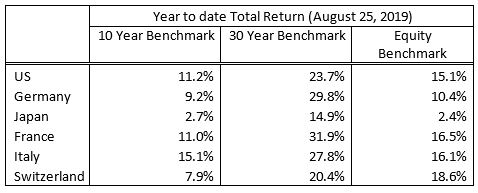
But when looking at the overall bond market today, “insane” is clearly the first word that comes to mind. To put it bluntly, how can so many investors accept to pay for holding debt securities? And why do so many market observers try to find far-fetched reasons to justify this present insane situation?

With some hindsight, it is difficult not to feel some reminiscences of the 1999 tech bubble: crazy valuations, spikes in prices, incoherent reasoning, abruptly all good reasons to buy because “things are different this time”, and in many cases the quasi-certitude to lose money over the long term. In fact, those buying German, French, Japanese or Swiss Government bonds today are sure to lose money if they hold it to maturity, whereas in 1999 at least those buying stupidly valued Internet companies could eventually have hoped to see them acquired at an even more stupid price.

In such a situation, it is unfortunately impossible to time the end of the madness, therefore extremely perilous to go short the assets that, in a logical world, should be shorted. A dear price had been paid by many brilliant investors in 1999 for having gone short the Nasdaq too early; the same applies this year with shorts on extended duration fixed income assets. But, remember how rewarding it was in 2000 to be short the Nasdaq, or at least to be away from it; it is a lesson that must be remembered.

The market will, from time to time, test convictions and drive prices far too high or far too low, much farther than most participants can cope with, which explains why there are buyers at tops and sellers at bottoms when common sense would recommend doing the opposite. Driving investors crazy and pushing them to make insane decisions is not an unusual behavior from Mr Market: “Who you trying to get crazy with this thing? Don’t you know I’m loco?”.

Coming back to today’s situation, how to deal with these negative yielding assets? For those who were brave and smart enough to hold them until now, we would advise to drastically reduce the exposure; and for the others to shy away, and concentrate on real businesses which generate cash-flow, increase earnings, invest, and are reasonably valued. Because this is the other insane consequence of abnormally low yields: how to discount future flows with incoherent factors? In theory a good company with low debt, good cash flow and an attractive dividend could be valued at insane multiples as well…

This comforts us with our positive stance towards equities, well balanced across sectors.

(*)“Insane in the brain”, Cypress Hill (https://www.youtube.com/watch?v=RijB8wnJCN0 )