Why Hedge Fund Selection Matters More Than Ever

Periods of market euphoria often encourage excessive risk-taking, the consequences of which only become apparent when the cycle turns.

Earlier this year, in our article Hedge Funds: 2026, the Year of Discipline, we argued that risk management would be one of the key differentiators in 2026. Looking back, that assessment appears to have been well founded.

For hedge fund selectors, 2026 has generally been a constructive year. Yet the environment has been anything but straightforward. Geopolitical tensions, the conflict involving Iran, persistent political uncertainty in the United States and the growing concentration of investment flows around artificial intelligence have created particularly demanding market conditions.

Equity long/short managers have, on the whole, generated positive alpha. Until the end of the second quarter, results were supported by sound sector allocation and effective stock selection. July, however, marked a sharp reversal. According to Goldman Sachs Prime Brokerage, it was the most destructive month for alpha generation since January 2022.

In an environment characterised by extreme market concentration, even highly disciplined managers struggled to avoid simultaneous losses on both long and short positions, despite the MSCI World Index ending the month in positive territory. The situation was further amplified by the collapse of a hedge fund heavily exposed to the artificial intelligence theme. Its concentrated and highly leveraged portfolio failed to withstand margin calls, triggering forced selling that reverberated across the broader hedge fund industry.

This episode serves as a reminder of a simple but critical reality: when markets become dominated by only a handful of investment themes, manager selection becomes increasingly important. Moments of euphoria often encourage excessive risk-taking, while the consequences tend to emerge abruptly when sentiment shifts.

At the same time, the hedge fund industry has attracted substantial inflows over the past five years. Several high-profile managers now oversee more than USD 100 billion in assets, while many multi-strategy platforms have experienced remarkable growth. At that scale, delivering differentiated performance becomes increasingly challenging. Maintaining a selective approach is therefore essential in order to avoid future disappointments.

We continue to favour two areas in particular: niche managers with limited capacity and strategies that still offer meaningful alpha potential, especially in Asia and within certain quantitative approaches.

Dispersion Creates Opportunity

Global Macro strategies have also experienced significant performance dispersion this year. In a volatile environment, the strongest managers have demonstrated an ability to manage risk effectively while adapting rapidly to changing market conditions. We continue to see particular merit in macro strategies given the economic and geopolitical uncertainties that remain. Access to the most talented managers, however, remains difficult and represents a meaningful advantage for investors with long-standing relationships across the industry.

Perhaps the most encouraging development this year has come from Asian long/short equity managers, particularly those focused on China. These managers successfully captured a meaningful share of the upside related to artificial intelligence while simultaneously reducing exposure during periods of market weakness. Their ability to adapt resulted in significant alpha generation while providing valuable diversification within portfolios.

Hedge Fund Selection Remains the Key Driver of Alpha

The hedge fund landscape continues to offer a wide range of opportunities, but manager selection and ongoing monitoring remain the primary drivers of long-term success. While private banks and investment platforms increasingly facilitate access to many of the industry’s best-known names, that is only part of the equation. The most compelling opportunities are often found among less widely known managers with limited capacity, specialised expertise and a genuine competitive edge. It is precisely in this segment of the market that active manager selection continues to create value.

Written by Cédric Dingens

Read the original French article published in AllNews:
Hedge Funds: la sélection fait toute la différence

Past performance is not indicative of future results. The views, strategies and financial instruments described in this document may not be suitable for all investors. Opinions expressed are current opinions as of the date(s) appearing in this material only. References to market or composite indices, benchmarks or other measures of relative market performance over a specified period of time are provided for your information only. NS Partners provides no warranty and makes no representation of any kind whatsoever regarding the accuracy and completeness of any data, including financial market data, quotes, research notes or other financial instruments referred to in this document. 

This document does not constitute an offer or solicitation to any person in any jurisdiction in which such offer or solicitation is not authorized or to any person to whom it would be unlawful to make such offer or solicitation. Any reference in this document to specific securities and issuers are for illustrative purposes only, and should not be interpreted as recommendations to purchase or sell those securities.

References in this document to investment funds that have not been registered with the Finma cannot be distributed in or from Switzerland except to certain categories of eligible investors. Some of the entities of the NS Partners group or its clients may hold a position in the financial instruments of any issuer discussed herein, or act as advisor to any such issuer.

Additional information is available on request. 

© NS Partners Group
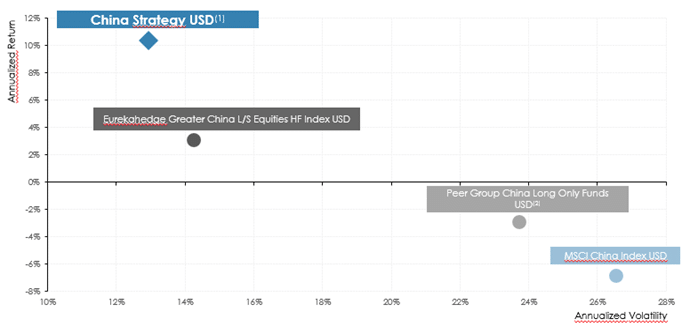
Chart of the Month – China: an interesting risk/return profile to be exposed to the region.

China: an interesting risk/return profile to be exposed to the region.

 
Source: NS Partners, Bloomberg. Data as of 30 April 2024. Performance in USD. Risk statistics against the MSCI China Index USD calculated on a monthly basis, with a risk-free rate of 1.0%.
(1) China B USD = Haussmann China/Asia Equity Long/Short allocation (K USD Share Class, with 1.40% management fees) from 31 December 2017 to 31 March 2021. From 1 April 2021 real track record of Mahjong China Fund B USD, net of fees. (2) Peer Group = long only China equity funds discretionary selected by NS Partners (10 funds), equally-weighted and rebalanced on a monthly basis. This slide includes historic returns and past performance is not a reliable indicator of future results. The value of investments can go down as well as up.

After 3 years of bear market in China, I see structural alpha opportunities emerging this year and managers are starting to gradually re-allocate capital in the region.

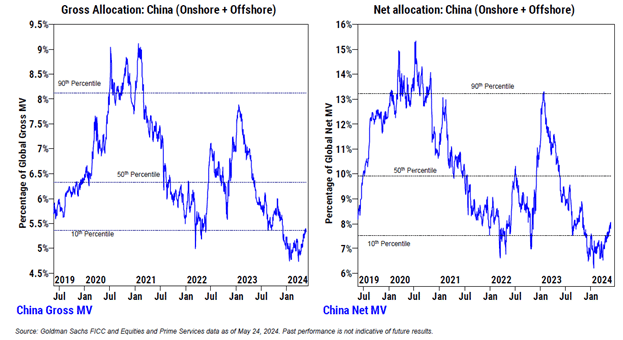
TMT stocks are the most net bought this year, information technology is the most overweight sector in this region. The financial sector remains the most underweight sector in the region, it has seen net inflows YTD but is among the most underweight ones in China.

Chinese equities continue to see slow but steady buying, with net buying flows. H shares have led the recent inflows followed by ADRs. A-shares continue to be net sold. But the most important Gross and Net allocation is gradually increasing.

Our strategy: China equity L/S multi-managers strategy can give the right diversification to investors that are willing to re-allocate capital to the region.

Managers are generating good performance so far this year. Since we started investing in the region, we had the ability to allocate capital with managers that were able to protect the capital in the down market and to generate good results in up market given good asymmetric returns.

The market in the region is structurally changed, moving from beta to alpha opportunities, thus we need to adopt rapidly to new investments regime and we need to be nimble in our approach; managers using Variable Net hedge fund approach can give the right flexibility. Overall, we prefer active investment over passive ones. Passive investments (ETFs) don’t follow the new trends that the economy is generating and active long only funds are less dynamic to move the exposure to the right sectors to capture market opportunities.

The return composition of the Chinese equities market is becoming more Alpha dominant. Stock selection has become a key driver in an environment where bifurcation of stock performance within an industry is a more common occurrence and it has also happed on a greater magnitude. After a period of systematic beta downtrend, markets are settling at a level of relatively strong support. At the same time, further clarity and stability across the economy and policy direction improve conviction level on stock selection, allowing investors to shift focus away from tail-end events and back into fundamentals.

China’s economy pivoted from export-manufacturing driven during 2000-2010, to domestic-consumption driven in 2010-20. It started another major rebalancing 2-3 years ago, amid the geopolitical tensions and its demographic challenges, to focus on self-reliance and advanced manufacturing.

Building a portfolio of local hedge fund managers adopting different strategies is the right approach to generate good risk-return performance. The universe of managers in China is big, there are hundreds of funds, manager selections is a key component.

The last 3 years was a big stress test for the managers, market experienced one of the worst drawdowns in history and I’m really convinced that from this period of bear market that big opportunities can emerge.


Past performance is not indicative of future results. The views, strategies and financial instruments described in this document may not be suitable for all investors. Opinions expressed are current opinions as of date(s) appearing in this material only. References to market or composite indices, benchmarks or other measures of relative market performance over a specified period of time are provided for your information only. NS Partners provides no warranty and makes no representation of any kind whatsoever regarding the accuracy and completeness of any data, including financial market data, quotes, research notes or other financial instrument referred to in this document. This document does not constitute an offer or solicitation to any person in any jurisdiction in which such offer or solicitation is not authorized or to any person to whom it would be unlawful to make such offer or solicitation. Any reference in this document to specific securities and issuers are for illustrative purposes only, and should not be interpreted as recommendations to purchase or sell those securities. References in this document to investment funds that have not been registered with the FINMA cannot be distributed in or from Switzerland except to certain categories of eligible investors. Some of the entities of the NS Partners Group or its clients may hold a position in the financial instruments of any issuer discussed herein, or act as advisor to any such issuer.  Additional information is available on request.
© NS Partners Group
Hedge Fund: efficienza dei mercati o rischio globale?

Hedge Fund: efficienza dei mercati o rischio globale?

Il settore degli hedge fund è tornato a raggiungere dimensioni molto significative, circa $3,83 trilioni a fine 2022, con i più grandi attori del comparto che ormai sono diventati degli ingranaggi fondamentali per il corretto funzionamento dei mercati, soprattutto grazie alla liquidità e all’efficienza che offrono. Inoltre, la capacità di sfruttare diverse asset class, la regolamentazione meno rigida e le elaborate strategie, permettono a questi fondi di accumulare ritorni sul capitale molto importanti. Per fare un esempio in termini numerici, nel 2022 Citadel, che detiene $62 miliardi di asset in gestione, ha ottenuto ben $28 miliardi di ricavi e $16 miliardi di profitti in un anno di forti ribassi per gli indici azionari, dove l’S&P 500, a confronto, ha perso oltre il 19%, il suo anno peggiore dal 2008. La prima condizione necessaria per garantire questo tipo di profittabilità sta nell’utilizzo di complessi modelli matematici, con cui vengono sfruttate tutte le possibili opportunità di arbitraggio e di vendita allo scoperto. La seconda, più intuibile, è l’utilizzo della leva finanziaria. Proprio qui sorge, infatti, il problema invocato dai regolatori. Alcuni hedge fund operano con denaro preso a prestito per amplificare i profitti, sottovalutando però le possibili distorsioni sui mercati, soprattutto durante i periodi di alta volatilità. La proposta è quindi quella di una maggiore trasparenza ad un settore che però fa della segretezza il suo mantra. Ciò che fa più timore, invece, è l’utilizzo di complesse strategie che coinvolgono i derivati finanziari, non inclusi sui bilanci, che portano alla creazione della cosiddetta leva sintetica. Non ultimo, un altro rischio legato ai derivati è quello che riguarda il margine. Nel caso di un crollo di Borsa subentra la margin call e, nei casi peggiori, i fondi si vedrebbero costretti a liquidare le proprie posizioni per soddisfare le richieste di ricostituzione del collateral da parte dei broker, intensificando quindi i ribassi.

Grafico: Performance netta di alcuni hedge fund a partire dalla loro fondazione, FT Research.

Nonostante ciò, imporre regolamentazioni più stringenti potrebbe dare scarsi risultati. Il controllo delle controparti, infatti, avviene già da parte delle banche che forniscono la leva. Piuttosto bisognerebbe imporre dei limiti all’eccessiva esposizione del settore bancario verso questi fondi. Il ricordo del crollo dei fondi LTCM e Amaranth, e più recentemente di Archegos, è ancora vivido nella mente degli investitori, ma l’efficace monitoraggio di attori ormai così preponderanti sui mercati rende la proposta simile ad un’illusione.

Fonti: Financial Times, Reuters, Bloomberg.

Di seguito l’ultima nota settimanale del nostro ufficio di Milano.

Nota settimanale 15.09.2023

  1. Panoramica macro
  2. Hedge Fund: efficienza dei mercati o rischio globale?
  3. Bank of Japan, l’ultimo samurai


Disclaimer

Le performance passate non sono in nessun caso indicative per i futuri risultati. Le opinioni, le strategie ed i prodotti finanziari descritti in questo documento possono non essere idonei per tutti gli investitori. I giudizi espressi sono valutazioni correnti relative solamente alla data che appare sul documento. Questo documento non costituisce in alcun modo una offerta o una sollecitazione all’investimento in nessuna giurisdizione in cui tale offerta e/o sollecitazione non sia autorizzata né per nessun individuo per cui sarebbe ritenuta illegale. Qualsiasi riferimento contenuto in questo documento a prodotti finanziari e/o emittenti è puramente a fini illustrativi, ed in nessun caso deve essere interpretato come una raccomandazione di acquisto o vendita di tali prodotti. I riferimenti a fondi di investimento contenuti nel presente documento sono relativi a fondi che possono non essere stati autorizzati dalla Finma e perciò possono non essere distribuibili in o dalla svizzera, ad eccezione di alcune precise categorie di investitori qualificati. Alcune delle entità facenti parte del gruppo NS Partners o i suoi clienti possono detenere una posizione negli strumenti finanziari o con gli emittenti discussi nel presente documento, o ancora agire come advisor per qualsiasi degli emittenti stessi. I riferimenti a mercati, indici, benchmark, cosi come a qualsiasi altra misura relativa alla performance di mercato su uno specifico periodo di riferimento, sono forniti esclusivamente a titolo informativo.  Il contenuto di questo documento è diretto ai soli investitori professionali come definiti ai sensi della direttiva Mifid, quali banche, imprese di investimento, altri istituti finanziari autorizzati o regolamentati, imprese di assicurazione, organismi di investimento collettivo e società di gestione di tali fondi, i negoziatori per conto proprio di merci e strumenti derivati su merci, soggetti che svolgono esclusivamente la negoziazione per conto proprio su mercati di strumenti finanziari e che aderiscono indirettamente al servizio di liquidazione, nonché al sistema di compensazione e garanzia; altri investitori istituzionali, agenti di cambio e non è da intendersi per l’uso di investitori al dettaglio. Accettando questi termini e condizioni, l’utilizzatore conferma e comprende che sta agendo come investitore professionale o suo rappresentante e non come investitore al dettaglio. Informazioni aggiuntive disponibili su richiesta

© NS Partners Group

Graphique du mois – Les gérants de fonds global macro sont de retour

Les gérants de fonds global macro sont de retour

Source: AQR

Fin de l’argent gratuit et retour de l’incertitude macroéconomique

Au cours des trois dernières années, le monde a considérablement changé en termes de géopolitique, de lutte contre le changement climatique et de perspectives d’investissement. Après la crise financière de 2008, les banques centrales ont pris l’initiative de soutenir les marchés financiers en inondant le système de liquidités. Les actions coordonnées des banques centrales se sont multipliées lorsque l’épidémie de COVID a fait irruption en mars 2020. Une des principales conséquences est que l’inflation élevée est enfin de retour et que la politique monétaire doit être radicalement inversée. L’ère de l’argent gratuit est désormais révolue, tout comme le régime de faible volatilité pour l’ensemble des classes d’actifs. La volatilité du marché peut se mesurer de plusieurs façons. Dans le graphique ci-dessus, le gérant quantitatif bien connu AQR tente d’identifier les régimes de «turbulence macro», celles-ci étant définies comme toute période de 12 mois où le niveau de l’actualité macro est supérieur à la moyenne. Le gérant mesure l’actualité macro en se fondant sur les variations de la croissance du PIB réel et de l’inflation, ainsi que sur les surprises (par rapport aux prévisions des économistes) en matière de croissance du PIB réel, de l’inflation et de la production industrielle. Depuis 2020, nous sommes de retour dans un tel environnement de turbulences macroéconomiques. Ce type de période peut durer longtemps, comme dans les années 1970 et 1980 ou au moment de la crise financière mondiale et durant celles-ci les gérants global macro ont connu des années fastes.

La volatilité devrait rester élevée

Les fluctuations des anticipations de politique monétaire devraient rester un moteur important du marché en 2023, ce qui signifie que la corrélation entre les actions et les obligations pourrait rester élevée. C’est ce qui s’est produit cette année, le portefeuille modèle 60/40 affichant ses pires performances depuis 80 ans! À l’avenir, les nombreux facteurs de risque — ton restrictif des banques centrales, inflation structurelle, éclatement des bulles, ralentissement de l’économie, crise énergétique, tensions géopolitiques, perturbations industrielles, montée de l’agitation sociale — ne signifient pas nécessairement que les marchés vont baisser, mais ils devraient, en revanche, rester volatils. Lors de fortes corrections du marché, la volatilité a tendance à s’envoler, la liquidité s’assèche et les corrélations augmentent soudainement, ce qui peut provoquer un désendettement forcé.

Plus de risques, mais plus d’opportunités aussi

Dans ce contexte, les stratégies de fonds spéculatifs non corrélées, telles que les stratégies global macro, devraient être particulièrement indiquées pour aider à diversifier les portefeuilles. Les gérants macro prennent des positions longues et courtes sur une série de classes d’actifs liquides (taux, indices d’actions, devises, indices de crédit et matières premières), principalement par le biais de contrats à terme et d’options, afin d’essayer de générer des performances décorrélées attractives sur la durée. À fin octobre, ils étaient en moyenne en hausse de 11,4% à 23,1% en cumul annuel (performances de l’indice HFRI Macro et de l’indice CS Macro HF), leurs gains étant essentiellement attribuables à des ventes à découvert sur les taux et à des positions acheteuses sur le dollar. Ils ont tendance à afficher des performances positives pendant les phases de dislocation du marché. Dans le passé, quand la volatilité implicite était élevée (indice VIX au-dessus de 25), les actions ont baissé en moyenne de 11,3%, tandis que les stratégies macro ont généré des performances annualisées de 6,1% (source UBS HF PB).

La flexibilité et une gestion rigoureuse des risques sont les clés de leur succès

L’avantage d’une stratégie global macro est la flexibilité du mandat. Le gérant peut investir dans toutes les classes d’actifs, en fonction des opportunités qui se présentent. Dans un environnement hautement volatile, la probabilité de trouver de bons points d’entrée/sortie est plus élevée. Un gérant global macro parvient à générer de bonnes performances corrigées du risque sur la durée s’il dispose d’un bon cadre de gestion du risque et s’il accorde une attention marquée à cet aspect dans son processus de due diligence. Disposant de niveaux élevés de disponibilités, qui rapportent maintenant 4%, ils sont maintenant payés pour attendre et prendre des risques lorsque des opportunités d’investissement intéressantes se présentent. En conclusion, la poursuite d’une politique monétaire restrictive et d’un régime de volatilité élevée devrait s’avérer favorable aux gérants macro en 2023.


Note

Indices de fonds alternatifs: Indice HFRI Macro Total (indice HFRIMI), Indice Credit Suisse Global Macro (indice HEDGGLMA).


Les performances passées ne garantissent pas les résultats futurs. Les opinions, stratégies et instruments financiers décrits dans le présent document peuvent ne pas convenir à tous les investisseurs. Les opinions énoncées sont celles valables à la date de publication de ce document. Toute référence aux indices de marches ou composites, indices de référence, ou autres mesures de performance relative des marches a une certaine période sont indiquées à titre d’information. NS Partners ne donne aucune garantie et n’est aucunement responsable de l’exactitude et de l’exhaustivité de l’ensemble des informations (données financières de marche, cours de bourse, avis de recherche ou description de tout autre instrument financier) contenus dans ce document. Le présent document n’est pas destiné aux personnes ou entités qui seraient citoyennes ou résidentes d’un lieu, état, pays ou juridiction dans lesquels sa distribution, sa publication, sa mise à disposition ou son utilisation seraient contraires aux lois ou règlements en vigueur. Les informations et données fournies dans le présent document sont communiquées à titre indicatif uniquement et ne constituent ni une offre, ni une incitation à acheter, vendre ou souscrire a des titres ou tout autre instrument financier. Il est fait référence dans ce document a des fonds d’investissement qui n’ont pas été enregistrés auprès de la Finma et ne peuvent donc pas être distribues en ou depuis la suisse sauf à certaines catégories d’investisseurs éligibles. Certaines des sociétés du groupe NS Partners ou ses clients peuvent être détenteurs d’une position dans les instruments financiers de l’un des émetteurs mentionnes dans ce document, ou agir en tant que consultant pour l’un d’eux. Des informations supplémentaires sont disponibles sur demande.

© Groupe NS Partners