Protected: Behind the Headlines: Decoding 2026’s Macro Regime Shifts | NS Partners Conference
The art market on the brink of a revolution: DXMarkets launches blockchain platform Maecenas
With its blockchain platform Maecenas, DXMarkets puts the art market on the brink of a revolution.
DXMarkets was one the start-ups which participated in Fusion’s first acceleration program back in early 2016. Its COO, Miguel Neumann, had explained how blockchain would facilitate illiquid portfolio management during Notz Stucki’s January 2016 investment conference… Well, little more than a year after, here we are!
After months of hard work, DXMarkets has created Maecenas, a blockchain-driven platform where shares of fine art are bought and sold.
On the platform, Maecenas divides great artworks into fragments, bought or sold by investors – just as they would buy or sell a share of a listed company. Which means investors can own a fragment of an artwork they could otherwise have never afforded.
On the other side, galleries can auction their masterpiece through Maecenas, selling fragments of the artwork – paying much lower fees than with traditional auction houses and getting immediate access to investors.
How does this work?
Here is the explanation of Marcela Garcia Casil, co-founder and CEO of Maecenas:
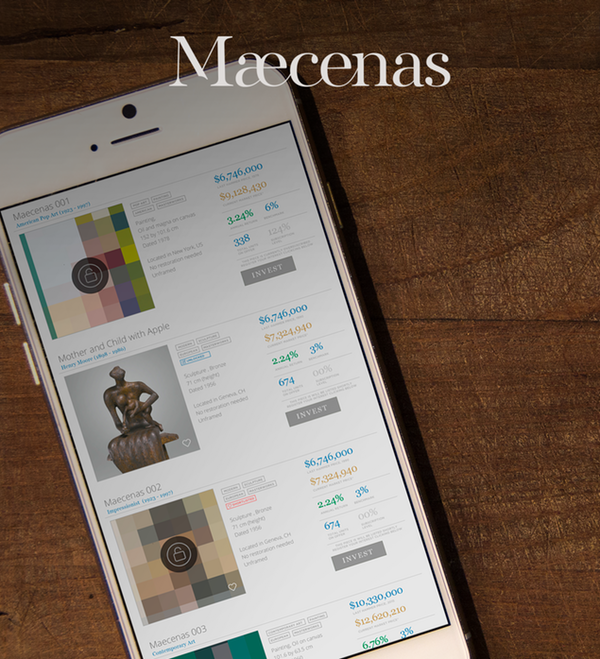
“The gallery, for example, puts the art ownership in a Special Purpose Vehicle (SPV) and owns 100 percent of that vehicle. And then the gallery sells 49 percent of the SPV on the Maecenas platform. The crowd buys shares in this SPV. The beauty of this is that the gallery raises money and still gets to hang the masterpiece in an exhibition. And as the value of the art increases, the gallery and the Maecenas investors see the value of what they own rise. Plus, there will be a leasing fee so that the investors are paid for use of the artwork in the gallery.
Maecenas will issue a token in its crowdsale that will be the token used for all settlements on the platform. We are calling the token: ART. Now, don’t confuse the ART token with the fragmentisation of the artworks. The ART token is a utility token that is used to settle transactions on the platform.”
In other words, Maecenas creates a liquid market for fine art investments by splitting the masterpieces into fractions. This is one of the concrete applications of blockchain. And when we think about it, not only any kind of art can be auctioned on such a platform but in fact, all kinds of valuable and tangible assets such as collectible cars, vintage wine, etc.
Welcome to the digital world!
To learn more on Maecenas and blockchain applications, you may contact
Marcelo Garcia Casil
Twitter: @maecenasart
Website: https://www.maecenas.co/
Andurand Capital @ Notz Stucki conference on 28 June 2016
« Trading floors the world over are littered with the bodies of those who tried to trade energy futures » the saying goes. I’ve heard it used recently regarding those who tried to short JGBs but most traders in the oil & gas business would agree. Remember Brian Hunter of Amaranth fame who blew up the whole multi strategy fund on over leveraged natural gas contracts in Alberta? In a few days, over £5Bln of capital evaporated in the clear blue Canadian sky to protect his positions, to no avail. The best and brightest have tried to ‘fly by the sun’ only to be humbled by the sheer complexity of assessing the value of energy prices. I once had a colleague who ran a European equity fund who refused categorically to touch equities in the sector as forecasts on the price of oil were more akin to sorcery than sound financial management. ‘What fates impose, that men must needs abide; It boots not to resist both wind and tide’ the Bard once said in Henry IV when the Earl of Warwick was tempting fate.
One person whose been bucking the trend of late is Pierre Andurand of Andurand Capital who launched his commodities hedge fund in 2013 and traded successfully around a few very strong calls, both on the upside and downside, for oil. We invited him as a guest speaker at the Notz Stucki Investment Conference on 28 June to share his views and shed some light on what drives his thought process.
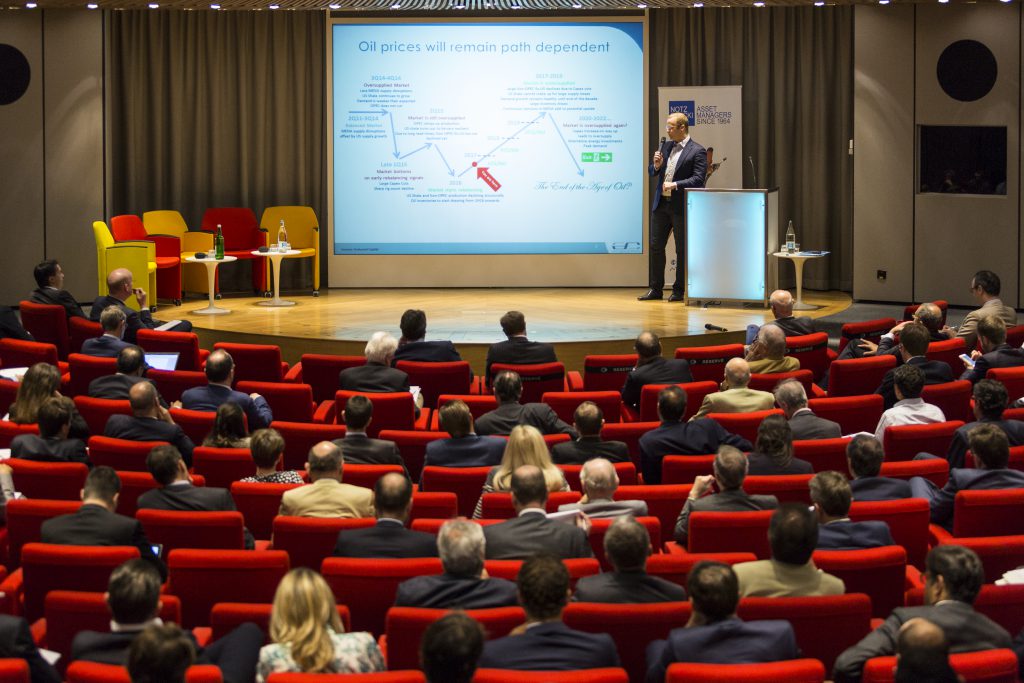
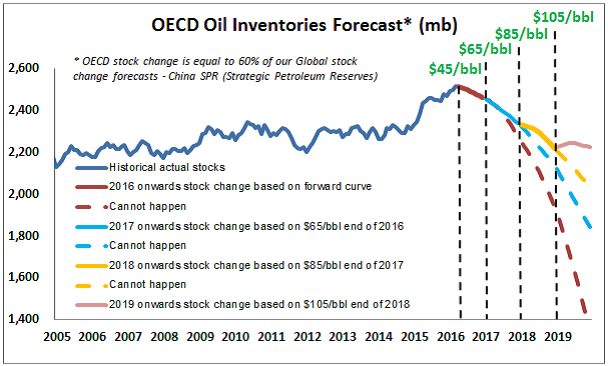
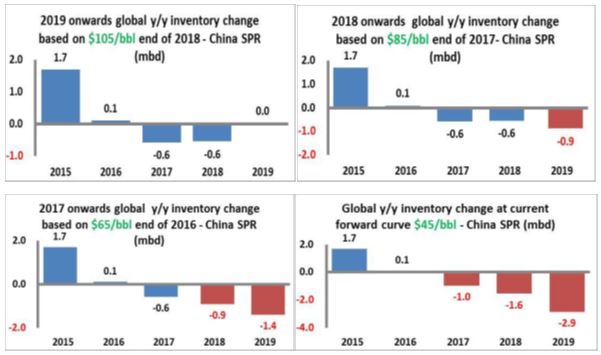
‘There’s clearly been some volatility in price’ states Andurand and goes on to add’ at these levels though I’m positioned to benefit from a multi-year rally in the price of oil.’ Andurand couldn’t have called it better these past 2 years and this message was heard loud and clear. He was very aggressive in communicating on the imminent collapse of the price of oil in 2014 and timed it perfectly last year, turning bullish on crude at the lows of pretty much $28. ‘The price of crude rose during the noughties to £115/barrel on the back of above trend EM and global growth. Subsequent to that, the market stayed balanced (at least from 2011 to 2014) as MENA supply disruptions (i.e. through the Arab spring) were offset by US supply growth’. Volatility was also down as large non-OPEC supply was offset by large option buying. ‘This didn’t last though’ opines Andurand ‘in 2014 because of a 1.5% deficit in storage capacity, the market plummeted from $111 to $28. OPEC’s decision not to cut during this period exacerbated the problem. Cutting production by OPEC members only made higher cost non-OPEC members more profitable and once the market understood it was in OPEC’s interest to keep prices low to gain market share, it was clear prices would keep on falling. In early 2015, markets came back slightly on the reappearance of storage capacity, lowered US rig counts and sharp cap ex cuts.’ It’s no surprise that inventory levels and storage capacity are the main drivers of price. ‘The market is still oversupplied in 2016 with OPEC still ramping up production and due to long lead times, non-OPEC (ex US) has not declined yet putting near term pressure on price.’ concludes Andurand.
Going forward, growth in US shale and part of OPEC will not offset production declines elsewhere and therefore it makes sense to be long the commodity according to Andurand. At current oil prices, he sees US shale oil production (5 mbd) is declining quickly and non-OPEC ex-US Shale oil (51 mbd) and other OPEC (21 mbd) production declines accelerating in the near future. Production in the 4 main OPEC countries (18 mbd) will continue to grow. Furthermore as projects in non-OPEC ex-US Shale oil and other OPEC have a long lead times, we see production declines accelerating significantly from 2018 onwards. Again, it’s worth bearing in mind that on the way up, US Shale production and the 4 main OPEC countries’ production growth will not cap the market as it will not be able to offset declines in non-OPEC ex-US Shale oil and other OPEC. Finally, the longer it takes for oil prices to rally, the larger the rally will be…
As far as demand is concerned, Andurand was fairly sanguine about the outlook for global growth and barring any tail events, it should stay fairly supportive. He also sees the impact of renewables, eating away at demand for oil, not being meaningful before 2023/2025 when electric cars make up 10% of the auto market. They shouldn’t be a headwind for price until then.