Q3 2026 Market Outlook – Quarterly Investment Review

Q3 2026 Market Outlook – Quarterly Investment Review

We’re not investing approximately $200 billion in capex in 2026 on a hunch. Andy Jassy, CEO of Amazon

For the first time since the Medici were bankers to François I, yields on 10-year French government bonds now stand above the yields on Italian, Spanish, Greek or Portuguese bonds. Louis Gave

Markets Navigate Rising Yields and Political Uncertainty

Markets contended with several conflicting forces during the third quarter. Bond yields rose, the oil price spiked, and the political backdrop was unsettled as the US approaches the midterm elections in November, with an increasing expectation that President Trump may lose his majority in Congress. In July a $45 billion AI focused hedge fund blew up when the S&P500 was down just 3%, due to excessive leverage. Nonetheless corporate earnings were strong, and some announcements spectacularly so. Moderna declared a successful trial result in July, and its stock price recorded the largest ever one day move for an S&P500 share with a 177% jump. During the quarter the US 10-year bond yield rose from 4.47% to 5.29%. The S&P500 rose by 2.3%. The Brent crude oil price rose by 29.5%, and gold rose 3.7%.

Bond Markets Are Sending a Warning Signal

Longer dated government bond yields have been breaking important levels. The 30-year bond in the US is at 5.63% (its highest level since 2002), in Japan they have broken above 4% (a level never seen since the country issues at 30 years), and in France and the UK they are 5.47% and 5.95%. The US 10-year yields 5.29%, also the highest level since 2002. The size of government debt is far greater than it was when yields were previously at these levels, so these higher yields are much more painful than they were then. The US budget deficit continues to deteriorate. The deficit in July was $432bn, far worse than the expected $300bn, and a significant deterioration from the $291bn the previous July, and worse than any single month outside the Covid crisis. For the US, and other western countries, the arithmetic of this debt is becoming unforgiving. $8 trillion of US Government debt will roll over in the next 12 months at interest rates 1% higher than their current coupons, adding $80bn in extra annual interest payments.

This is before the $2 trillion annual deficit is funded. Each refinancing deepens the deficit and adds more debt. It is probably because of these runaway budget deficits that western bond yields are rising as markets start to question the sustainability of this enormous debt issuance. There is also the inflationary pressure from higher commodity prices. The day before the US bombed Iran the 10-year Treasury yield was at 3.95%, now it is at 5.29%. While oil prices have risen the impact has been cushioned by drawing down reserves. However there has been a much more dramatic rise in oil products, such as diesel where supply has been constrained by refineries being shut down in the Gulf, and the destruction of capacity in Russia. Higher prices for diesel and other oil derivative products feed quickly into higher transportation costs, and puts pressure on labour costs, all of which is inflationary and adds further pressure to bond yields. What is most worrying is that these deficits and spiralling costs are occurring during a relatively benign economic period. How much worse would the figures look if the economy slipped into recession. Nonetheless if US Treasury yields go much higher then US pension funds would start to be natural buyers. Their target return tends to be 6-8%. If yields approach 6% then it makes sense for them to buy that return in a product guaranteed by the government.

Structural forces make changing policy difficult for governments. For forty years interest rates fell, and for the decade and a half following the financial crisis of 2008 raising debt was almost cost free. Spoilt by these conditions’ governments expanded their spending plans, largely on welfare. A vast expansion of social spending ensued. Perhaps the height of this lax attitude to spending was President Trump’s promise to give every adult American a $5000 cheque if the Republicans retain control of both houses of Congress. If delivered this would see borrowed money offered to voters by a government already heavily overindebted. Now an ageing population requires more pension and healthcare payments, while globalisation introduced a far more competitive labour force leading to an entrenched unemployment class. Social welfare payments are ballooning.

Any threat to remove the benefits for these groups has proved electoral suicide, so necessary economic decisions have become politically impossible. The only way to curb profligate governments and control entitlement spending is for bond yields to rise to the point that threatens or produces a crisis which forces the government to take hard decisions. Bond markets appear to be doing just this. Governments are also facing competition from the private sector for the first time in many years. The slow recovery since 2008, particularly of the banking sector, has meant that the private sector has not sought major financing. The AI revolution has changed this. The largest technology companies which were self-financing up to now, have been conducting enormous spending on projects to develop their AI projects, which has required them to use the debt markets.

So, governments are demanding mountains of money for their welfare plans while the tech giants are demanding mountains of money for productive infrastructure like the grid, power, and datacenters. Money goes where it is treated best so governments need to compete for this capital with some of the most efficient and successful companies of all time. This is healthy. Nevertheless, rising rates are always uncomfortable for financial assets, because equity market corrections are nearly always caused by a recession or monetary tightening. The current rise on rates raises the potential for a setback.

The AI Investment Boom Faces Its First Real Test

Stock markets still continue to be dominated by the AI theme, which in turn is dominated by a handful of companies, particularly the so-called Magnificent 7 and semiconductor companies. July saw a sharp correction in these names, which wiped out the Situational Awareness fund. However, the most damage occurred in the Far East and particularly Korea, where speculative hysteria reached extreme levels. When the correction arrived 3.4% of the adult Korean population received a margin call, and there were stories of speculators selling their blood plasma to cover their losses.

Importantly though this correction was caused by financial over extension not fundamental earnings. The companies involved continued to post stellar earnings results. Nonetheless bond markets have started to question the gargantuan spending by the companies building the AI infrastructure and as with government debt the yields of the debt of US big technology companies have risen; and for example, in July the debt of Oracle was downgraded. The scale of the AI build out is enormous. The cumulative capital expenditure for the next few years is estimated at about $11 trillion which is far larger than previous large capital projects such as the internet build out in 2000 or housing boom that led to the bubble in 2008.

A lot of the cashflow from this expenditure goes to the semiconductor companies whose chips power everything, but the average life of these chips is far shorter than the railway tracks or fibre optic cables that were overexpanded during previous bubbles, so it is a valid question to ask what depreciation rate and what the return on capital of these investments will be? A considerable amount of the economic growth in the US has been due to the vast spending of Open AI and Anthropic, the leading developers of AI software, but this could slow down.

Both companies have highlighted risk concerns of the dangers of unbridled AI, and as the advantage gap has narrowed between them and their competitors, including Chinese models, it isn’t obvious why consumers will continue to pay several times more for the cleverest application when the other models perform adequately the task most users require. If this sector slows down, then that would have significant implications for both US GDP growth and the stock market.

Strong Earnings Continue to Support Equity Markets

With all these concerns why has the stock market held up so well? The principal reason is that earnings have been exceptionally strong, and this is partly due to AI starting to boost profits of companies beyond the technology sector by improving efficiency. Global earnings have been growing at a rate of mid-teens to twenty percent, which is well above anything experienced in post war history, other than in a recovery from a cyclical economic low point. The effect is twofold. AI can be used to improve productivity and to lower costs. It is particularly effective in companies that use a lot of data which it can digest and organise in seconds. Banking is one example and it is remarkable that while the technology companies have gone from being cash generative to debt hungry, banks have done the reverse going from being dependent on government bail outs to being in a position where they are returning significant amounts of excess cash to their shareholders.

Opportunities Beyond US Exceptionalism

This year is seeing further evidence of a reduction of American exceptionalism in terms of stock market performance. Since Trump was sworn in most other regions have outperformed the US, and in the case of the Emerging Markets and Japan by a handsome margin. This reflects better starting valuation levels of share prices outside the US, but also an improved economic environment.

Many Emerging Markets, for example, have followed far more orthodox economic policies than their Developed Market peers. With strong trade surpluses and far stronger fiscal balances than the West their currencies should appreciate offering extra potential for return. In terms of sectors the energy and mining sectors have been strong. Higher energy prices make oil stocks an obvious beneficiary of the troubles in the Middle East. It is an anomaly that they represent only 3.5% of the index yet are estimated to account for over 8% of the earnings.

The longer the oil price remains high the more glaring this anomaly will be. Mining companies have an equally strong outlook as they benefit from both government expenditure, due to the need to renovate old public infrastructure, and the AI boom, because datacentres and the electrification of the grid is commodity intensive. Gold should also perform well. History suggests that governments facing high debt burdens rarely overcome them through austerity. Especially in democratic systems they maintain nominal interest rates below the rate of inflation, which results in currency debasement and even financial repression.

This environment is supportive of gold as investors seek to protect their wealth and purchasing power. Moreover, for longer term investors an opportunity has been opened up by the crowding into the AI theme by most investors. Currently trading is dominated by computing program driven funds, passive flows, and pod shops that are chasing quarterly returns. They tend to herd into the same names and sell everything else. This creates an opportunity for investors with longer time frames that can buy companies with good fundamentals that have been sold to cheap levels, though the caveat to this is that there is no certainty on when they will be rerated.

Investment Outlook: Volatility Returns but Opportunities Remain

The Hormuz situation presents the world with more uncertainty than one and two quarters ago. Elevated and rising oil prices have a history of causing financial upheaval because of their effects on increasing prices and wages. When oil prices rise enough they have often tipped the economy into recession. Bond yields are reflecting this, but they also reflect strong growth, and this growth is producing strong corporate earnings. If the energy situation is resolved both bond and equity markets are likely to improve. The opportunities are in select areas, but investors are likely to have to withstand more volatility than in the past few years.

Written by James Macpherson

Click HERE to download the full Q3 2026 market oulook.

Past performance is not indicative of future results. The views, strategies and financial instruments described in this document may not be suitable for all investors. Opinions expressed are current opinions as of date(s) appearing in this material only. References to market or composite indices, benchmarks or other measures of relative market performance over a specified period of time are provided for your information only. NS Partners provides no warranty and makes no representation of any kind whatsoever regarding the accuracy and completeness of any data, including financial market data, quotes, research notes or other financial instrument referred to in this document. This document does not constitute an offer or solicitation to any person in any jurisdiction in which such offer or solicitation is not authorized or to any person to whom it would be unlawful to make such offer or solicitation. Any reference in this document to specific securities and issuers are for illustrative purposes only, and should not be interpreted as recommendations to purchase or sell those securities. References in this document to investment funds that have not been registered with the FINMA cannot be distributed in or from Switzerland except to certain categories of eligible investors. Some of the entities of the NS Partners Group or its clients may hold a position in the financial instruments of any issuer discussed herein, or act as advisor to any such issuer. Additional information is available on request. © NS Partners Group
Q2 2026 Market Outlook – Quarterly Investment Review

Q2 2026 Market Outlook – Quarterly Investment Review

The US is pouring more capital into AI data centers in 6 years (~$930B) than the inflation-adjusted cost of the Marshall Plan, Apollo, Manhattan Project, and the Interstate Highway System — combined. Meanwhile: AI ≈ 45% of the S&P. Energy ≈ 4%. Everyone is overweight the thing that needs power. Underweight the power. – Ron Stoeferle, May 12th 2026

Markets Look Through the Hormuz Crisis

Despite the troubling backdrop in the Middle East, equity markets enjoyed a strong quarter. This was partly because at the end of March markets were near the bottom of their plunge following the closure of the Hormuz Strait, but also due to exceptionally strong earnings driven by capital expenditure in AI-related projects and governments continuing to provide substantial fiscal support. Nonetheless, with the situation in Hormuz still unresolved at the end of June, it was astonishing how powerful the move was, as the S&P 500 surged to new highs. The rally was led by the semiconductor index, which doubled, although it also masked a furious rotation out of software stocks such as Microsoft and Adobe, which continued to decline. This move was reflected in Emerging Markets, where a handful of stocks in Korea and Taiwan leapt higher.

For the quarter, the MSCI World rose 13.3%, the MSCI Emerging Markets Index gained 22.6%, US 10-year Treasuries were flat, and gold fell 14.2%.

The Hormuz crisis remains unsettled. So far, the world has been shielded from a major inflationary shock by drawing down reserves; estimates suggest that 1.4 billion barrels of oil and oil products have been released globally from reserves since the conflict began. However, this cushion is not limitless. While the United States and Iran have signed a Memorandum of Understanding aimed at ending the conflict, agreeing on the details is proving difficult. Despite an overwhelming military victory, the US has failed to establish control of the vital sea lanes through which oil, gas and many of their derivatives flow.

Global Supply Chains and the Return of Inflation Risk

The conflict has highlighted how many critical products originate in the region, including sulphuric acid, which is essential for mining; helium, which is vital for semiconductor manufacturing; fertiliser; and jet fuel. The situation underscores a wider point: there are numerous global choke points. After thirty years of globalisation, production has become concentrated in a handful of locations, while the risk of disruption has increased.

The Malacca Strait, for example, is under three kilometres wide at its narrowest point. China maintains an almost complete monopoly in the production of rare earths, while Asia dominates large parts of the world’s manufacturing base. The global supply system is a sophisticated ballet built on the assumption that there will be no impediments. The de-industrialisation of the West has therefore left it vulnerable to choke points on the other side of the world.

Restarting these industries at home is proving difficult. The result is a world that is more prone to inflation, both because countries are likely to stockpile commodities to guard against future disruptions and because efforts to relocate strategic industries will be highly resource intensive. In many areas, countries will effectively be starting from scratch. In international shipping, for instance, the largest American shipping company, Matson, accounts for just 0.2% of the global market.

The AI Investment Boom Continues

In the United States, the stock market is being driven almost exclusively by the AI boom. Indeed, this boom is responsible for much of the growth in the economy. The numbers are extraordinary. The hyperscalers are forecast to spend $805 billion on their AI plans this year and $1.116 trillion next year. Remarkably, these spending plans continue to increase.

McKinsey estimates that $6.7 trillion will need to be spent on data centres between now and 2030. The scale of investment has reached the point where many of these companies are spending all of their cash flow, and more, to remain competitive. It is a curious situation in which the most profitable companies in history are reinvesting virtually every dollar they earn simply to stay in the race.

This spending is boosting corporate earnings in three ways. It is driving capital expenditure, supporting stock market gains and therefore consumer spending through wealth effects, and improving productivity. Since the launch of ChatGPT, US labour productivity has increased in 13 of the past 14 quarters.
While select AI-related stocks have soared, many of the commodities essential to building the required infrastructure and data centres have been largely overlooked. Having lagged the broader AI trade, they are beginning to look increasingly attractive.

Mega-Cap Fundraising and Growing Liquidity Concerns

The last quarter was notable for the launch and announcement of several enormous stock market listings. Elon Musk’s SpaceX listed at a valuation of $1.77 trillion, raising $86 billion of fresh capital, followed a few weeks later by a further $20 billion in the debt markets. Together with his Tesla holdings, Musk became the world’s first trillionaire, with a net worth exceeding the value of bitcoin.

Anthropic and OpenAI are also targeting market listings at valuations above $1 trillion. In addition, Alphabet raised $80 billion in equity capital and Meta is expected to raise substantial funds as well. In total, these companies may raise close to $300 billion. While sizeable, this remains manageable in the context of a stock market that returned $1.6 trillion to shareholders last year.

However, from mid-August through year-end, approximately half of SpaceX’s market capitalisation — roughly $1 trillion of stock — becomes unlocked and eligible for sale. The scale of this potential supply is considerably more challenging to absorb. Given the pipeline of upcoming IPOs and secondary offerings, the second half of 2026 could experience significantly greater liquidity stress than investors have become accustomed to during recent years of abundant liquidity.

Moreover, the returns on AI investment remain largely unproven. Revenues are modest and profits even more so. Yet AI has become such a dominant market narrative that it has drained attention and capital from many other sectors, leaving broad swathes of the market languishing.

This presents a particular challenge for private equity, which has struggled to realise investments despite strong public markets because many assets are still held at valuations that buyers are unwilling to accept. Private equity and private credit flourished after the 2008 financial crisis largely because they operated with lighter regulation than public markets and banks. However, signs of strain are beginning to emerge.

Many institutions have substantial allocations to private assets. To the extent they require liquidity and cannot access it through those investments, they may need to sell listed equities and bonds instead, creating additional pressure on public markets.

Bond Markets Face Structural Headwinds

OECD bond markets have been disappointing investments for several years. One reason is that governments across the developed world have issued excessive amounts of debt for more than two decades as they attempted to spend their way towards economic growth. The debt burden has now become so large that interest payments are consuming ever-growing portions of national budgets.

In the United States, federal interest expense represented 8.7% of federal receipts in fiscal 2021. During the first five months of fiscal 2026, that figure exceeded 20%. In May, the US Treasury sold 30-year bonds at a yield above 5%, the highest level since 2007 and a sign that enthusiasm for the world’s most important bond market is fading.

Nor does the United States have the most concerning outlook. The UK picture is particularly alarming. Government spending consistently exceeds projections, while debt raised during the era of ultra-low interest rates now needs to be refinanced at materially higher yields.

The extent of the adjustment can be seen in a UK government bond issued in May 2020 and maturing in 2062, whose price fell from 100 to as low as 22 in May this year. UK government bond yields are now higher than those of Greece and Morocco.

The outlook for bonds remains challenging. Inflationary pressures from the Iran conflict are still filtering through the global economy, while even technology companies are raising prices, with Apple increasing some prices by as much as 20%. This comes at a time when many governments are already grappling with fiscal deficits and rising pressure to increase military expenditure.

Why Japan Could Matter More Than Investors Expect

Perhaps the most significant bond market development has occurred in Japan. The near-zero interest rates that prevailed for almost three decades have started to move higher and closer to those available in Western markets.

Japan’s enormous pool of domestic savings has long supported global asset markets because opportunities at home were limited. As Japanese yields become more attractive, capital has a growing incentive to return home. Should that process accelerate, it could have meaningful implications for speculative assets and liquidity conditions globally.

Investment Outlook: Diversification Over Concentration

At present, stock markets remain dominated by the AI theme and the extraordinary earnings growth being generated by the companies leading this technological revolution. AI is undoubtedly transformative. However, transformative industries can become poor investments when enthusiasm reaches extremes, because everyone builds simultaneously and pricing power evaporates when demand eventually slows.

The bubble may therefore lie more in the “E” than the “P” of the P/E equation.
It is notable that Warren Buffett recently remarked that he was seeing more speculation than at any other point in his career — a remarkable statement from a ninety-five-year-old investor with such experience.

The safer opportunities may lie in trends that were temporarily interrupted by the Iran conflict. Last year saw a rotation away from highly valued US assets towards more attractively priced opportunities in Europe, Japan and Emerging Markets, although investors should be careful not to chase the hottest parts of the market.

A US market collapse is not inevitable. While US indices are trading at elevated levels, they may simply deflate over an extended period, as occurred between 1966 and 1982 when the market went essentially nowhere. Beneath the surface, however, there were still numerous opportunities and skilled stock pickers generated attractive returns.

As we conclude this Q2 2026 Market Outlook, investors should increasingly focus on diversifying portfolios across geographies and sectors. Bonds remain broadly unattractive, while in currencies the US dollar is likely to weaken moderately over time. Particular attention should be paid to the Japanese yen, which may become increasingly influential as global capital flows evolve.

Written by James Macpherson

Click HERE to download the full Q2 2026 market oulook.

Past performance is not indicative of future results. The views, strategies and financial instruments described in this document may not be suitable for all investors. Opinions expressed are current opinions as of date(s) appearing in this material only. References to market or composite indices, benchmarks or other measures of relative market performance over a specified period of time are provided for your information only. NS Partners provides no warranty and makes no representation of any kind whatsoever regarding the accuracy and completeness of any data, including financial market data, quotes, research notes or other financial instrument referred to in this document. This document does not constitute an offer or solicitation to any person in any jurisdiction in which such offer or solicitation is not authorized or to any person to whom it would be unlawful to make such offer or solicitation. Any reference in this document to specific securities and issuers are for illustrative purposes only, and should not be interpreted as recommendations to purchase or sell those securities. References in this document to investment funds that have not been registered with the FINMA cannot be distributed in or from Switzerland except to certain categories of eligible investors. Some of the entities of the NS Partners Group or its clients may hold a position in the financial instruments of any issuer discussed herein, or act as advisor to any such issuer. Additional information is available on request. © NS Partners Group

Q1 2026 Market Outlook – Quarterly Investment Review

Q1 2026 Market Outlook – Quarterly Investment Review

The guerrilla wins if he does not lose. The conventional army loses if it does not win. – Henry Kissinger

Stock markets’ strong performance in 2025 continued into the first two months of this year, despite an increasingly disturbing geopolitical backdrop. This Q1 2026 market outlook examines how quickly sentiment shifted as geopolitical tensions escalated and began to materially impact global markets.

On January 3rd, US special forces captured President Maduro of Venezuela and brought him to face trial in New York on charges of narco-terrorism. As the quarter progressed, President Trump sought to annex Greenland, an autonomous territory of Denmark, and rhetorically suggested that the US could annex Canada, while also announcing his intention to ‘take Cuba’. While these developments contributed to a growing sense of instability, they were ultimately overshadowed by the US/Israeli attack on Iran on the last day of February.

Iran’s response was decisive. By effectively closing the Straits of Hormuz—through which around 20% of the world’s energy supply transits—the country triggered the largest global energy disruption since the Second World War. Oil prices surged by 68% in March alone, reshaping expectations for growth and inflation alike.

This sudden escalation exposed fractures within the NATO alliance and raised broader questions about the role of the United States as a stabilising global force. Markets, which had largely ignored geopolitical noise at the start of the year, rapidly repriced. By the end of the quarter, the MSCI World Index had declined by 3.4%, while US 10-year Treasury bonds were marginally lower.

A fragile and highly binary environment

The current situation remains fluid, uncertain and increasingly binary. Despite overwhelming conventional military superiority, the US has struggled to secure safe passage through the Straits of Hormuz. The threat posed by low-cost, asymmetric tactics—drones, naval mines and fast-moving explosive vessels—has proven highly effective.

Oil tankers, by nature slow and vulnerable, are particularly exposed. Even naval forces have had to retreat at times to avoid concentrated drone attacks. While limited shipments continue under Iranian oversight, the broader disruption remains unresolved.

The economic implications are significant. The longer the situation persists, the greater the strain on global supply chains. Inflationary pressures are already emerging as delays, shortages and logistical bottlenecks feed through to prices. Compounding this, damage to regional energy infrastructure may take years to repair, suggesting that the effects of this shock could extend well beyond the immediate crisis.

Beyond oil: a systemic supply shock

While oil dominates headlines, the real impact is more complex and far-reaching. Refined products such as diesel, jet fuel and naphtha are essential inputs across multiple industries. The disruption therefore affects not just energy markets, but the broader functioning of the global economy.

The region hosts 68 oil refineries, strategically located to benefit from low-cost energy. These facilities produce a wide range of materials that underpin industrial activity—from transportation fuels to petrochemicals used in plastics.

Energy remains deeply embedded in modern economic systems. Oil and gas are not only central to transport, but also to electricity generation, fertiliser production and manufacturing processes.

For instance, Taiwan relies on liquefied natural gas (LNG) for roughly 40% of its electricity generation, with a significant portion sourced from Qatar. LNG is difficult to store at scale. Any disruption risks forcing rationing, particularly for industrial users. This would have immediate consequences for semiconductor production—an essential component of the global technology ecosystem and AI supply chain.

The Middle East also supplies a substantial share of the world’s helium, critical for both semiconductor manufacturing and aerospace applications. In addition, it is a key source of sulphuric acid, required for processing metals such as copper, nickel and uranium—materials central to electrification and the energy transition.

Another critical vulnerability lies in agriculture. Approximately one-third of global fertiliser shipments pass through the Straits of Hormuz. The timing of the disruption—coinciding with the spring planting season in the Northern Hemisphere—raises the likelihood of food price inflation in the months ahead.

Macroeconomic transmission channels

The economic impact of higher energy prices is well understood, but no less significant. First, rising costs reduce consumers’ disposable income, leaving less available for discretionary spending. Second, heightened uncertainty leads households and businesses to delay major purchases.

Third, concerns about employment prospects tend to increase precautionary savings, further dampening demand. Finally, if inflation accelerates, central banks may be forced to tighten monetary policy, increasing borrowing costs and slowing economic activity.

What makes the current situation particularly challenging is the lack of short-term alternatives. Energy systems are not easily adaptable. Vehicles, industrial processes and heating systems cannot quickly shift away from fossil fuels, reinforcing the persistence of the shock.

Historically, oil price spikes of this magnitude have often preceded economic slowdowns or recessions. While today’s global economy is less energy-intensive than in the 1970s, the scale and breadth of the current disruption remain concerning.

Financial markets: vulnerabilities beneath the surface

This shock comes at a time when several areas of the financial system already appear stretched. Technology companies—particularly hyperscalers—are investing heavily in infrastructure, with capital expenditure expected to reach $600 billion this year, largely driven by AI development.

At the same time, parts of the private credit market are showing signs of strain. These segments, often less transparent, may be particularly sensitive to tightening financial conditions. In parallel, an estimated $3.8 trillion of private equity assets remain unsold, awaiting favourable exit conditions.

Higher energy prices and increased volatility could place additional pressure on this ecosystem, raising the risk of forced adjustments or delayed liquidity events.

Another important consideration is the role of energy-exporting nations in global capital flows. Historically, Gulf states have recycled oil revenues into international financial markets, notably US government bonds and equities. Any disruption to these flows—whether due to reduced production or increased domestic spending needs—could remove a key source of liquidity.

This comes at a time when public finances in many developed economies are already under strain. US government debt has reached $36 trillion and continues to rise rapidly. In the UK, welfare expenditure now exceeds income tax revenues. These constraints limit policymakers’ ability to respond aggressively to future shocks.

A path to de-escalation?

Despite the severity of the situation, there are reasons to believe that a resolution remains possible. Both the United States and Iran face strong incentives to avoid a prolonged conflict.

In the US, the upcoming mid-term elections represent a significant political constraint. A deterioration in economic conditions could weaken the administration’s position, particularly given the narrow balance of power in Congress.

Iran, meanwhile, is grappling with acute economic stress. Hyperinflation and currency collapse have created conditions that historically increase the risk of domestic instability. These pressures may encourage a negotiated outcome.

Should a resolution be reached and the Straits of Hormuz reopen, energy markets could stabilise relatively quickly. Oil prices, currently elevated, could fall materially, alleviating pressure on both inflation and growth.

Recovery scenario and structural drivers

In such a scenario, the broader economic backdrop could reassert itself. Fiscal stimulus in major economies—including the United States, Germany and Japan—remains supportive. At the same time, China continues to benefit from strong export dynamics.

Longer-term structural trends also remain intact. The expansion of data centres to support artificial intelligence, alongside the need to modernise electricity grids, is driving sustained demand for commodities and infrastructure investment.

Recent events may even reinforce these trends. The disruption has highlighted the strategic importance of secure and diversified supply chains, particularly for critical materials. As a result, governments and companies may increase investment in resilience, including stockpiling and domestic production capacity.

Conclusion: navigating uncertainty

Markets have entered a phase where outcomes are increasingly dependent on geopolitical developments. The range of potential scenarios remains wide, from prolonged disruption and economic slowdown to a relatively rapid normalisation.

The longer the current impasse persists, the greater the risk of compounding effects across supply chains, inflation and financial markets. However, political and economic incentives on both sides suggest that de-escalation is a realistic possibility.

In parallel, policymakers—particularly central banks—may respond to deteriorating conditions with supportive measures, especially in politically sensitive periods.

For investors, this environment calls for caution and discipline. Diversification, resilience and a focus on underlying fundamentals remain essential. While uncertainty is likely to persist in the near term, periods of dislocation can also create opportunities for those positioned to navigate them effectively.

Written by James Macpherson

Click HERE to download the full Q1 2026 market oulook.


Past performance is not indicative of future results. The views, strategies and financial instruments described in this document may not be suitable for all investors. Opinions expressed are current opinions as of date(s) appearing in this material only. References to market or composite indices, benchmarks or other measures of relative market performance over a specified period of time are provided for your information only. NS Partners provides no warranty and makes no representation of any kind whatsoever regarding the accuracy and completeness of any data, including financial market data, quotes, research notes or other financial instrument referred to in this document. This document does not constitute an offer or solicitation to any person in any jurisdiction in which such offer or solicitation is not authorized or to any person to whom it would be unlawful to make such offer or solicitation. Any reference in this document to specific securities and issuers are for illustrative purposes only, and should not be interpreted as recommendations to purchase or sell those securities. References in this document to investment funds that have not been registered with the FINMA cannot be distributed in or from Switzerland except to certain categories of eligible investors. Some of the entities of the NS Partners Group or its clients may hold a position in the financial instruments of any issuer discussed herein, or act as advisor to any such issuer. Additional information is available on request. © NS Partners Group

Protected: Behind the Headlines: Decoding 2026’s Macro Regime Shifts | NS Partners Conference

This content is password-protected. To view it, please enter the password below.

Protected: Behind the Headlines: Decoding 2026’s Macro Regime Shifts | NS Partners Conference

This content is password-protected. To view it, please enter the password below.

Quarterly Investment Review – Q4 2025

Quarterly Investment Review – Q4 2025

We’re seeing substantial asset inflation away from the dollar as people are looking for ways to effectively de-dollarise, or de-risk their portfolios vis-a-vis US sovereign risk.
Ken Griffin

‘‘The multiples of technology stocks should be quite a bit lower than the multiples of stocks like Coke and Gillette because we are subject to complete changes in the rules’’ Bill Gates in 1998

‘‘I’m willing to go bankrupt rather than lose this race’’
Larry Page, co-founder of Google

2025 was a gangbuster year for financial markets. Most equity markets delivered double digit gains, and most bond markets also generated positive returns. Apart from oil and the grains market, commodity markets were strong, and precious metals enjoyed spectacular returns. For once the US market was not the best performer. After a decade and a half of dominating equity returns the US produced one of the weaker performances, and if the currency is taken into consideration that result was even further behind, as the US dollar fell approximately 10% during the year. Elsewhere strong results were widespread across European, Asia and the Emerging Markets. The MSCI World Index was up 19.5% in US dollars or 16.9% measured in Local Currencies, and the S&P500 was up 16.4%.

Given the political background in 2025 this result might seem surprising. President Trump initiated a trade war by imposing tariffs which bludgeoned the world trade system. In Europe, the UK and France endured rolling political difficulties centred on both countries inability to contain their debt problems. The Ukraine war continues, while the Gaza war has reached an uneasy truce. What accounted for the market’s rise was good earnings growth in the US, while in Europe it was due more to a rerating. Underpinning all markets was an exceptionally supportive liquidity environment. Fiscal policies in all the major economies were benign – the US, China, Japan and most EU countries ran deficits of about 5% of GDP; low interest rates prevailed across the world; the US dollar weakened, which was particularly helpful for those Emerging Markets whose currencies were pegged to the dollar; and oil prices declined by close to 20% in US dollars and even more in other currencies, which has the effect of a giant tax cut for the world’s consumers. 2025 thus represented a rare occasion when the global economy, even though it wasn’t in recession, was stimulated by every lever at Governments’ disposal. This stimulus looks set to continue into 2026 as Trump’s One Big Beautiful Bill kicks in during January, as well as a promise of more deregulation. Germany’s giant fiscal boost will also get underway, and OPEC have increased their production to keep energy prices subdued. Given the midterm elections in the US in November President Trump will do everything he can to juice the economy in the run up to that.

Such stimulus could trigger inflation, and the biggest danger to stock markets would be a selloff in the bond markets, particularly the long end, on fears that the incontinent profligacy of government spending is unsustainable. While bond markets were stable in 2025, they have been poor investments in the last decade due to mounting concerns about Western debt profiles. According to Gavekal, since July 2020 the real return on a constant 10-year duration US Treasury bond has been minus 33%, and minus 37% for a German bund. Many Western countries debt to GDP ratios have risen above 100% and have annual deficits of 5–7% The interest cost on Government debt, for example, now exceed £110bn in the UK and $1 trillion in the US. As these debts spiral ever higher bond investors are being presented with the equivalent of investing in a share that yields 4% while it is annually increasing its share count by 7%. It was a striking feature of 2025 to see the complete failure of governments’ attempts to rein in these deficits. Trump campaigned a year ago on a promise to slash government spending, but Elon Musk’s DOGE effort collapsed in three months. The UK and France failed to remove even minor items of welfare spending from their budgets. It appears to be impossible to control the excesses in the public sector in these countries. In this context the change of Federal Reserve Chairmanship when Jerome Powell retires in May may be one of the most significant in history. The new Chairman will be chosen by President Trump on the basis that they will be expected to set rates significantly below current levels. Coming at a time when inflation is above target, deficits are at record levels, and global confidence in US policy is fragile, investors will have to grapple with how markets react to this new regime at the Fed. Meanwhile Governments will continue to overspend. The likelihood is that this spending will only be controlled when there is a failed bond auction which will force them to economise.

The US equity market’s superior returns have overwhelmingly stemmed from the extraordinary performance of its technology sector and particularly the largest companies, commonly referred to as the Mag 7. Since November 2022 when ChatGPT was released the US stock market has added $30 trillion in market capitalisation as the profits promised by AI (Artificial Intelligence) have come to obsess investors. As a result, the largest stock, Nvidia, has a larger weighting in the MSCI World Index than the entire Japanese market. In order not to fall behind in the AI race the leading companies are spending gigantic sums. Forecasts estimate that they will spend $566 billion in 2026, following $441 billion in 2025. Projections for the next several years suggest it will continue at these levels. Unlike the internet boom which rewarded successful operators for minimal capital investment, the AI build out is capital intensive and the returns uncertain. The datacentres that are at the heart of AI are subject to rapid obsolescence, with their useful economic life estimated at less than eight years. The relentless innovation in the sector could mean that whatever is cutting edge today is overtaken in the next few years leading to costly updates and overhauls, making it even more challenging to earn a satisfactory return on today’s investment. When money is allocated so fast in what remains a speculative industry the risks become much higher. There is little doubt that AI will be a transformational technology, but as with the railways and the internet much of the early capital invested may come to grief. The concern is that because the Mag 7 have been so entwined with the rise in the market if they fail to execute a satisfactory return on their enormous investments this failure will undermine the market. Their health has become the health of the entire market. Equally concerning is if this investment does justify itself then where will this profit come from? The most likely source is that it will derive from companies shedding labour. This uncertainty on how AI will be deployed into the economy means that firms have already reduced hiring, particularly of graduates. PwC have reduced graduate hirings by 35-40% for example. As firms work out how to use it, this jobs freeze may morph into firings. Historically when technology has made people redundant, they have found new jobs, but the speed of change this time may be quicker making the transition harder. Eventually the impact will be on the older generation who have less transferrable skills and the effect of this could be cataclysmic. This is likely to become an increasing political problem.

Click here to download the full document.


Past performance is not indicative of future results. The views, strategies and financial instruments described in this document may not be suitable for all investors. Opinions expressed are current opinions as of date(s) appearing in this material only. References to market or composite indices, benchmarks or other measures of relative market performance over a specified period of time are provided for your information only. NS Partners provides no warranty and makes no representation of any kind whatsoever regarding the accuracy and completeness of any data, including financial market data, quotes, research notes or other financial instrument referred to in this document. This document does not constitute an offer or solicitation to any person in any jurisdiction in which such offer or solicitation is not authorized or to any person to whom it would be unlawful to make such offer or solicitation. Any reference in this document to specific securities and issuers are for illustrative purposes only, and should not be interpreted as recommendations to purchase or sell those securities. References in this document to investment funds that have not been registered with the FINMA cannot be distributed in or from Switzerland except to certain categories of eligible investors. Some of the entities of the NS Partners Group or its clients may hold a position in the financial instruments of any issuer discussed herein, or act as advisor to any such issuer. Additional information is available on request. © NS Partners Group

Quarterly Investment Review – Q3 2025

Quarterly Investment Review – Q3 2025

“In times of rapid change experience can be your worst enemy.”
John Paul Getty

“Sooner or later every generation is shocked by the behaviour of interest rates.”
S. Homer and R. Sylla, A History of Interest Rates (1977)

“Government is basically unfixable.”
Elon Musk

Equity and bond markets advanced during the third quarter recovering from the turmoil following the introduction of tariffs in April. The MSCI World was up 7.3%, and the
US 10-year bond rose by 1.3%. In the currency market the dollar continued to weaken and is now down 9.9% for the year. Reflecting this move Gold has risen by 47% year to date.

Bonds have been a poor investment over the last decade. The ten-year rolling return from US Treasuries to January 2025 was minus 1.3%, the worst performance on record. This resulted from a combination of the exceptionally low interest rates that prevailed during the 2010s, and the return of inflation five years ago. Every month over the last four years inflation has been above the Federal Reserve’s 2% target. Alongside this poor performance Government debt has been ballooning. US National Debt exceeds $37 trillion, equivalent to about $279,000 per household (based on 132.6m households). For comparison the median net worth per household is about $192,700 (the mean is about $627,900). President Trump’s One Big Beautiful Bill which passed into law in early July exacerbates the problem. It is estimated that the Bill will increase the US fiscal deficit by a further US$3 trillion over the next decade. This from a President that campaigned in last year’s election to improve the fiscal position. Elon Musk’s attempts to rein in Government spending through the DOGE project have fizzled out, and the Administration has returned to running a budget well beyond its income. President Trump’s attacks on the Federal Reserve Chairman, Jerome Powell, and threats to take away the Central Bank’s independence have undermined faith in US bonds even more. In Europe the situation is even worse. Both the UK and France have appalling debt profiles which continue to deteriorate. These problems derive from the seemingly inescapable weight of entitlement spending and interest costs, aggravated by generous healthcare provision in the face of deteriorating demographics. The UK now spends twice as much on debt interest as education. France last managed to balance its budget in 1974. Nor are these chronic problems the result of low tax collection. Most European populations are over-taxed, and it will be difficult to squeeze more out of over-burdened taxpayers. The top 1% of UK income taxpayers already pay for 28.5% of the income tax paid. In terms of controlling spending both the UK and French Governments have failed in their attempts to reduce their expenditure, being forced to reverse even small reductions in social benefits. The continuing risk for government bonds in all these spendthrift countries is that when their governments cannot tax, they start to print money to pay the difference, thereby debasing their currency and eroding the value of their bonds. In effect it is default by another name.

Such precarious governmental finances would seem to be an unfavourable backdrop for equity markets, but they have shrugged off concerns. Since President Trump’s tariff announcement in April this year the S&P500 has added $35 trillion of value, equivalent to half the GDP of the US. Much of this increase is related to the technology sector. Since the release of ChatGPT in November 2022 markets have become obsessed by the view that AI (Artificial Intelligence) will lead to a surge of productivity and profitability. The largest companies are investing gargantuan sums to try and secure this, and it has led to an extraordinary increase in the market capitalisations of the beneficiaries. Nvidia’s market cap, for example, has risen from $308 billion to $4.4 trillion in three years. Besides being the centre of AI, America also benefits from much more competitive energy prices, courtesy of the fracking revolution, which has helped both businesses and consumers. Unlike the US Government the S&P companies have much healthier balance sheets and with the economy expanding steadily these companies are extremely profitable. They are generating excess cashflow and a lot of that is returned to shareholders through share buybacks. Together with flows from retail investors $7-8 billion dollars of liquidity flows into the US market every day. In most bull markets cashflow is absorbed by IPOs, as entrepreneurs take advantage of a strong stock market to list their companies. But this has not happened this time. Half the market consists of index tracking funds which cannot buy new issues because they are not yet part of an index. The rest of the market is very short term focused (the so-called pod shops), or too price sensitive to pay the high multiples that the current market is enjoying. So, the IPO market is moribund, and the flows that would have been diverted to new issues have remained bottled up in the existing index. As a result, the S&P resembles a cash machine which recycles much of the cash it produces back into the market. This is a perfect recipe for a bubble, but it will take higher interest rates or weak earnings to break this dynamic.

Globally markets are in a classic inflationary boom. Fiscal and monetary conditions in all major economies are loose. The US has abandoned DOGE and embarked on an aggressive stimulus package, further fuelled by the Federal Reserve starting to cut interest rates. In Europe nearly all countries are expanding their fiscal deficits, with a particularly significant boost in Germany, accompanied by the ECB also cutting rates. Japan is discussing its own fiscal easing whilst keeping its interest rates well below inflation. China has a budget deficit of 10% this year, while its interest rates are at record lows. These loose financial conditions are reinforced by low energy prices. A further boost is the falling dollar, which is highly stimulative for Emerging Markets. Markets reflect this. The financial, industrial and commodities sectors are outperforming, and Emerging Markets are outperforming Developed Markets. The fall in the dollar is encouraging investors into other parts of the world. The euro, for example, has gained 13.3% against the dollar this year. President Trump’s rhetoric, particularly on withdrawing the US defence umbrellas from Europe, and tariff actions may necessitate a deeper unity between European countries, creating a less nationalist and more pan-European approach. This could result in significant cross-border consolidation in sectors such as defence, financials and telecoms to create European champions which invest locally and compete globally. National interests make this hard to achieve but there have been tentative moves in this direction, and a precedent from the 1970’s that proves this can be accomplished is Airbus, which was formed as a strategic response to Boeing. For Emerging Markets, the weaker dollar is crucial due to it leading to lower import costs and rate cuts which improve growth. Investors have been and are underweight, so this year’s strong performance is partly adjusting that, as investors reweight to this neglected area. Furthermore, Emerging Markets have followed far more orthodox policies than elsewhere so the foundations for strong economic growth and stock market performance are in place.

Entering the final quarter of 2025 there is a sense that markets are complacent. The strong performance of gold reflects this, particularly as a haven against a blow up in European sovereign bonds. After such a strong market there are pockets of overvaluation, and any disappointment on growth or AI would leave markets vulnerable, particularly in the US. However, while bonds enjoy more yield than previously, the returns remain unattractive, and cash is being slow roasted by Central Banks fixing interest rates at negative real yields. This background is forcing investors into stock markets where there remains a strong earnings story. While these conditions endure markets are likely to continue to rise.

Click here to download the full document.


Past performance is not indicative of future results. The views, strategies and financial instruments described in this document may not be suitable for all investors. Opinions expressed are current opinions as of date(s) appearing in this material only. References to market or composite indices, benchmarks or other measures of relative market performance over a specified period of time are provided for your information only. NS Partners provides no warranty and makes no representation of any kind whatsoever regarding the accuracy and completeness of any data, including financial market data, quotes, research notes or other financial instrument referred to in this document. This document does not constitute an offer or solicitation to any person in any jurisdiction in which such offer or solicitation is not authorized or to any person to whom it would be unlawful to make such offer or solicitation. Any reference in this document to specific securities and issuers are for illustrative purposes only, and should not be interpreted as recommendations to purchase or sell those securities. References in this document to investment funds that have not been registered with the FINMA cannot be distributed in or from Switzerland except to certain categories of eligible investors. Some of the entities of the NS Partners Group or its clients may hold a position in the financial instruments of any issuer discussed herein, or act as advisor to any such issuer. Additional information is available on request. © NS Partners Group

Quarterly Investment Review – Q2 2025

We’re running roughly a 7% fiscal gap and probably a 3% gap is what’s sustainable. The further you drift from that, the closer you get to the point where it becomes uncontrollable. It’s a job I don’t want, but it’s a job that needs to be done.

Warren Buffett on DOGE & the US deficit in his final Berkshire meeting

The US no longer represents a rock such as anchored the West for so many decades, but more like sand, shifting underfoot.

Max Hastings


Quarterly Investment Review – Q2 2025

The second quarter of 2025 started in dramatic fashion with the announcement by President Trump of his tariff proposals, described by him as Liberation Day. This precipitated the largest three-day decline in the S&P since the 1987 crash, leading to the temporary easing and suspension of the tariffs till July 8th while further negotiations take place. The quarter ended equally dramatically with the US engaging in the first official military action against Iran since 1979, when the Shah was deposed. The scale of the tariffs was shocking with countries facing double, treble or more of what they had expected, and the announcement was delivered with unusually undiplomatic aggression. At the end of May Elon Musk, who had led the cost cutting DOGE initiative, departed having fallen far short of the original targets set in the post-election euphoria. However, despite all these upheavals, by the end of the quarter most stock markets had advanced, and bond yields were barely changed. The only significant impact was on the dollar which fell by 10.7%, recording the worst first six months start to the year since 1973. Gold rose by 6%, and bitcoin by 30%. So, despite the chaotic political and military news flow financial markets enjoyed a good quarter.

The final level of US tariffs is still unknown, but on current indications the likelihood is that they will settle around 14-15%, a far higher amount than has prevailed for decades, but lower than threatened in early April. At one point Trump imposed a 145% rate on China. For comparison the effective tariff rate was 2.4% last year. It hasn’t been clear whether the primary purpose of these tariffs is to raise revenue or encourage industries to reshore, but their inflationary potential and the uncertainty that they cause for many industries has caused considerable alarm for businesses. Politically though they have worked for Trump. They exhibit a clear preference for labour over capital, making them popular in the swing states which secured his election victory last November, and given the electoral importance of these states these policies are likely to be durable. Yet with China Trump appears to have overplayed his hand. China depends on little from the US beyond semi-conductors, and even here the technological gap is closing, whereas the US imports hundreds of products from China, many of them of critical importance, hence the enormous trade deficit. Even the US defence industry depends on Chinese-processed rare earths to keep going. With so many American businesses dependent on Chinese supply chains the US was forced to back down from its initial position. By contrast, China is well prepared for this trade war having been adjusting to American aggression on trade policy since 2017. Given how intertwined the two economies have become after thirty years of integration, a face-saving resolution is in both sides interest.

Click HERE to download the full document.


Past performance is not indicative of future results. The views, strategies and financial instruments described in this document may not be suitable for all investors. Opinions expressed are current opinions as of date(s) appearing in this material only. References to market or composite indices, benchmarks or other measures of relative market performance over a specified period of time are provided for your information only. NS Partners provides no warranty and makes no representation of any kind whatsoever regarding the accuracy and completeness of any data, including financial market data, quotes, research notes or other financial instrument referred to in this document. This document does not constitute an offer or solicitation to any person in any jurisdiction in which such offer or solicitation is not authorized or to any person to whom it would be unlawful to make such offer or solicitation. Any reference in this document to specific securities and issuers are for illustrative purposes only, and should not be interpreted as recommendations to purchase or sell those securities. References in this document to investment funds that have not been registered with the FINMA cannot be distributed in or from Switzerland except to certain categories of eligible investors. Some of the entities of the NS Partners Group or its clients may hold a position in the financial instruments of any issuer discussed herein, or act as advisor to any such issuer. Additional information is available on request. © NS Partners Group

Quarterly Investment Review – Q1 2025

The EU was formed in order to screw the United States

President Donald Trump 26 February 2025

Quarterly Investment Review – Q1 2025

The first quarter saw the inauguration of President Trump and almost immediately this led to a series of dramatic changes in the political climate. Final detail on many policies hasn’t always been clear but among the more significant policies that have been indicated has been the proposal to raise tariffs on various goods, a decline in the importance of the climate change narrative, the abandonment of Ukraine and corresponding greater accommodation of Russia, a fracturing of the NATO alliance, and the suggestion that Canada, Greenland and Panama come under US control. These pivots in American policy signal the end of the post 1945 Settlement and led directly to Germany’s government voting through a €1 trillion bill to increase spending on defence and infrastructure, casting aside their fiscal and military restraints, a major reversal. An equal impact on markets was the announcement in January by a Chinese firm called Deepseek that its semiconductor chips could perform as well as some of those of the American giants at a fraction of the cost, thereby challenging American leadership in AI, which has become the most important trend in the stock market in the last few years and was the embodiment of US exceptionalism. These events generated a mass of noise and commentary. Yet at the end of the quarter most markets were affected much less than might be thought. The S&P fell 4.6%, The MSCI World index fell 2.7%, the US 10- year bond market rose 5.5%, and the US dollar fell 4%. Gold rose 19%.

The levels of debt and deficits in the Western world mean that Governments have started to face significant issues as global bond markets question the sustainability of this vast debt load being supported by flimsy growth. Nonetheless it is impossible to predict what level of debt creates extreme stress. Japan has shown that fiscal stress is not guaranteed even where the government debt has been ballooning for decades. The most important market is the US, where Government expenditure is running at a rate of 6% above receipts. Worryingly this is during a period when the economy is reasonably strong, which begs the question of what would happen if a recession arrived. The US needs to refinance $7.6 trillion of maturing debt in 2025, in addition to issuing new bonds to meet any budget deficit, and as interest rates rise the interest bill rises commensurately. US interest payments are now the second highest item in the US Government budget (greater than the defence budget), and the stock of Government debt is increasing by $1 trillion every 100 days. Elon Musk is attempting to make inroads on Federal spending, but even the Trump Administration has said that its target by 2028 is to lower the fiscal deficit from 6% to 3%. Deficit spending is entrenched, and this at a time when both tariffs and reshoring of industry will keep upward pressure on inflation and interest rates. One solution to reduce the debt is to raise taxes. US taxes are low relative to National Income which is one reason that stock market profits have been so high. However, Trump looks unlikely to take this path having been elected on a low tax agenda. Europe’s debt problems are even more acute because the tax burden is already high. Europe’s expansion of the welfare state has crowded out other priorities which has led to the confrontation with Trump who has insisted that they bear more of their defence expenditure. With no appetite for austerity most European Governments are having to confront tough choices. These decisions are all the harder given that despite the spending binge of the last decade few of the citizenry in western nations feel satisfied.

Click here to download the full document.


Past performance is not indicative of future results. The views, strategies and financial instruments described in this document may not be suitable for all investors. Opinions expressed are current opinions as of date(s) appearing in this material only. References to market or composite indices, benchmarks or other measures of relative market performance over a specified period of time are provided for your information only. NS Partners provides no warranty and makes no representation of any kind whatsoever regarding the accuracy and completeness of any data, including financial market data, quotes, research notes or other financial instrument referred to in this document. This document does not constitute an offer or solicitation to any person in any jurisdiction in which such offer or solicitation is not authorized or to any person to whom it would be unlawful to make such offer or solicitation. Any reference in this document to specific securities and issuers are for illustrative purposes only, and should not be interpreted as recommendations to purchase or sell those securities. References in this document to investment funds that have not been registered with the FINMA cannot be distributed in or from Switzerland except to certain categories of eligible investors. Some of the entities of the NS Partners Group or its clients may hold a position in the financial instruments of any issuer discussed herein, or act as advisor to any such issuer. Additional information is available on request. © NS Partners Group

Perception vs. Reality: Should we blindy buy high dividend yield stocks? NO. Should we buy increasing dividend yield stocks? YES.

Daniel Kahneman, the Nobel Prize in Economic Sciences in 2002, wrote a best-selling book entitled “Thinking, Fast and Slow”. The central thesis of the book is that human beings have two modes of thought: System 1: Fast, instinctive and emotional;  System 2: Slow, deliberative and logical. We can say that System 1 resembles  the PERCEPTION, whereas,  System 2 is closer to the REALITY. Being so fast and so emotional, sometimes the PERCEPTIONS may distort or exaggerate the news delivered by the market, whereas REALITY gives the investor a medium-long term framework to better assess the market situation.

Discover our monthly series “Perception vs. Reality”!

PvR Sep16
Source: Bloomberg

PERCEPTION

The common wisdom says that buying high dividend yield (HDY) stocks is an investment strategy that is more profitable and less risky than buying other stocks. Many investors like receiving dividend checks from companies that pay regularly regardless of the share price movement. Besides, HDY companies must be doing well in their business as they have the cash to pay the dividend. More than 50% of the historical returns of US equities comes from the dividends. Additionally, in a low yield return environment like today’s, more investors focus on HDY stocks to compensate for the lower levels of fixed-income coupons. Finally, in a relatively high valuation environment like the one we have in 2016, high dividend yield stocks seems to be less risky.

REALITY

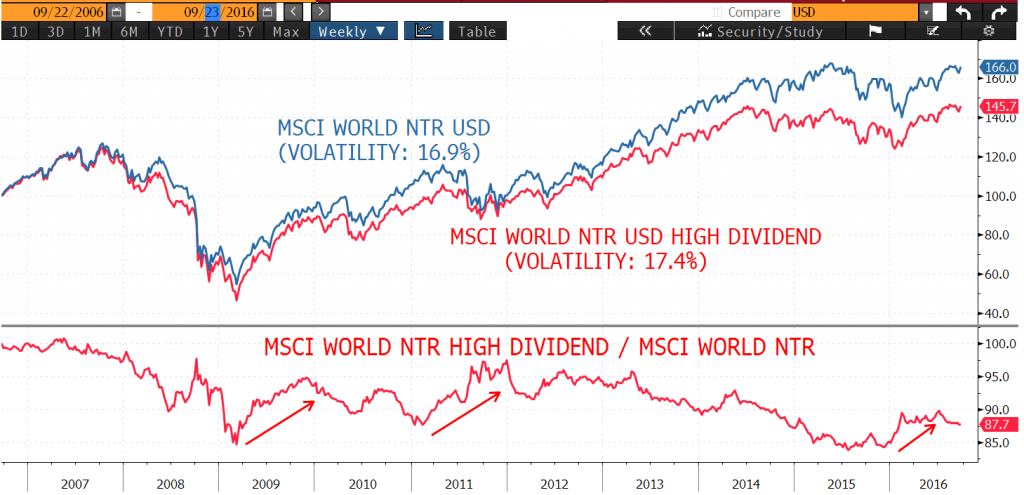
The graph above shows the performance of the MSCI World Net Total Return Index in USD vs. the performance of the MSCI World Net Total Return USD High Dividend stocks, and surprisingly the HDY strategy has underperformed by 12.3% accumulated during this 10 yr. period. To make matters worse, the volatility of the HDY strategy has been 17.4% vs 16.9% of the total index. Just the opposite of the initial expectations. Why such a counterintuitive evidence?

Let’s take the famous Gordon Growth Model to value a stock: Value = D / (k – g), where:
D: Next year’s expected annual dividend per share.
K: Discount rate of required rate of return.
G: Expected dividend growth rate (assumed constant)

When an investor blindly buys a HDY stock is missing the RISK of the stock (the K in the formula) and also missing the EXPECTED GROWTH rate (the g in the formula) of the dividend. For instance, many banks had had in the past high dividend yields that could not be maintained, hence the growth was negative and the shares fell dramatically during the 2008 crisis. Another typical case is the utilities and telecom companies that have high dividends but very low growth in their business, so they are not such good investments.

But, wait a second! We have all heard about successful ETFs linked to the S&P500 Dividend Aristocrat. This index has outperformed the S&P500 by 3.0% per year for the last 10 years. Isn’t this a contradiction? Apparently yes, but looking at the description of the index, they choose companies that “followed a policy of consistently increasing dividends every year for at least 25 consecutive years”. The key word is consistently increasing dividends or sustainable dividends.

One important remark in the graph is that despite the overall underperformance of a blind HDY strategy, there are periods where HDY stocks do relatively well as it has been the case during this year where investors flew to anything that looked like high yield asset: REITs, Fixed-Income HY, Emerging Market debt, Real Estate, and HDY stocks (see the bottom panel in the graph). Nevertheless, this outperformance has historically been short lived and this year also we have seen a relative peak performance by 30-June.

CONCLUSION

Investors should not follow blind simple strategies to invest like buying HDY stocks. Very often, these companies cannot maintain the dividend and eventually cut the dividend. For instance some HDY stocks today are Royal Dutch (7.2%), Ericsson (6.3%), Allianz (5.5%), Vodafone (5.2%), AT&T (5.1%), Rio Tinto (4.2%), Unicredito (5.9%), etc. Chances are that some of these companies will not maintain the dividend or if they do, the dividend will not grow for a while.

Just a little change in the strategy to INCREASING dividend stock companies might work much better like Nestlé, Medtronic, General Electric, etc. These companies have a lower dividend yield (2.9%, 2.0% and 3.0% respectively), but increasing over time.