« In theory there’s not much difference between practice and theory – but in practice, there is. » Yogi Berra.
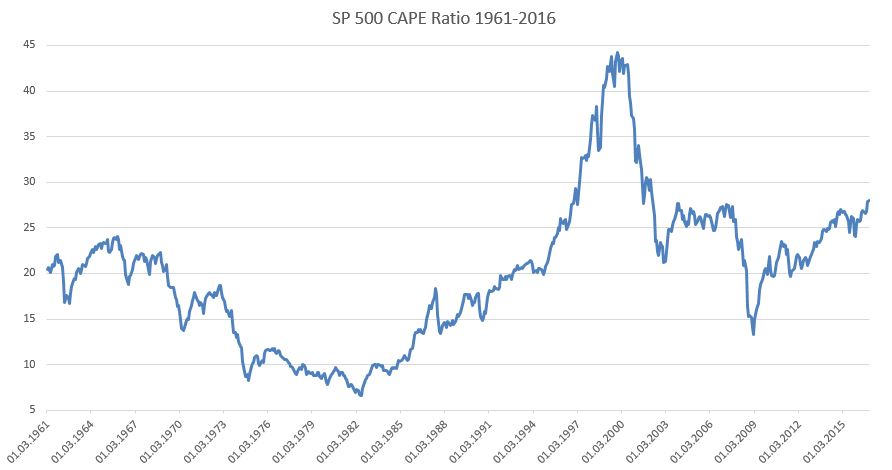
Source: Bloomberg, Notz Stucki
More and more warnings are being sent about the unsustainability of the current CAPE ratio for the SP500 and that a correction should occur, based on the very high level of the famous CAPE – the Cyclically Adjusted Price Earnings ratio.
This valuation measure of the equity market, brought by John Campbell and Robert Shiller in 1988, consists in taking a long term (typically 10 years) average of real earnings to calculate the Price Earnings ratio of a given equity index in order to smooth out short term profits’ volatility.
The economists did not set an absolute level of cheapness or expensiveness for their ratio, but the frequently mentioned levels are 20 (expensive) and 12 (cheap). Based on these numbers, investors should be wary of buying stocks when the CAPE stands above 20 (currently it is close to 28), and should on the contrary increase their exposure when the CAPE hovers below 12.
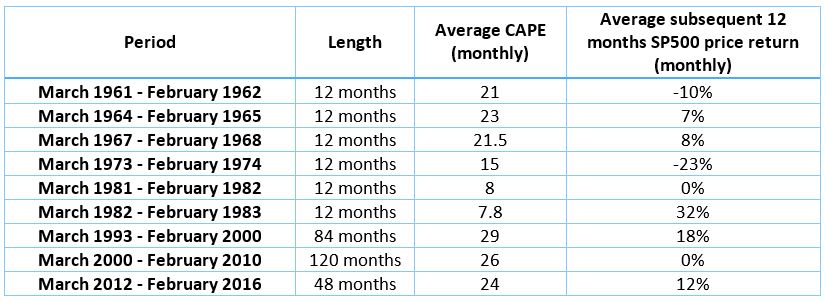
Our friend Jeffrey Saut, chief strategist at Raymond James Associates, has repeatedly questioned the accuracy of this measure during the last few years, so we’ve decided to crunch the numbers and simply look at some historical data to assess the relevance of the current warnings about the CAPE. The table here below recapitulates some periods with their associated CAPE and the monthly average of the subsequent 12 month price return on the SP500.
Based on these numbers, the conclusion is pretty straightforward: the predicting power of the CAPE for future returns is extremely poor if you set the 20 and 12 levels for dearness or attractiveness. Maybe the most striking example is between 1993-2000 when the average CAPE was 29, a record, but the average SP500 return of any given 12 month period during this time frame was a whopping 18%!
Even though CAPE is high today we think it has to be mitigated by a few factors:
Interest rates ar still at historical lows, propping up valuations.
Today’s CAPE includes the terrible 2008-2009 period when earnings were decimated, which should correct after 2019 CAPE calculations.
The SP500 today is less cyclical than it used to be. There’s dominant group of sector like non -cyclical Information Technology, Healthcare, Consumer Staples which were not so highly represented in the past, when Industrials, Energy and Consumer Discretionary had much higher weightings.
History seems to tell us that, as shown in the table, there’s no golden rule for assessing an alarming level for the CAPE.
The well-known CAPE theory would incite us to step away from US equities today, but we beg to differ.
Practice, as Yogi Berra said, does not necessarily go in sync with theory!
Notz Stucki January 2017 investment conference in Geneva : notes
On the occasion of its semi-annual Investment Conference in Geneva held on January 10th, 2017, Notz Stucki welcomed the following guest speakers:
Jeffrey Saut,Chief Investment Strategist & Managing Director, Equity Research, Raymond James Louis-Vincent Gave, Chief Executive Officer, Gavekal Christian Kopf, Director of Economic Research and Investment Strategy, Spinnaker Capital Group Juerg Nagel, Partner, Member of the Management Board, Head of Portfolio Management & Marketing, MIV Asset Management
Damiano Paterno Castello introducing the conference and our guest speakers
Here are the notes on the conference.
2016 was a year of political surprises, and in markets a year in which almost all managers struggled to keep up with the indices. The political upsets have been well covered. The poor relative performance of active managers has been widely discussed too. 2016 was a tough year for them as illustrated by considering that the Dow moved 31,000 points as calculated by the daily moves, yet ended the year almost flat. The speakers all pointed to signs of a better environment for active managers, and a few other reasons why the last few years have been so difficult. First the S&P has been remarkably strong, outperforming almost everything. For example in 2015 only US Real Estate and International Small Caps did better. More interestingly if the cash holdings in mutual funds and implementation costs are stripped out then 50% of active managers beat their relevant ETFs. Indices have been driven by a fairly narrow group of stocks. These dominate the ETFs. As these stocks become overvalued it makes sense to have active rather than passive managers. Rising interest rates will also favour active managers as company fundamentals will count for more. Likewise the withdrawal of QE will help as QE has gushed money into relatively few stocks which have developed a momentum trade of their own. As QE ends stocks will have to rely more on their earnings to rise. The conference was presented with two different views of the US. Raymond James presented an extremely bullish view, and then Gavekal gave a much more cautious view, though they remain positive on markets elsewhere.
Jeffrey Saut, Chief Investment Strategist & Managing Director, Equity Research, Raymond James @Notz Stucki Investment Conference
Raymond James’s view is that the market will continue to grind higher, albeit with periodic setbacks which are part and parcel of all bull markets. This is the most hated bull market in history and consequently most people are not in it. Yet bull markets usually endure for fourteen years suggesting that we are barely half way through this one. Encouragingly in July 2016 the market broke out to the upside after an eighteen month consolidation. Following the US elections and the Republican sweep of the Presidency and Congress there will be much more co-operation in Washington. This will enable the smoother passage of the proposed tax reform, and fiscal package. Alongside this the Fed is likely to raise interest rates at a glacial pace. As profits recover the market will transition from one driven by interest rates to one driven by earnings. Low inflation, rising earnings, and slow rises in interest rates will create a strong environment for a rising market. Employment is strong which will keep consumption strong and the US is underpinned by soaring levels of creativity and technological improvements. US energy is booming, the banks are in good shape, manufacturing is improving, and corporate balance sheets are healthy. In 2017 S&P earnings are forecast to be $131 which puts the market on a multiple of 17 times. However every 1% of tax cut can increase those earnings by $1.31 so if Trump achieves the 20% tax cut he’s proposed the earnings can increase by up to $26. The one area to avoid are the bond proxies as the bond bull market is probably over. Themes like waste collection, cyber security, e-commerce, defence and disruptive technology all have powerful tailwinds. With no sign of investor enthusiasm for the market and plenty of supports the market should grind higher.
Gavekal is not worried about two of the issues that are on many commentators worry list for 2017, namely Europe and China. Europe’s elections this year will be less dramatic than last year’s. Le Pen won’t win in France, and Merkel will win in Germany. With oil prices low and the euro weak the European economy is supported. Indeed it may be a coiled spring as having experienced little investment for ten years, if things do improve then the rebound could be dramatic. Europe can therefore be a source of upside surprise. China is in a year of political transition and will be focused on things being stable at all costs.
Gavekal’s concerns centre more on the US. These concerns are largely Trump related. The largest uncertainty is the question as to what extent his campaign rhetoric on reducing globalisation to protect American jobs will be put into practice. Potentially this is extremely harmful for a whole range of US companies and those in the rest of the world. If Trump really attacks globalisation it will be hugely disruptive. The risk of this seems uncomfortably high. It is hard to assess but given the high levels of US equities they seem vulnerable to having priced in the good news (not yet enacted), and to be ignoring any negatives which could be substantial.
Another concern is how the fiscal deficit will be financed. Trump starts his Presidency with US Government debt at $20 trillion. This debt has ballooned in the last few years and most of it was bought by the Fed, but they have stopped buying and are trying to unwind their position. US consumers or companies could buy it but the Trump plan envisages them to continue spending and to start to invest. Foreigners could but they have been selling US bonds recently. With the Fed shrinking its balance sheet and foreign Central Banks withdrawing money, liquidity is tightening. This could lead to problems but markets have been behaving as though we are entering a reflation. This is why Trump’s attitude is on globalisation and trade is so crucial. If the US turns protectionist then from the current exuberant position the markets’ reaction could be severe. If not, and Trump retreats from his rhetorical position and basically accepts the evolving trading relations of past decades, then the world may experience a similar cycle seen in the last forty years whereby a strong US lifts everywhere else, but particularly those export countries that sell there like North Asia. The US fiscal deficit will then expand to the benefit of the rest of the world. The binary nature of this situation shows the difficulty of this market. It is impossible to invest for both outcomes.
Christian Kopf, Director of Economic Research and Investment Strategy, Spinnaker Capital Group about
“A Rising Tide – Spinnaker Capital’s Outlook for Emerging Markets” @Notz Stucki Investment Conference
Markets have started strong in the first week of 2017, continuing the rally in the last two months of 2016. Mr Trump will be inaugurated as President in ten days and then we will start to see what his policies really are. Given the strength of the recent rally a consolidation is likely anyway. Whether the optimism of the markets is justified or whether the markets have got ahead of themselves will become evident as the new administration reveals itself during the course of the year. However the dynamism of US business should never be under-estimated and that will continue to present opportunities regardless of the politics. There are lower valuations in the rest of the world and following several gloomy years if Europe and Asia can achieve a more confident attitude then these markets may surprise. The US market may be the most hated bull market but virtually no-one owns Europe with confidence so any improvement in sentiment could lead to a better market.
Juerg Nagel, , Partner, Member of the Management Board, Head of Portfolio Management & Marketing, MIV Asset Management, about “Innovation in Medtech” @Notz Stucki Investment Conference