Chart of the Month – Swiss Equity Market: low volatility does not mean low risk!

Swiss Equity Market

Low volatility does not mean low risk!
Source: Notz Stucki

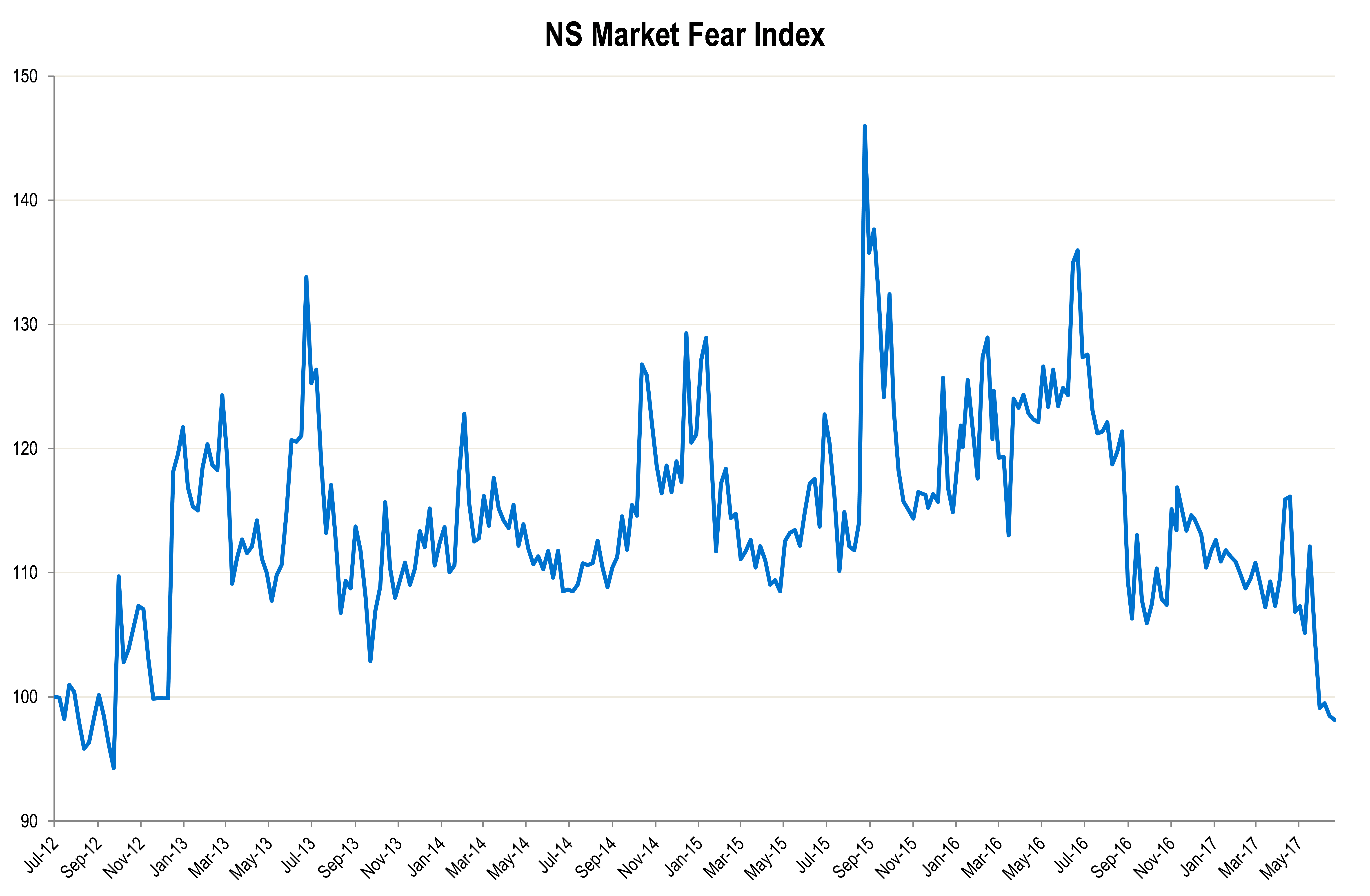
In an environment characterized but high political and policy risk, low levels of market volatility seem paradoxical. Volatility expectations for stocks and bonds have sunk to levels not seen since 1990. The VIX Index, which reflects a market estimate of future equity volatility, traded below the psychological level of 10 during 16 days this year (it only occurred 35 times since 1990) and the MOVE Index, which measures bond volatility, reached its all-time low recently.

There are different explanations for such a low volatility environment:

  1. On the macro side, low interest rates have encouraged investors to buy assets boosting their prices and in turn reducing volatility. With QE, central banks have put a floor under global asset prices with unprecedented balance sheet expansions. Finally solid economic growth with contained inflation means little reason for prices to move significantly.
  2. Market participants have changed their way of investing with large inflows into passive investment solutions like index-trackers and ETFs across all asset classes and the growing popularity of low volatility/diversified risk premia funds. Due to regulation, banks and insurers have invested massively into Government bonds to the detriment of “traditional risk” assets. Finally, algorithmic trading represents more and more of daily market volumes and machines are able to capture short term moves or inefficiencies, which mean smaller and fewer swings in prices before equilibrium is found.

But this doesn’t mean low risk! In asset allocation models, exposure to risky assets have increased over the last few weeks as low volatility is a mathematical driver of trade sizing codified in hundreds of billions of risk managed investment strategies. This false signal of safety could result is an inability for investors to appreciate how quickly market conditions  could change, which make trading strategies more vulnerable to unwinding and amplifying a risk-off event.

At the Notz Stucki Group, the Asset Allocation Committee decides of the asset allocation of managed portfolios. A balanced portfolio currently shows the following allocation: 50% equities, 25% fixed-income and 25% absolute return strategies with little cash.

The NS Market Fear Index (please see above) is a fusion of volatility indices on equities, fixed-income, currencies and commodities with a similar weighting in each asset class as we have in the balanced portfolio over time. The recent levels reached by the NS Market Fear Index are among the lowest for the last 5 years.

But we are aware of the situation and are acting accordingly. First, we adapt our asset allocation in function of the changing market environment and we don’t hesitate raising cash if needed. Secondly our main focus is active management and we are invested both internally and externally with flexible independent asset managers who try to preserve capital. Finally, we bought some puts in equity portfolios, have maintained a short duration in fixed-income products, decreased the exposure to managers with higher leverage and keep a 25% allocation to absolute return strategies which are less sensitive to periods of risk off and volatility spikes.
A mixed picture for low volatility names

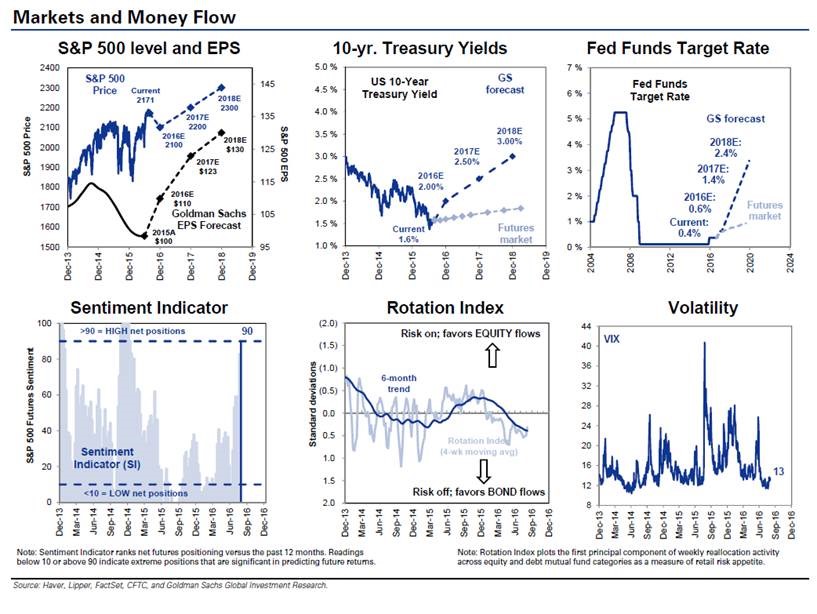
Low vol as a factor has had a mixed year. It outperformed at the beginning of the year during the spikes in volatility in Q1 but gave quite a bit back as the market moved from defensives to cyclicals, basic materials and EM names. That being said, the headline numbers don’t tell the whole story as it’s been a tale of two markets with a narrow group of names outperforming throughout the year whilst others have buckled under the weight of sector rotations…. a bifurcated outcome that acts in many ways as a fair representation of the impact a handful of large tech names have had on the overall market but with some notable differences.

Essentially, some low volatility stocks (mainly in consumer staples) were the direct beneficiaries of a market looking for high yielding, long duration assets. As the long bond went, so did these defensive names clearly benefitting from inordinately high levels of interest in bond proxies as rates languished in negative territory. Clearly the market placed a premium for long term dividend yield regardless of the fact that both top and bottom lines have been anaemic for years for these companies.

Markets and Money Flow

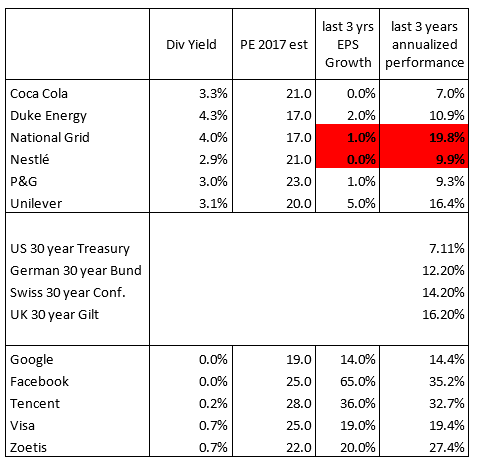
“The hunt for yield has been done with complete disregard for price” opines Pierre Mouton who manages several funds for Notz Stucki in Geneva and goes on to add “it has propelled some stocks to very high levels and leading to very good performance despite very poor to non-existent earnings growth. It is striking to see that in the examples below taken from DSM’s latest research piece, the performance of some defensive stocks tend to match, more or less, the performance of a 30 year bond issued by their country’s Governments: Coca Cola has shown a 7% CAGR the last 3 years, matching the US 30 year Treasury’s CAGR, National Grid 19.8% versus 16.2% for the Gilt and Nestlé 9.9% versus 14.2% for the Swiss Confederation.”

The lower part of the table below shows high growth companies, which have performed very well also, but with convincing earnings growth. Surprisingly Unilever, Nestlé, P&G and Coca Cola are more expensive than Google. Procter trades at 23x nest year estimated EPS versus 25x for Facebook despite immense differences in their earnings growth.

mixed picture
Source: DSM research

Again, it’s not the whole consumer staples group nor is it the low vol factor that is overpriced. Firstly, even though some names appear expensive, consumer staple’s premium to the market has stayed pretty much the same relative to the market and more importantly in line with their eps growth. Secondly, these are household names for the most part that been around for a long time, have by definition inelastic business models which appeals in a deflationary environment, are exceptional managers (Colgate being a clear leader here) and have quite a bit of potential in EM as the middle class grows in countries in India and China. Doesn’t that deserve a premium to both the market and newer (although high growth) digital business models in times of uncertainty? It probably does.

“Overall low volatility names are made up of 4 sectors with vol between 8 and 12% vs a market in the 17% range: consumer staples, telecoms, pharma and utilities. Even though these companies are high yielding and some lack eps visibility, as a group they’re certainly not overpriced relative to the market” states Angel Sanz who works alongside Pierre and acts as Notz Stucki’s chief strategist.

He goes on to conclude “healthcare trades at a discount of 6% to its historical 10 year PE multiple due to the ‘Hillary effect’, utilities are also at a discount which is below historical averages, and telecoms are growing earnings and are at market multiples. Low vol names did well obviously in January and February when volatility spiked but have levelled off since then as sector rotations continued unabated throughout the year. If the long bond were to correct on the back of inflation fears, it’s the whole market that will be affected and not simply the Proctors and National Grids of the world. They may even fare better due to the fact that they’re low volatility.”