The power of luxury: growth and resilience

The power of luxury: growth and resilience

Despite the current economic downturn, the luxury sector is resilient and continues to grow, while maintaining high margins.

In the current global landscape, luxury companies have established themselves as attractive and strategic investments. In the context of major challenges, the sector is emerging as a bastion of economic stability and a status symbol. Luxury giants such as Hermès and LVMH, iconic companies such as Prada and little gems such as Jungfraubahn are examples that not only embody luxury and exclusivity, but also offer solid financial opportunities.

Indeed, despite global economic fluctuations, the luxury sector has demonstrated a remarkable capacity for resilience and financial stability. Indeed, even in times of economic downturn, these companies often retain their value thanks to the loyalty of their wealthy customers. A case in point is Hermès, which has maintained steady growth over the years, even during recessions, thanks to the exclusivity of its products. In terms of performance, the company has even outperformed technology giants such as Meta and Alphabet, while exhibiting lower volatility.

A WELL-DIVERSIFIED SECTOR
Another great advantage that characterises most of the players in this industry is their diversified portfolio, which covers different brands and market segments, ranging from fashion and accessories to hotels and high-end drinks. LVMH is an excellent example of this diversification, with over 70 brands under its umbrella, including legendary names such as Louis Vuitton, Dior and Moët & Chandon. This strategy not only mitigates risk, but also facilitates geographic expansion by taking advantage of growth in emerging markets.

INNOVATING WHILE REMAINING TRUE TO THEIR HERITAGE
These companies also stand out for their ability to innovate while preserving their heritage and maintaining very high barriers to entry. Prada, for example, is renowned for its emphasis on innovation in design and materials, combining traditional Italian craftsmanship with modern technology. This fusion of innovation and tradition gives rise to unique products that appeal to demanding and loyal consumers, guaranteeing a steady stream of income and keeping the circle closed to just a few exclusive brands.

STRONG PRICING POWER
Finally, another attractive feature of luxury companies is their exceptional brand positioning, which enables them to set high prices, with margins far higher than those of their less exclusive competitors. This recognition is the result of decades of investment in quality, design and refined marketing strategies. Jungfraubahn, known for its exclusive destinations in the Swiss Alps, has established itself as an icon of luxury mountain tourism, attracting a global clientele in search of unique and unrivalled experiences.

Investing in luxury companies such as those mentioned above guarantees solid financial stability and effective diversification, thanks in part to their intangible value through prestige and exclusivity. Indeed, these companies not only market products, they also offer experiences and an ambitious lifestyle that continues to be sought after worldwide, particularly by the younger generation. For these reasons, acquiring luxury companies can be a strategic and profitable long-term decision.

Exploring luxury through a new lens of growth: sustainability

Exploring luxury through a new lens of growth: sustainability

Luxury is Flourishing

Recent financial reports from companies like Hermès, LVMH, Compagnie Financière Richemont, and Ferrari have impressed investors, showcasing their dedication and ongoing pursuit of profitability. According to Bain & Company, the global luxury market reached EUR 1.5 trillion in 2023, marking a robust growth of +8%-+10% compared to 2022 and setting a new industry record. Forecasts indicate continued growth, potentially reaching EUR 2.5 trillion by 2030. Investing in these assets has generated a return on investment in euros over the past five years of +424% for Hermès, +285% for Ferrari, +244% for LVMH, and +101% for Compagnie Financière Richemont, compared to a market increase of “only” +77% over the same period (MSCI World index). The strengths of these players, such as high entry barriers, effective margin management, strong balance sheets, pricing power, adaptability, and the rise of the emerging middle class, are unequivocally evident.

A Polluting Industry

After examining the financial potential of these investments, it’s crucial to also consider sustainability. How can the luxury sector position itself in this revolution? Can we truly envision a luxury sector that is more sustainable? Luxury, almost by definition, stands apart from highly polluting industries such as energy, mining, or heavy industry. However, some aspects of the luxury industry have poor environmental records. Focusing on personal luxury goods globally, which represent 24% of global spending on luxury items, it’s evident that the accessories and apparel industry performs poorly in this regard. For instance, over 8% of human-induced greenhouse gas emissions stem from the production and transportation of clothing and shoes (Quantis). However, it’s important not to equate luxury with fast fashion. Luxury purchases are inherently more considered in terms of sustainability, with each piece often holding sentimental value and encouraging intergenerational transmission, thereby reducing environmental impact.

Sustainability Embedded in the Consumer’s Consciousness

Today, sustainability plays a pivotal role in consumer purchasing decisions, especially among younger generations. Bain & Company predicts that by 2030, Generations Y and Z will represent between 75% and 85% of luxury market purchases. Generation Z undeniably places a high value on human connection, demonstrating a strong desire for meaningful interactions during their purchases. They also show a clear preference for products that are produced ethically and with consideration for the environment.

What Solutions Exist?

Aside from its participation in COP28, the luxury industry is increasingly demonstrating a commitment to social and environmental sustainability. Some major brands have already taken significant steps, such as discontinuing the use of fur and providing transparency regarding the origin of exotic skins. They are also exploring alternatives to traditional leather, such as vegan leather, mushroom leather, or cactus leather. These initiatives, integrated into a circular economy, include fabric resale platforms. Additionally, the second-hand market, favoured by younger generations, is expected to experience an annual growth rate of +7.2% between 2024 and 2032 (IMARC Group). Over the last three years, the market has experienced accelerated expansion, with Europe maintaining its position as the largest market and hard luxury accounting for over 80% of the total market share. This approach offers consumers the opportunity to acquire authentic luxury products at affordable prices while extending the lifecycle of these products within a circular economy.

The primary challenge lies in production and distribution chains. In this regard, initiatives such as the Aura Blockchain Consortium, launched nearly three years ago, aim to enhance traceability and transparency in these chains. Similarly, in the cosmetics industry, initiatives like TRASCE (Traceability Alliance for Sustainable Cosmetics) monitor the entire production process, from beauty product formulas to packaging, to support sectors in their ecological transition. Today, brands struggle to progress if they do not reduce their carbon footprint, both in packaging and production chains.

Engagement, transparency, traceability, and innovation in seeking alternatives are now crucial. By adopting these practices, the luxury industry can not only maintain its status but also shape a sustainable future. This enhances brand reputation, long-term resilience, and competitive advantage. Luxury is and will remain an attractive investment.


Past performance is not indicative of future results. The views, strategies and financial instruments described in this document may not be suitable for all investors. Opinions expressed are current opinions as of date(s) appearing in this material only. References to market or composite indices, benchmarks or other measures of relative market performance over a specified period of time are provided for your information only. NS Partners provides no warranty and makes no representation of any kind whatsoever regarding the accuracy and completeness of any data, including financial market data, quotes, research notes or other financial instrument referred to in this document. This document does not constitute an offer or solicitation to any person in any jurisdiction in which such offer or solicitation is not authorized or to any person to whom it would be unlawful to make such offer or solicitation. Any reference in this document to specific securities and issuers are for illustrative purposes only, and should not be interpreted as recommendations to purchase or sell those securities. References in this document to investment funds that have not been registered with the FINMA cannot be distributed in or from Switzerland except to certain categories of eligible investors. Some of the entities of the NS Partners Group or its clients may hold a position in the financial instruments of any issuer discussed herein, or act as advisor to any such issuer.  Additional information is available on request.
© NS Partners Group

Chart of the Month – Emerging markets’ affinity for luxury: a growing trend

Chart of the Month – Emerging markets’ affinity for luxury: a growing trend

Are you currently considering investment opportunities in emerging markets, all while maintaining a strong presence in assets listed on both European and American markets?

Luxury might just be the ideal solution.

While the luxury sector began the year on a strong note, it has faced challenges in the past two months. Luxury equities saw a decline in August and September, attributed to various factors such as increasing interest rates, disappointing economic data from China including renewed concerns about the real estate market potentially affecting consumer demand and shifts in analyst recommendations. These elements have introduced uncertainty regarding these growth assets.

Nevertheless, the financial results reported during the first half of the year provide an encouraging outlook and underline the resilience of this thematic investment. Many of the leading luxury groups are predominantly listed on European and American markets. However, it is essential to assess the extent to which their revenue is derived from emerging markets. A global estimate is therefore essential.

When focusing on the most prominent and distinguished luxury brands, such as LVMH, Hermès, Kering, Moncler, and Burberry in the realm of soft luxury category, Estée Lauder and L’Oréal in the beauty and cosmetics, Compagnie Financière Richemont for hard luxury, Diageo and Pernod Ricard for spirits, and Porsche and Ferrari for automobiles, it becomes evident that the Asia-Pacific region, predominantly represented by China, plays a significant role. This region accounts for over 25% of first-half 2023 revenue. Notably, Hermès leads the pack with a substantial 49% contribution, followed closely by Burberry and Moncler at 44%. Similarly, for Compagnie Financière Richemont and Pernod Ricard the dynamic market contributes 41%. Should we broaden our perspective to encompass other emerging regions, such as for example Latin America and Africa, we find that major luxury groups maintain exposure levels exceeding 35% to emerging countries.

Why are emerging countries catalysts? The luxury sector is buoyed by consumption, increasingly driven by the expanding middle class. Emerging countries are experiencing notable economic growth, with China leading the way and poised to maintain its position at the forefront. Asian consumers aspire to showcase symbols of success and embrace cosmopolitan lifestyles. This year, however, China experienced a slowdown in growth, recovering more slowly than expected. Nevertheless, by 2030, it is predicted that the Chinese, in their own country, will be the largest consumers of luxury goods, according to the renowned firm Bain and Company.

Another rapidly growing economy making headlines is India which is re-entering the global economic spotlight on several fronts. Although luxury consumption in India is currently relatively low, it is showing substantial growth, with a remarkable 26% year-over-year increase. Millennials are the driving force behind the flourishing luxury industry, as India boasts the largest share of millennial consumers among major international economies, exceeding 30%. This demographic profile, combined with rapidly rising urban household incomes, is fueling the swift growth of luxury consumption in India. The Indian economy appears to be on a robust growth trajectory, with one of the fastest GDP growth rates among major world economies.

Investing in emerging markets through well-established and well-managed European and American companies is a prudent strategy. The luxury sector has demonstrated resilience and is considered an all-weather investment. In many cases, the Price/Earnings ratio (P/E) for these companies has returned to pre-COVID levels. Historically, buying luxury company stocks during market corrections has proven to be a profitable investment strategy.


Past performance is not indicative of future results. The views, strategies and financial instruments described in this document may not be suitable for all investors. Opinions expressed are current opinions as of date(s) appearing in this material only. References to market or composite indices, benchmarks or other measures of relative market performance over a specified period of time are provided for your information only. NS Partners provides no warranty and makes no representation of any kind whatsoever regarding the accuracy and completeness of any data, including financial market data, quotes, research notes or other financial instrument referred to in this document. This document does not constitute an offer or solicitation to any person in any jurisdiction in which such offer or solicitation is not authorized or to any person to whom it would be unlawful to make such offer or solicitation. Any reference in this document to specific securities and issuers are for illustrative purposes only, and should not be interpreted as recommendations to purchase or sell those securities. References in this document to investment funds that have not been registered with the FINMA cannot be distributed in or from Switzerland except to certain categories of eligible investors. Some of the entities of the NS Partners Group or its clients may hold a position in the financial instruments of any issuer discussed herein, or act as advisor to any such issuer.  Additional information is available on request.
© NS Partners Group

Chart of the Month – A luxury everyone should afford

A luxury everyone should afford

Looking for a long-term investment that can withstand the economic turmoil? Well, consider luxury!

Marketwise, a year never resembles the previous one. The last five years have been subject to many headwinds: Covid-19, Ukraine-Russia conflict, rising interest rates, inflation, etc. Finding a sector, an investment that resists and performs during these different and multiple periods of shocks is difficult.

Luxury might be a good candidate. We like this sector for its all-terrain characteristics, its resilience and adaptability.

On the European market, luxury is gradually establishing itself as a major sector and is gaining in importance. It now represents 19% of the French CAC40 index and LVMH has become the largest European company with a market capitalization of EUR396 billion at the end of February. Luxury got off to a flying start in January, riding on the current optimism on China. Indeed, the Chinese Economy showed a strong rebound which bodes well for luxury stocks. China’s manufacturing purchasing managers’ index rose to its highest level since April 2012.

The luxury sector is vast and its definitions are multiple, which adds a layer of complexity and confusion. This is why one must remain selective and focus on the major luxury players that sailed on headwinds. We no longer need to demonstrate the quality of their balance sheets, their ability to report higher results and double-digit margins year after year and their success in offsetting one region with another. Their scale brings them access to the best designers and increasingly to celebrities.

For example, let’s have a look at an equally weighted portfolio composed of 4 large and well-known listed luxury companies. First component, LVMH the most diversified group active in soft luxury (clothes, shoes, leather goods, etc.), hard luxury (watches and jewellery), perfumes and cosmetics, wines, hotels, and more, then Hermès, active in soft luxury, Cie Financière Richemont in hard luxury, and finally Estée Lauder in cosmetics and beauty, the latter being more defensive by nature. The dollar-based basket composed of these 4 equally weighted stocks has outperformed the MSCI World, as well as the 11 Global Industry Classification Standard (GICS) sectors over the last 5 years.

Most luxury stock prices are at all-time high. What about the future? Today the valuation multiples are high but appear reasonable, as the estimated Return on Equity and Earning per share are higher for the luxury basket presented than for any sectors. Its fundamentals remain sound and intact, as China brings some good hope. Additionally, one should keep in mind that inflation is still present and that luxury companies have strong pricing power, as demand for luxury goods is fairly inelastic to price. This means that they can protect their margins. But what would happen to the luxury sector in times of recession? The sector’s consumer base is wider spread and less sensitive to economic slowdown than most and it benefits from a simultaneously defensive and growth profile. In other words, the sector is able to grow profits whatever the economy throws at it. In order to capture the right moment, one entry signal to watch closely is the luxury premium. After shooting up, the premium has fallen back to historical levels, so now could be a good buying opportunity.

It is quite impossible to predict the coming year, but one thing is certain: investing in luxury and adding on/doubling down on this investment on eventual corrections seems to be an interesting strategy.

“Luxury will be always around, no matter what happens in the world”. Carolina Herrera


Past performance is not indicative of future results. The views, strategies and financial instruments described in this document may not be suitable for all investors. Opinions expressed are current opinions as of date(s) appearing in this material only. References to market or composite indices, benchmarks or other measures of relative market performance over a specified period of time are provided for your information only. NS Partners provides no warranty and makes no representation of any kind whatsoever regarding the accuracy and completeness of any data, including financial market data, quotes, research notes or other financial instrument referred to in this document. This document does not constitute an offer or solicitation to any person in any jurisdiction in which such offer or solicitation is not authorized or to any person to whom it would be unlawful to make such offer or solicitation. Any reference in this document to specific securities and issuers are for illustrative purposes only, and should not be interpreted as recommendations to purchase or sell those securities. References in this document to investment funds that have not been registered with the FINMA cannot be distributed in or from Switzerland except to certain categories of eligible investors. Some of the entities of the NS Partners Group or its clients may hold a position in the financial instruments of any issuer discussed herein, or act as advisor to any such issuer.  Additional information is available on request.
© NS Partners Group

Luxury: diversity and all-terrain performance

Luxury: diversity and all-terrain performance

Why not invest in luxury? The sector has proved its resilience and adaptability.

Like other industries, luxury was hit hard in 2020 by lockdowns and the abrupt stop of international travel. After bouncing back in 2021, luxury stocks ended 2022 in the red. This negative year, however, gave investors some good opportunities. The big luxury groups saw their valuations first rocket then settle back. Multiples now look high but remain reasonable.

Luxury a big winner from China’s reopening

Luxury got off to a flying start this year, riding the surge of optimism on China, a big driver for the sector. Sales had actually grown strongly in the United States and Europe last year, despite China being locked down due to its zero-Covid policy. China’s reopening and the return of domestic and international flights now point to a catch-up surge and, for the luxury sector, a year of rising sales and revenue.

Luxury premium back down despite its 5-year outperformance

The last five years have included plenty of headwinds: Covid-19, the war in Ukraine, rising interest rates, inflation, etc. Despite this, over the last 5 years Hermès, LVMH and Ferrari stocks have gained +223%, +177% and +129%, respectively. The same goes for earnings per share, up +155% at Hermès and LVMH and +80% at Ferrari. Over the same period, luxury as a sector outperformed the market by +15.8%. Of course, some sub-sectors were impacted, particularly travel and hospitality which are heavily correlated with tourism.

Luxury stocks traditionally trade at a premium to the market. What happens to this premium can be used as an entry signal. And, after shooting up, it has fallen back to attractive historical lows.

Diverse geographies and consumers

Investing in luxury means investing in a sector sheltered by high entry barriers, in companies with sound and healthy balance sheets, growing revenue and usually double-digit margins. Less obviously, it also gives you exposure to emerging markets. Hermès, Kering, Burberry, Salvatore Ferragamo, Compagnie Financière Richemont and Swatch, for instance, make between 38% and 47% of their revenue in Asia.

Until recently, most of the shopping by this clientele was done while travelling abroad. To expand local consumption in China, the luxury majors built up local exposure, opening multiple stores and creating websites to target these markets. China’s reviving consumption is therefore good news, particularly as Chinese consumers have built up billions of yuan in unspent savings over the last three years.

Luxury can cope with anything

Inflation is still a factor. However, companies in the luxury sector command strong pricing power as demand for luxury goods is fairly inelastic to price. This means they can protect their margins. But what happens to the luxury sector in times of recession? The sector’s consumer base is wider spread and less sensitive to economic slowdown than most and it benefits from a simultaneously defensive and growth profile. Luxury houses are cash rich and free to make acquisitions. Groups are diversifying, led by the biggest of them all LVMH, which is active in soft luxury (clothes, shoes, leather goods, etc.), watches and jewellery, perfumes and cosmetics, wines, hotels, and more. This year, Kering said it was creating a strategic division to break into the beauty sector. Thanks to a huge and expanding consumer base, the sector has room to grow 60% by 2030, according to consultants Bain & Company. Generation Z is in the front line. Gen Z-ers are demanding and buy their first luxury goods at around 15, 3-5 years younger than their Millennial predecessors. Generation Z and the upcoming Generation “Alpha” (younger but with similar consumption patterns) should make up around a third of the luxury market by 2030. In response, luxury is adapting, digitising and expanding its footprint on social media and in the metaverse.  It is also embracing environmental and social issues, prioritising transparency in processes, supply lines and management of second-hand goods.

So the constantly evolving luxury sector is doing rather well and its fundamentals remain sound and intact. It remains resilient and able to grow profits whatever the economy throws at it.


Past performance is not indicative of future results. The views, strategies and financial instruments described in this document may not be suitable for all investors. Opinions expressed are current opinions as of the date(s) appearing in this material only. References to market or composite indices, benchmarks or other measures of relative market performance over a specified period of time are provided for your information only. NS Partners provides no warranty and makes no representation of any kind whatsoever regarding the accuracy and completeness of any data, including financial market data, quotes, research notes or other financial instruments referred to in this document. This document does not constitute an offer or solicitation to any person in any jurisdiction in which such offer or solicitation is not authorized or to any person to whom it would be unlawful to make such offer or solicitation. Any reference in this document to specific securities and issuers are for illustrative purposes only, and should not be interpreted as recommendations to purchase or sell those securities. References in this document to investment funds that have not been registered with the Finma cannot be distributed in or from Switzerland except to certain categories of eligible investors. Some of the entities of the NS Partners group or its clients may hold a position in the financial instruments of any issuer discussed herein, or act as advisor to any such issuer. Additional information is available on request.

© NS Partners Group

Chart of the Month – Equities: focus on sectors & themes

Equities: focus on sectors & themes

Source: Notz Stucki

In the early days of Notz Stucki, the country was an important factor to cherry pick the best companies for an equity portfolio. Capital markets were more isolated, trade flows were smaller, interest rates differed among countries, and some countries had specific political risks. As a consequence of that, the top-down investment process started with the country view and, after that, sector view and stock picking.

As the economies became more integrated from the trade point of view and from the capital market point of view, the country notion became less important. The birth of the euro for instance, changed the nature of equity investments and many investors started to consider the Eurozone or Europe as one region to invest, and not specific countries.

Time went by and when we look at the market today, we notice that sectors have become the dominant factor to explain performances:

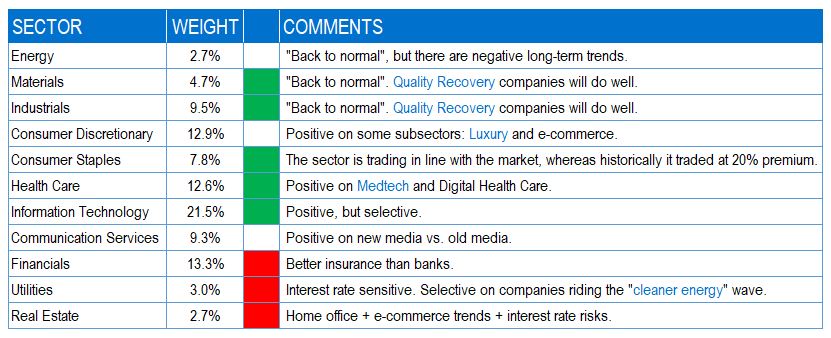
  • US energy companies lost 37.6% in 2020 and European energy companies lost 37.2%.
  • Information Technology in the US gained 44.5% and the Asian IT companies gained 51%.
  • Companies linked to “cleaner energy” have performed very well regardless of their geographical exposure.

Why have sector/themes become a dominant factor rather than countries/regions?

  • Trade flows for goods have increased over the last decades.
  • Flow of services has increased over the last decades.
  • Capital markets are more integrated.
  • Big multinational companies are dominating the market so the domicile of the company may differ from the origin of its revenues. For instance, Roche (Swiss company) has 50% of its sales in the USA, 21% in Asia, and 22% in Europe.
  • The asset management industry has recently focused more and more on investment themes like Digitalisation, Circular economy, Health, Wellness, Water, Artificial Intelligence, Cloud, etc, and those investments are free to select companies from all the regions.

IMPLICATIONS FOR NOTZ STUCKI INVESTMENT PROCESS AND MARKET VIEWS

With this more explicit focus on sectors and themes, we have modified our recommendations accordingly, so we have the following expectations at the beginning of the year:

  • Positive view on Materials and Industrials to play the theme: “Back to normal”. With 3 vaccines already approved for emergency use, we expect the economies to recover by the 2H21, so we have this positive view on these cyclical sectors.
  • Positive view also on Consumer Staples, MedTech and Information Technology. They have attractive PEG ratios versus the world equity index, and they enjoy positive trends for the next decades.
  • We still hold a negative view on Financials, a sector that is negatively affected by low rates and that is being attacked by many new Fintech companies who would like to “eat” the profits of, specially, the banks.
  • We also like the theme of Cleaner Energy, a cross-sector theme that takes companies from Information Technology, Industrials, Utilities and Materials.

After the good rally in equities in 2019 and 2020, the focus on sectors and themes will help investors navigate a challenging period with demanding valuations in many companies.


Past performance is not indicative of future results. The views, strategies and financial instruments described in this document may not be suitable for all investors. Opinions expressed are current opinions as of date(s) appearing in this material only.

References to market or composite indices, benchmarks or other measures of relative market performance over a specified period of time are provided for your information only. Notz, Stucki provides no warranty and makes no representation of any kind whatsoever regarding the accuracy and completeness of any data, including financial market data, quotes, research notes or other financial instrument referred to in this document.

This document does not constitute an offer or solicitation to any person in any jurisdiction in which such offer or solicitation is not authorized or to any person to whom it would be unlawful to make such offer or solicitation. Any reference in this document to specific securities and issuers are for illustrative purposes only, and should not be interpreted as recommendations to purchase or sell those securities. References in this document to investment funds that have not been registered with the FINMA cannot be distributed in or from Switzerland except to certain categories of eligible investors. Some of the entities of the Notz Stucki Group or its clients may hold a position in the financial instruments of any issuer discussed herein, or act as advisor to any such issuer.

 Additional information is available on request.

© Notz Stucki Group

Chart of the Month – Luxury: resilience of the 3 musketeers

Luxury: resilience of the 3 musketeers

Marketwise, a year never resembles the previous one. Nevertheless, one element persists: the ability of the major Luxury Goods companies to sail on headwinds, to adapt and resist. Many events have put the market under pressure this year: political and economic episodes, sectoral rotations, trade war, uprising in Hong Kong… Some of these events have had a greater impact on companies in the luxury sector (trade war between the United States and China, riots in Hong Kong, announcement of taxes on imports from the European Union, slowing in China). There is concern about the ability of these companies to overcome this pressure, with the Chinese consumer being the largest consumer in Luxury Goods and Hong Kong being a central attraction for Asian consumers.

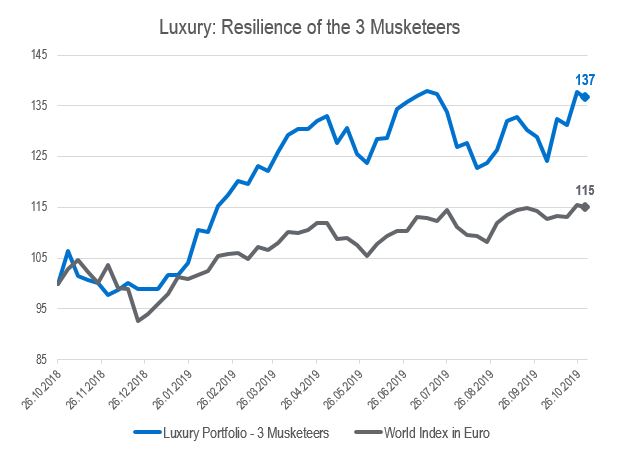
In the last 12 months, a portfolio composed of the equally-weighted three big luxury goods companies outperformed the market significantly, after recovering December’s losses much faster than the latter. These three major luxury goods companies, none other than LVMH, Hermès and Kering, published their third quarter results in October. The observation is the same for all: the three recorded strong sales growth in the third quarter (which includes the riot period in Hong Kong and its escalation). Of course, sales in Hong Kong weakened, but they were completely offset by the other Asian regions, resulting in a strong acceleration of growth in Asia. This region represents between 40% and 50% of the sales of these three companies. These companies have put great efforts into expanding this region of the world, developing e-commerce and opening stores to increase local consumption.

Luxury has a bright future ahead, with a moderate premium today over global equities. We are close to 9% and have already reached much higher levels several times in the recent past (20%). A low premium is generally a good indicator to enter this sector of opportunity.

Stock prices react quickly, these companies keep surprising by their level of margins, their great ability to diversify within their business lines and to adapt to consumer demand. The headwinds will still be very strong in the last quarter of the year but growth is on track! A lesson to learn: these three musketeers still have some nice things to show and it would probably not be a bad idea to buy them at market corrections.

Chart of the Month – Sustainability practices gained traction in luxury

Sustainability practices gained traction in luxury

Source: Bloomberg, RobecoSAM, Notz Stucki

Environmental, Social and Governance (ESG) are today on many people’s lips. This scatter chart shows an interesting attribute of Luxury. When it comes to deep analysis of those ESG criteria, we find a lot of specialists, and we have selected the RobecoSAM Total Sustainability rank(1) to illustrate our purpose.

To compose our Luxury portfolio, European, American and Swiss Luxury conglomerates have been selected. First, in Euro zone, the now very famous KHOL (Kering, Hermès, l’Oréal, and LVMH), Cie Financière Richemont for Switzerland and Estée Lauder, Tiffany and Tapestry (Coach, Kate Spade, Stuart Weitzman) composed our American Luxury leaders. We compare this portfolio and all its components to the MSCI World Index, in abscise the RobecoSAM Total Sustainability Rank, higher score is the better, and on the y-axis, last 5Y performance in USD.
This Luxury portfolio (equally weighted positions) outperformed the MSCI World Index both in last 5Y performance and Sustainable issues.

GOOD NEWS

The Luxury sector is resilient, enjoys exceptional fundamentals, strong balance sheets, and growth potential. Companies pursue restructuring. After falling into disgrace with some sales issues and economic slowdown, Hard Luxury (Watches and Jewelry) subsector is now in better shape and Swiss watch exports are now positive for the 15th month in a row. A new wind blows on Luxury. Companies have to adapt to younger customers who are more demanding, more sensitive to the world in which they are growing, evolving, building their future. Respectability, Traceability, Equality, Impact are now common sense. The number of people dedicated to sustainable development in Luxury companies is increasing and radiates in each business, product and strategy.

Luxury looks like a good investment, offers growth and sustainability. There is no reason not to put more effort in Sustainable, ESG factors that are real contributors to the performance.


(1) RobecoSAM is an investment specialist focused exclusively on Sustainability Investing. A company’s Total Sustainability Score encompasses three dimensions (Economic, Environmental and Social). Scores are ranged from 0 to100.
RobecoSAM Total Sustainability Rank for MSCI World Index is weighted average of scores of all companies.

Chart of the Month – Looking for an Investment Opportunity? Think Luxury!

LOOKING FOR AN INVESTMENT OPPORTUNITY? THINK LUXURY!

Source: Bloomberg, Notz Stucki

In Geneva, January is synonymous with fine watchmaking, an opportunity for brands to present new watch models and innovations.  The SIHH just closed its doors, let’s take a moment and talk a little bit about the great potential we see in Luxury.

The chart above compares total returns in local currencies of 2 indices and 2 luxury companies over a 5-year timeframe. When it comes to indices, the MSCI World Index is a proxy for the entire market and the S&P Global Luxury Index is composed by 80 of the largest publicly traded companies engaged in the broad luxury sector. Then, we have Swatch Group, a pure Hard Luxury player (Watches and Jewellery) and LVMH, a well-diversified luxury company (Leather goods, Apparel, Wines & Spirits, Cosmetics and Watches and Jewellery). The result is clear: the Hard Luxury player Swatch had a negative 1.69% total return over the period versus +105.63% for LVMH and +39.09% for the luxury index.

What conclusions can we draw from all this? First, the selected timeframe can be split in two phases: after a good period of outperformance the luxury market stopped its rally and reached its peak in February 2014. What really brought the performance down? Beyond the turmoil provoked by the Greek debt crisis, falling oil prices, potential recession, China’s economic slowdown and production overcapacity…the performance was brought down by one subsector in particular: Hard Luxury. For Hard Luxury players (see Swatch as an example), the spectacular fall into disgrace started in February 2014 and has lasted until recently. What happened? The subsector encountered some sales issues. Companies grew too aggressively during the first phase, outperforming by far the market, but have had to deal since then with falling sales and exports, restructuring and currencies issues. The sector has now entered a transition period, hopefully reaching a stabilisation in a 1 to 2 years’ horizon.

Fortunately for the Luxury sector, it has been driven during the last 2 years by other subsectors as Cosmetics, Leisure and Soft Luxury. Companies are well-structured and have offered slower but more secure and healthier growth in all their divisions. Let’s take the example of LVMH. After underperforming in the first phase both the market and the luxury sector, the company has been driven by its diverse divisions, the good performance of Soft Luxury (apparel, leather goods), Cosmetics and Wine & Spirits and has taken advantage of the lower euro cost base. The question now being asked is can it last forever? Probably not at this pace; as investors we have to remember that subsectors rotate over time and precisely Soft Luxury may fade in time or slowly give way to others. Winners may become losers as it happened in November 2014. The Luxury sector, due to its resilience and its recent turnaround, looks like a good investment. This sector enjoys exceptional fundamentals, strong balance sheets, and growth potential, and reserves some pleasant surprises. Companies have started restructuring, emphasis has been put on luring each generation (baby boomers, millennials…). PEs are stable, EPS continue to stabilise, in relative terms, Luxury has a similar PE (16x results) but a higher expected ROE than the market.

Gone are days when Luxury was an unloved sector. The trend is moving in the right direction for the sector: January performance for the Luxury index was 4.80%, outpacing the MSCI World Index by 236 bps…

Market Research on Watches

Since the dawn of humanity, we’ve been fascinated with time. For our Neolithic ancestors who built Stonehenge by carrying 30 ton monoliths for hundreds of miles and assembling them in a semi-circle, it was actually a matter of life and death. Having the ability to tell with infinite precision the time of both summer and winter solstices gave them an indication of when best to plant crops and therefore eat and survive. Although intangible and meaning different things too many people and cultures, we can all agree on one thing regarding time: it’s crucial.

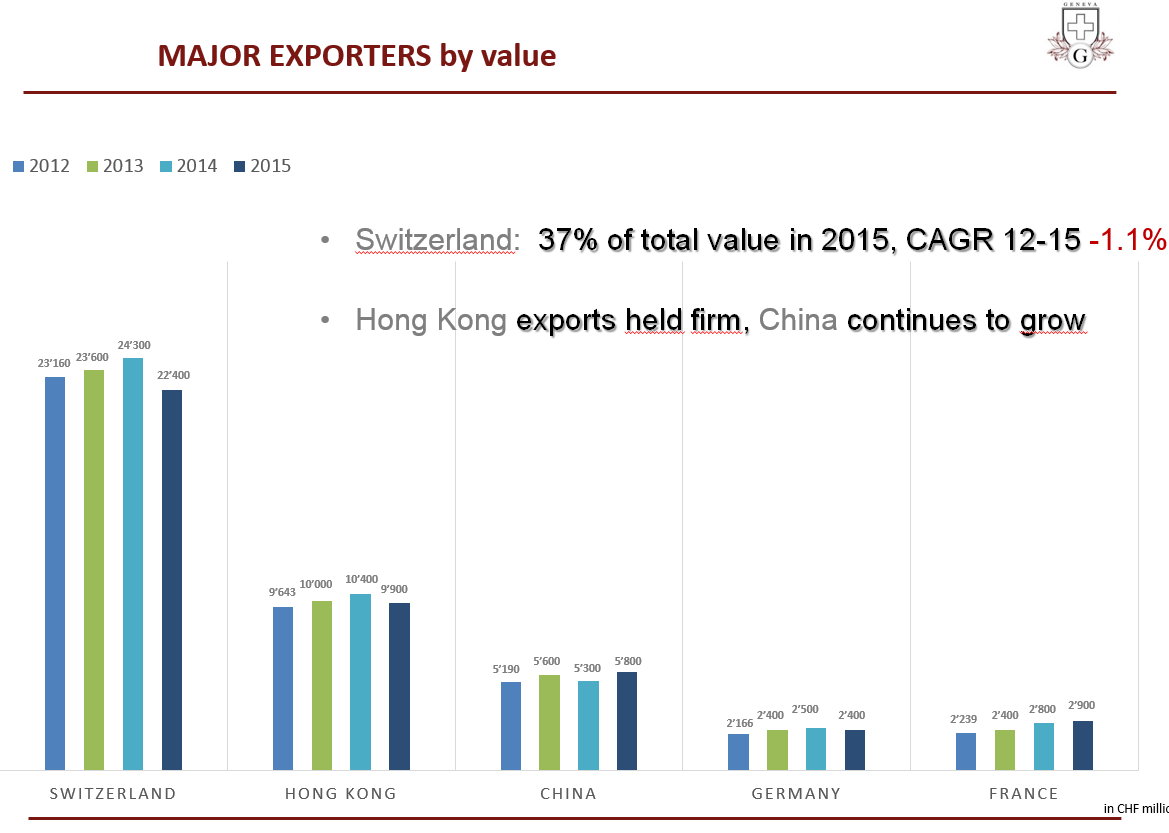
Therefore it’s no surprise this significance needed to be reflected in the value of the object that was used to tell time. From ancient Egyptian sundials, to the Rajput’s in Rajasthan who associated precious gems with specific periods of the day, all the way to the intricate time pieces of today, there’s been huge amounts of desirability associated with these objects. It’s no wonder the Swiss today export close to $22BLn worth of luxury time pieces a year. It’s also evident that nations who are finding new sources of wealth want to express it through high end watches. For men today, at least in the West, it can be argued it’s one of the only pieces of jewelry they can wear.

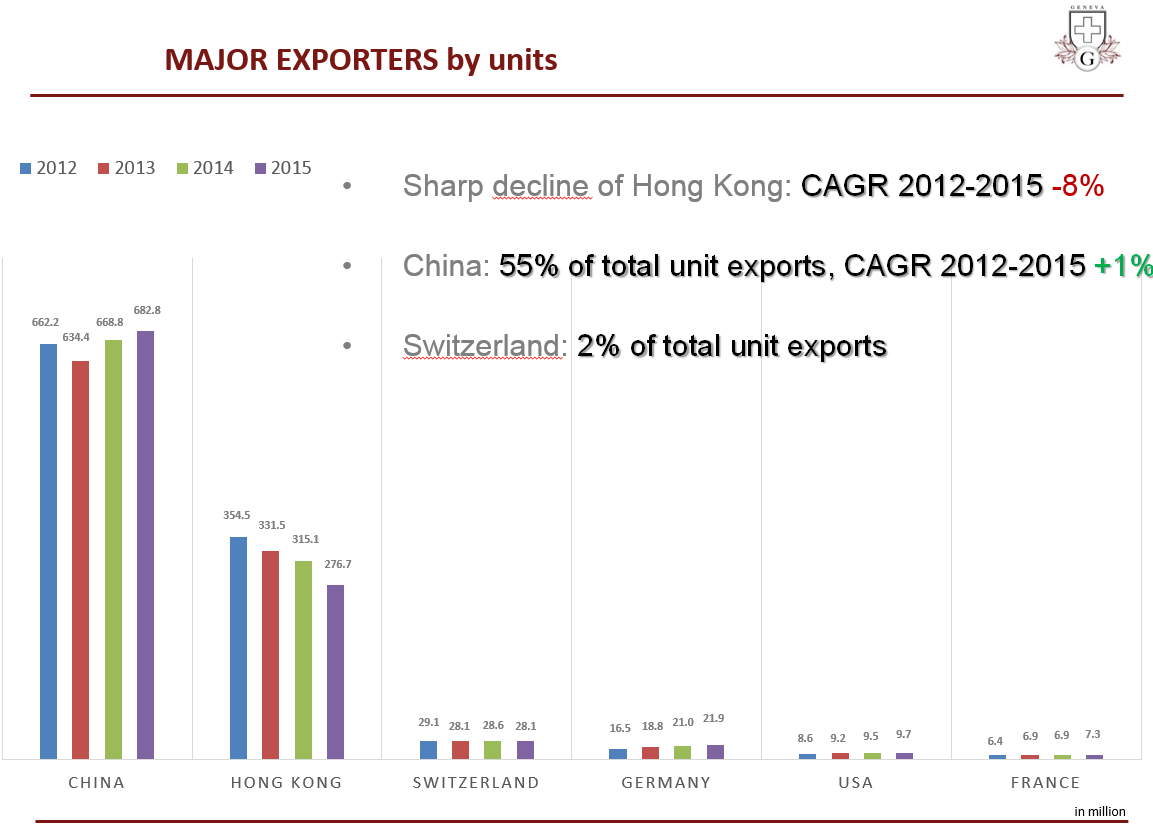
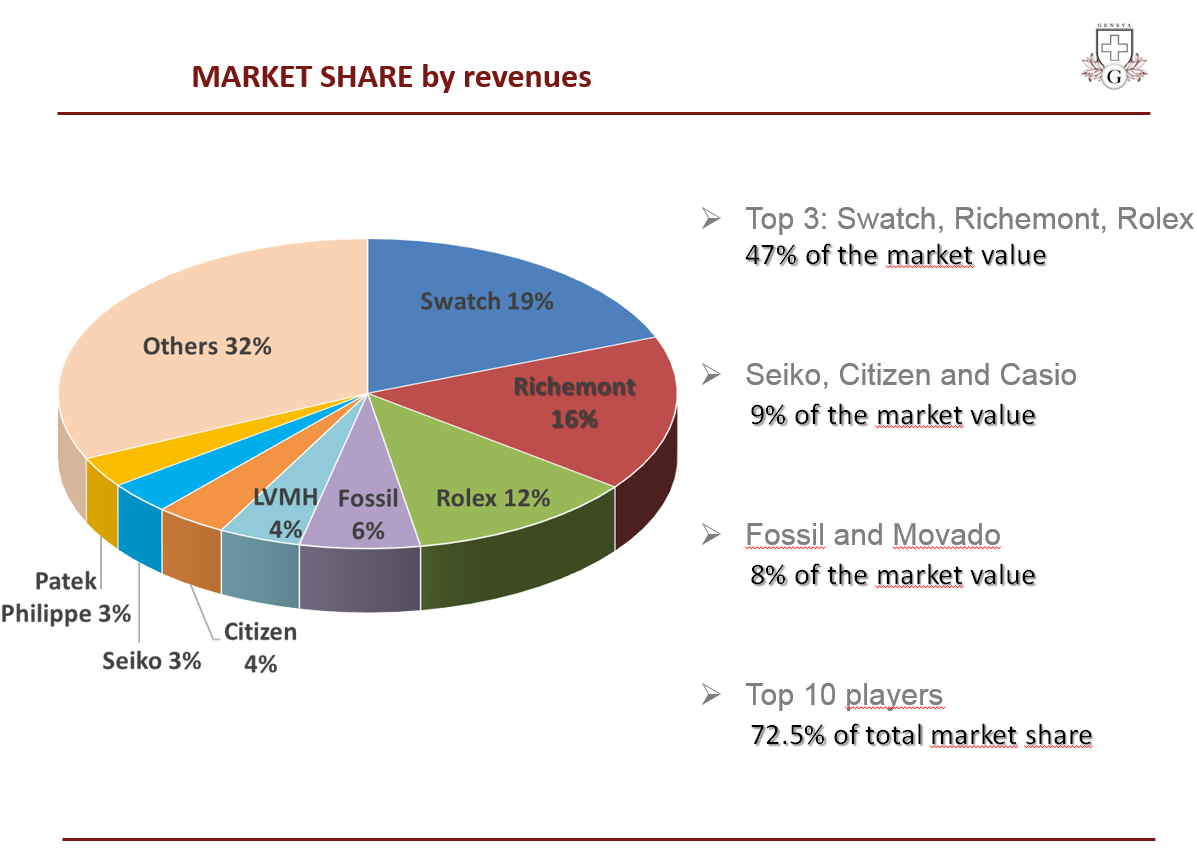
That being said, today’s market for watches is as complex as the concept of time itself. A large market (world production stands at 1.2Bln units in 2015 with a global value of $50Bln), there is quite a bit differentiation between players. China for instance acts as 1st producer with 683MM units sold in 2015 but with Switzerland the 1st exporter in value with $22Bln in 2015. Anecdotally, the average price of a watch exported by China in 2015 is $4 whilst the average price of exported Swiss watches for the same year was $748.

Source: Genthod Wealth Management

By revenue, Rolex is by far the world leader at CHF4.5Bln in 2015, 3 times larger than Omega the second in line. Cartier is third and among those three top brands, the average selling price is over CHF 5K. To the list of names in the affordable category, we now need to add the growing market for smartwatches. There were 79MM wearable devices (all categories of smartwatches) sold in 2015 which outsold Swiss watches in Q4 by 8.2MM units to 7.9MM. The average price of a smartwatch is $100-$800 impacting entry level players in the ‘conventional’ watch market the most. Apple is the leader in «Lifestyle» and even though they don’t break down their numbers our research seems to indicate that between 10-15mln of units were sold last year for $5-12Bln in revenues. Fitbit is the leader in «health» with 21mln of units sold for $1.8Bln. We assess the market can grow by +40% in 2016 and +20% in CAGR expected until 2020.

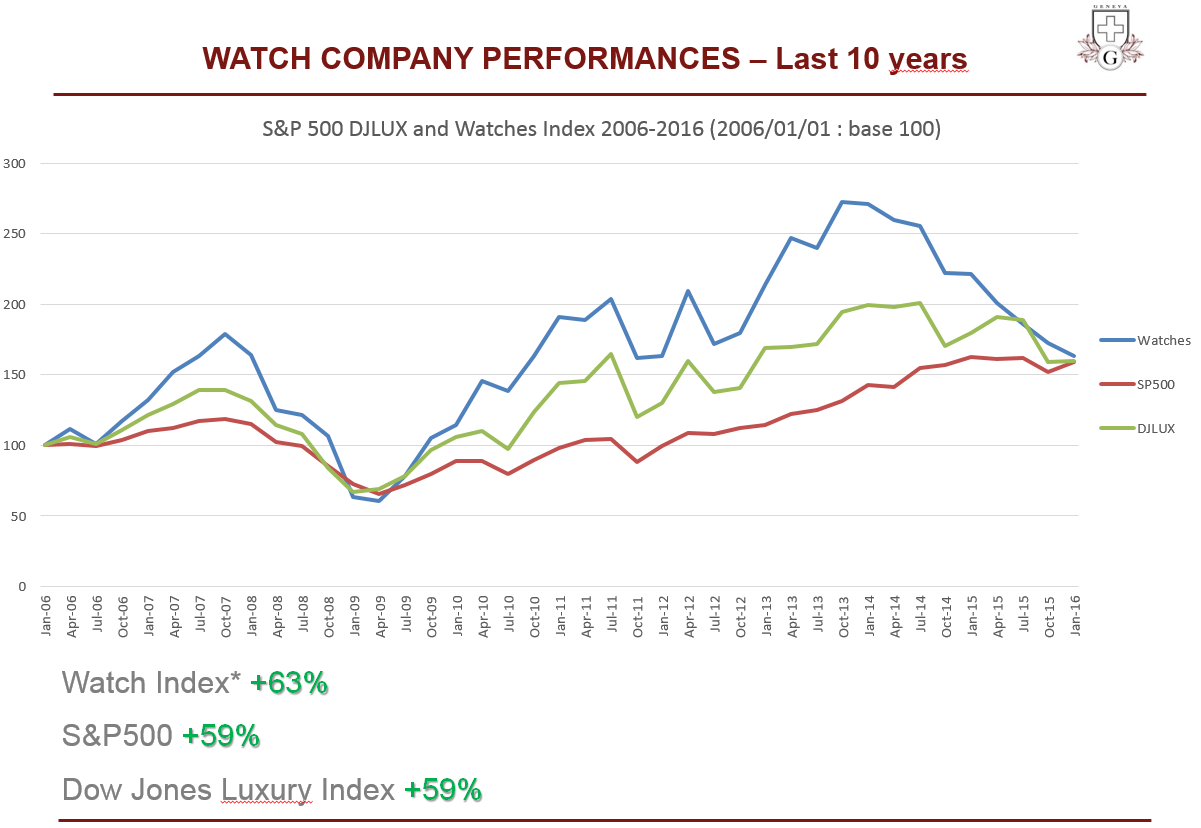
Due to all the varying elements mentioned above, there’s been quite a bit of disparity within the group as relates to individual stock performance. Timex, headquartered in India, was up 178% last year, whilst Richemont and Swatch were down 19% and 21% respectively. Over the past 10 years an equal weighted index of watch company equities slightly outperformed the S&P 500 (63% vs 59%) but this doesn’t tell the full story… there have been periods of marked underperformance as well as outperformance. PEs for sector stand at a 2% premium to the MSCI World but historically have commanded a 20% premium. Only once did the index fall below the S&P and that was during the Sep ’08 to Jan ’09. The main period of underperformance started in 2013 and was triggered by the Chinese premier XI Jinping’s drive against corruption. As ostentations signs of wealth had to be curbed by the Chinese elite overall, sales in China slumped leading to marked underperformance of the sector. At present we feel this information is fully discounted in the stocks and we can expect a period where EPS for watch makers, especially for products between $1K and $5K to start picking up.

Source: Genthod Waelth Management
Source: Genthod Waelth Management, Fédération de l’industrie horlogère suisse

Franck Muller’s data and surveys show that even though Hong Kong is a ‘nightmare’ for watchmakers and the US is still in decline, but the average unit price is higher in the States. Again, even though entry level products are impacted by smartwatches and ‘absolute luxury’ is facing tough times, sales of products between $1K and $5K were resilient in Q1 2016. In Europe,  Franck Muller see a mixed picture with the UK continuing to outperform but with Belgium and Switzerland still facing difficulties… Japan experienced lower growth than in 2015 (but on tough comparisons) and Canada remains robust. In parallel, Swiss Watch Exports data showed solid growth in Europe with Germany the best performer followed by the UK.

To conclude, it appears to us high-end luxury companies are less innovative and over exposed to Asia which remains a problem. On the other hand, accessible luxury will be the winner as much more dynamic than the rest (TAG, Movado). Entry-level companies have diversified in smartwatches but they need to gain more credibility as it’s not their core business and face challenges to work with new partners (Intel, HP, Google). Smartwatches will grow fast (there are few new players) especially for «Lifestyle» SKUs. By way of names we like, in the US, there’s Movado thanks to their smartwatch offering and their diversified entry-level license business. We’re concerned with Fossil though, with a concentrated license business (MK, EA) and deteriorating margins. In Europe, we like Richemont thanks to their diversified watch portfolio (from accessible to absolute luxury) and their strong euro-based jewelry business. We’re extremely cautious on Swatch due to high exposure to the Swiss franc and new competition from smartwatches. In Asia, we like Citizen as it benefits from Chinese tourism in Japan and high rate of ‘newness’.  We would also avoid hard luxury distributor, Emperor Watch & Jewelry, as wealthy Chinese consumers shun Hong Kong.


*To tap into this theme as well as help our clients gain exposure to the global luxury sector, Notz Stucki and luxury watch maker Franck Muller have entered into an association and launched a Luxury goods equity fund, the “DGC – Franck Muller Luxury Fund“.  The main impetus is to focus on companies with strong brands that have the ability to protect their margins through pricing power… a proposition that makes much more sense in our view in a deflationary environment. Please feel free to contact us if you have any questions regarding the fund or the above.