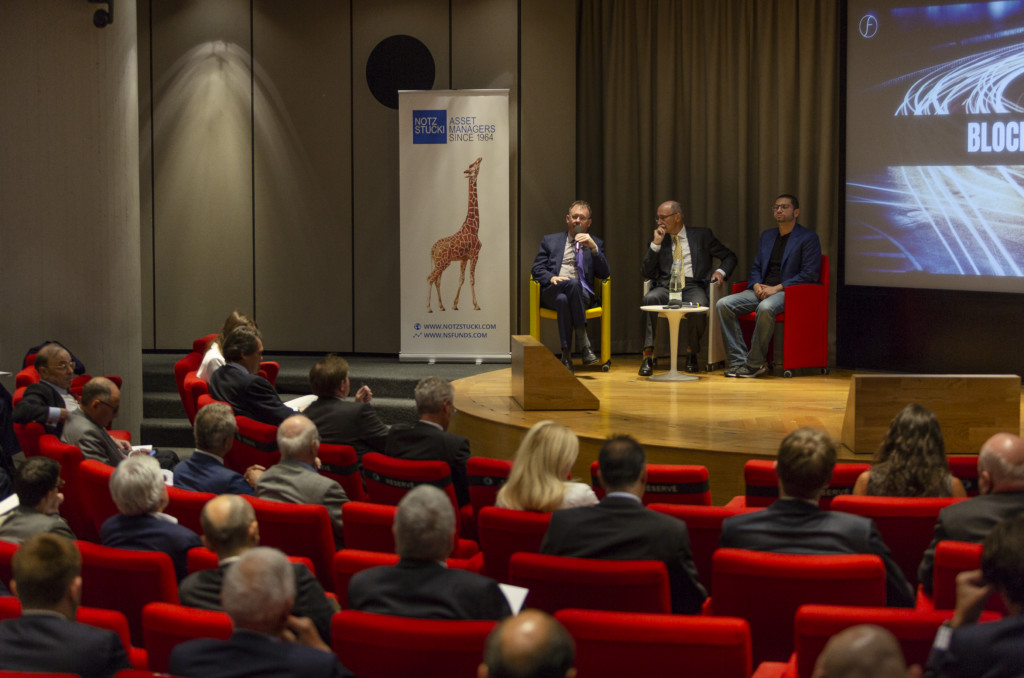
Notz Stucki Investment Conference

Notz Stucki Broadcasted Investment Conference – 29 June 2021
It has been clear since March 2020 when the pandemic struck that the world has been grappling with a completely different situation to anything anyone has experienced previously. The dramatic collapse in economic activity and equally unprecedented monetary and fiscal expansion was unparalleled in recent history. The experience of 2020 and 2021 has been opposite in the sense that last year the economy was in a state of collapse, while financial markets were booming, and this year the economy has been recovering fast, while since February financial markets response has been more muted. Now a year on from the initial panic investors are starting to look forward to what the consequences will be, particularly as regards inflation.

The consensus among market commentators is that the world will experience higher inflation from the middle of the current decade. There are strong reasons for this. Monetary policy is actively trying to generate inflation; fiscal policy is ultra-expansionary with governments and central banks globally united in pursuing growth rather than price stability; the reduction in globalisation as a result of the trade dispute with China; the emergence of technology monopolies leading to the threat that disinflationary pressures will be lessened; political trends favouring labour more; and demographics being less favourable. These are all compelling reasons and it is hard to believe that there won’t be some inflation. Certainly the relentless trend of disinflation that has prevailed for the last thirty years is being interrupted. However the concerns of many in the market that inflation is going to return to levels that did so much damage in the 1970’s may be misplaced. A more benign scenario is possible, and even likely.

Future inflation may be more like that seen in the 1950’s. What is important is how high inflation reaches and how quickly it gets there. A sudden jump to 5% plus inflation would be very challenging for markets. But if inflation creeps up gradually and remains in the 1 – 3% range the markets should be comfortable with this because it will be accompanied by strong growth. This is why the 1950’s comparison is relevant because in the 1945 – 1965 period macro policies targeted growth and employment in the same way as now. Encouragingly the markets at the moment are subscribing to this outcome. Despite the plethora of inflation fears from commentators both bonds and equities are behaving as though the economy and profits will continue to expand for the next five years. The reason that markets are sanguine about inflation is probably because the scale of the economic collapse was such that it will be difficult for inflation to get traction. There are temporary shortages and bottle necks in certain areas, but overall there is too much excess capacity. In particular unemployment remains high so it will be hard for workers to achieve structurally higher wages. Equally the exceptionally strong growth that we are witnessing now will not be sustained. The re-opening boom is by definition a one off. Over the next year the imbalances in the economy should adjust and the market be able to grow higher growth than we had over the last decade, and while inflation will also be higher it will not be high enough to derail equity markets.

This leads to the following investment conclusions. Bonds will slowly lose their purchasing power. Yields are so low that they are unattractive, but they are unlikely to move dramatically. The expectation is that the yield of the US 10-year will move in the range of 1 – 2% for the rest of this year. Given this equities remain reasonably priced, and those outside the US are cheap. On a five year view the rotation from growth to value should continue thanks to the better economy. However short term growth shares, driven by technology, may have a final surge. The Nasdaq chart looks very similar today to where it was in the summer of 1999 before the final blow off at the end of 1999 and early 2000. Many technology shares look very overvalued relative to their fundamentals, but that won’t stop them going much higher if the market becomes enthused by growth again as inflation fears dissipate. After that the value trend should reassert itself, and that is likely to benefit companies outside the US. In currency markets the dollar looks well supported for the rest of this year, but as flows move out of the US it will decline. Asian currencies are likely to be the principal beneficiary of this.

Please click here to download our Investment Policy Notes. 


Past performance is not indicative of future results. The views, strategies and financial instruments described in this document may not be suitable for all investors. Opinions expressed are current opinions as of date(s) appearing in this material only.

References to market or composite indices, benchmarks or other measures of relative market performance over a specified period of time are provided for your information only. Notz, Stucki provides no warranty and makes no representation of any kind whatsoever regarding the accuracy and completeness of any data, including financial market data, quotes, research notes or other financial instrument referred to in this document.

This document does not constitute an offer or solicitation to any person in any jurisdiction in which such offer or solicitation is not authorized or to any person to whom it would be unlawful to make such offer or solicitation. Any reference in this document to specific securities and issuers are for illustrative purposes only, and should not be interpreted as recommendations to purchase or sell those securities. References in this document to investment funds that have not been registered with the FINMA cannot be distributed in or from Switzerland except to certain categories of eligible investors. Some of the entities of the Notz Stucki Group or its clients may hold a position in the financial instruments of any issuer discussed herein, or act as advisor to any such issuer.

Additional information is available on request. © Notz Stucki Group
Notz Stucki Broadcasted Investment Conference

Notz Stucki Broadcasted Investment Conference – 12 January 2021

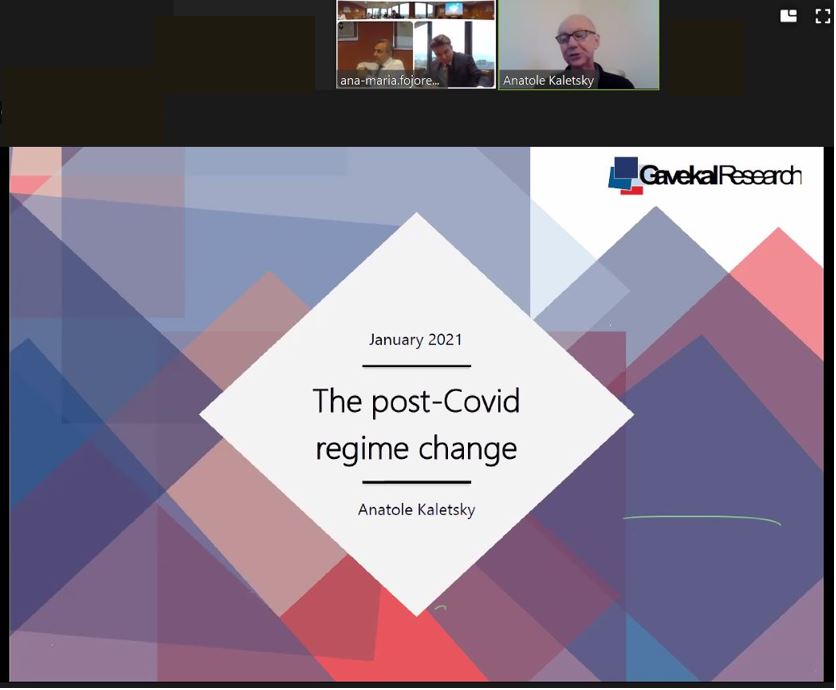
Anatole Kaletsky during our NS Broadcasted Investment Conference

2020 was one of the most remarkable years for both the global economy and financial markets, witnessing perhaps the largest short term economic collapse ever, followed by governments and central banks unleashing the most enormous stimulus packages ever to offset the lockdowns that they had mandated. These stimulus packages far exceeded what would have been thought possible a year ago, and as the crisis evolved became ever greater. The conference considered what the effects may be over the medium and long term.

The sudden collapse in economic activity last year was unprecedented, though it was met with an equally unprecedented response in terms of fiscal policy. As such history is much less helpful as a guide to the future, simply because there are no previous examples to compare this situation to. Since March the world has been stuck in a Covid induced shut down, in which large parts of the economy have been prevented by law from operating normally. Since then the global economy has been in a state of collapse, but stock markets bottomed on 23. March just three weeks into the crisis, initially in response to the huge stimulus, but latterly as they have started to look to the medium and long term and detect a brighter future. Markets are being tugged in opposite directions by these two giant forces – the economic plunge and the tsunami of liquidity. As time passes the balance of these two forces will change and today we are at an important transition as we start to exit lockdowns with the arrivals of several vaccines that will allow a slow return to normality.

As we enter the next stage there is a high probability that the tremendous stimulus will start to overcome the economic collapse. The public health situation is on the brink of improving because of the vaccines. Further there is always a time lag between the announcements of a stimulus and its impact on the economy. Usually this lag is about six to nine months, but this time it is likely to be one to two years because of the delay that has occurred before business is allowed to return to normal. So the various stimulus packages will arrive with full force this summer and it is highly likely that 2021 will see a strong return to growth, and this boom should last for the next two to three years. The market has anticipated this, rallying with extraordinary speed in reaction to the size of the packages and the explicit statements by Central Banks that they would keep monetary policy loose for several years. Indeed the conditions are extremely conducive for the bull market to continue. On top of current fiscal and monetary policies two other supports to growth were achieved last year. First the EU has finally managed to agree a unified fiscal policy which goes a long way to removing the risk of another European crisis. Second the Asian bloc has handled the crisis far better than the West both in terms of protecting its economy and its public health. It looks as though this area can grow strongly even if the US and Europe remain subdued. These more vibrant economies may decouple from the West, but in any event they are providing a strong support to global growth.  All these conditions are ideal for creating bubbles in equities and there is little doubt that in some areas these already exist, with some areas of US tech being the most obvious example. Bubbles always burst eventually but timing this is impossible and they have a tendency to go far further than what is believed to be possible. Investors need to be aware of this but there are plenty of other areas of the market which can do well.

Looking further ahead there are consequences that investors need to start to consider. The first is inflation. The likelihood is that the massive money printing and spending by governments will lead to inflation. It is almost certain that over the next decade inflation will be higher than the rate that has pertained over the last forty years. There were anyway a number of structural forces pushing inflation higher namely: the weakening of globalisation; expansionary fiscal and monetary policy; the shift in technology from being a disruptive force to the establishment of monopolies; politics shifting to a position that is more supportive of labour leading to the rise of wages; and demographics. The debt piles that have been built up over the last few years also make inflation a temptation for governments, as historically that has always been the way that they have repaid them. So the question becomes how rapidly does inflation return? If it bounces back to a 4-5% rate in the next couple of years then that will be very negative for financial asset classes and social stability. However if it only creeps up gradually over the next few years then we could see a repeat of the Keynesian Golden Age that dominated the period from the late 1940’s to mid-1960’s which enjoyed strong growth and employment. This scenario is plausible because output gaps are so large coming out of Covid it is hard to see where inflation will come from. There is a strong possibility that we get strong growth accompanied by controlled inflation. This period could last a decade or even more. What is strange at the moment is that many commentators are expressing a lot of concern about inflation, but making almost no comment on this possibility that we may be entering a long term expansion, while financial markets appear completely unconcerned by inflation but are starting to price in the longer term growth.

The next nine to twelve months will be a crucial period. If we see growth returning and inflation does not take off in an alarming way then sentiment in financial markets will harden towards the view that we can get a low inflation boom. There are plenty of themes for markets to get excited about such as the energy and transportation revolutions that are taking place. Globally markets may start to focus more on the East as those countries return to normal more quickly than the West. With liquidity and stimulus so abundant valuations may rise to much higher levels than those witnessed in the past as PE ratings rise. The main danger to this outlook is inflation. If there are signs that it is starting to move significantly higher, then that would end an era that has prevailed since the early 1980’s. For several decades bond and equity values have been set on the basis that prices would be relatively stable. If they start to jump higher that changes everything, but for the next few months markets should enjoy the combination of lots of liquidity and a recovering economy.

Please click here to download our Investment Policy Notes. 


Past performance is not indicative of future results. The views, strategies and financial instruments described in this document may not be suitable for all investors. Opinions expressed are current opinions as of date(s) appearing in this material only.

References to market or composite indices, benchmarks or other measures of relative market performance over a specified period of time are provided for your information only. Notz, Stucki provides no warranty and makes no representation of any kind whatsoever regarding the accuracy and completeness of any data, including financial market data, quotes, research notes or other financial instrument referred to in this document.

This document does not constitute an offer or solicitation to any person in any jurisdiction in which such offer or solicitation is not authorized or to any person to whom it would be unlawful to make such offer or solicitation. Any reference in this document to specific securities and issuers are for illustrative purposes only, and should not be interpreted as recommendations to purchase or sell those securities. References in this document to investment funds that have not been registered with the FINMA cannot be distributed in or from Switzerland except to certain categories of eligible investors. Some of the entities of the Notz Stucki Group or its clients may hold a position in the financial instruments of any issuer discussed herein, or act as advisor to any such issuer.

Additional information is available on request. © Notz Stucki Group

Notz Stucki Investment Conference

Notz Stucki Investment Conference – 14 January 2020

Louis-Vincent Gave during his presentation @NS Investment Conference, 14 January 2020

2019 was a great year for financial assets with every major market rising, some of them strongly, such as oil and the S&P 500. Against this backdrop there were some surprises which may have significant influence as we head into 2020. The meeting discussed four of these. First the breakdown of the China/HK relationship. Second the Fed reversing its tightening policy and restarting QE. Third, the unprecedented situation of $17tn of negative yielding bonds that was reached in August. Finally the divergence between the oil price and the performance of energy stocks; oil was the best performing asset of the year, but energy was the worst performing sector in the S&P.

Xi Xinping is the first Chinese President who has had a foreign policy of significance. Under his leadership China has adopted an imperial vision with its belts and roads policy which aims to tie China into the world and make it more central in global trade. To finance all the infrastructure surrounding this project required a deep, liquid financial centre which China was fortunate to inherit from the British with Hong Kong. However Hong Kong’s role was compromised by the elections in November when, with a big turnout, the population voted emphatically for the pro-democracy parties. Effectively 70% of the electorate voted against Beijing. As a result China will promote Shanghai and Shenzhen as alternatives, but for them to be credible China needs to take off capital controls, and this a risky process in a command economy. However it is because of this that official pronouncements from China have changed more from threats to devalue the RMB, to announcements talking of a strong currency supported by positive interest rates in line with Chinese people’s savings culture.

In the last quarter the Fed reversed its monetary tightening and restarted QE. They did this when the repo market broke down in September, and they started adding $60 billion a month to ensure it worked smoothly. Why did the repo market break down? It is not clear but it may have been caused partly by the fact that the borrowing needs of the US government are so enormous now that the private sector cannot absorb them, and so the Fed has to step in to maintain stability. From 2010 to 2016 US Government spending was flat (due to the constraints imposed by the Tea Party), but now it has exploded. The budget deficit now runs at $5.6bn a day, and the Fed funds between a third and half this. The Fed is scheduled to end this support in March, but in an election year the likelihood is that it will continue. In effect MMT has arrived, and it is noticeable that since the Fed reversed course the dollar has fallen.

The negative yields in bond markets represent the biggest bubble in financial history. It seems extraordinary that this happens at a time of monetary and fiscal profligacy. It rests on two pillars. The first is that interest rates will never go up again, and the second that investor demand for bonds will remain strong. The first pillar remains as strong as ever, but the second is wobbling a bit. Markets became more sceptical last year of assets with stretched valuations, as evidenced by the collapse of WeWork, and a sharp derating of companies like Uber. This scepticism could one day extend to the idea of paying to own an asset whose raison d’être was to pay you. Another development was that Sweden raised interest rates after judging that negative interest rates had not improved growth but had done significant damage to the financial sector and pensions. Sweden was an early adopter of negative rates, but their move will at least raise the level of debate in other Central Banks. More fundamentally, negative rates will start to battle with rising inflation figures. The US CPI is at a ten year high. More inflation may be in the pipeline – many of the riots and discontent seen around the world stem from the loss of purchasing power by workers. With labour markets tight, wages have the capacity to rise. In any event the ability of the negative interest rates’ bubble to expand further seems limited as governments turn more to fiscal measures. The new ECB Chairman said in her first speech that fiscal deficits should rise.

Q&A Session. Louis-Vincent Gave, Munib Islam, Stefan Blum

Finally what will come of the disconnect between the oil price and oil stocks? The oil price rise exceeded the S&P gain in 2019, but oil stocks were the worst performing sector in that index. This is even odder given that analysts predict that the energy sector’s earnings will be the strongest in 2020. There has been little new investment in the sector in recent years, and oil is a finite resource. There is a strong likelihood that it may break out upwards from the $40-60 trading range that it has been in the last few years.

Some of the assumptions that underlay 2019’s strong performance may be challenged in 2020. Inflation and the US dollar will need close watching. Inflation could rise further as a result of higher energy prices, or labour costs. Politics is an influence on both, and in the case of labour the increase in nationalism and consequent pressure to reduce flows of labour and immigration could lead to labour shortages. This takes place in the context of budget deterioration almost everywhere. For the investor it is time to look at currencies beyond the dollar – in the emerging market bloc, Australian dollar, Canadian dollar, sterling and gold. Negative yielding bonds should be sold, and only selective Emerging Market debt offers much interest in the fixed income space. In equity markets investors should start to look outside the US to the Japanese, European and Emerging Markets, and to sectors like energy and biotech.

From left to right: Louis-Vincent Gave, Stefan Blum, Munib Islam

Please here to access the speakers’ presentations.

Notz Stucki Investment Conference

Notz Stucki Investment Conference – January 8th 2019

2018 was an ugly year in financial markets with every major asset class falling. Equities were the worst performer, but even US Treasuries fell. Only US cash showed any return. Our meeting reviewed some of the causes of this poor result, and also the outlook for 2019.

The principle reason was that there were lots of demands on liquidity last year, that sucked cash out of financial assets. Interest rate rises were one of these pulls. Another was the Federal Reserve shrinking its balance sheet, a process that had reached a level of $50bn a month by the final quarter. On top of all this the US budget deficit is expanding steadily and is projected to reach 5% of GDP in a few years. The budget deficit is of particular concern as it is expanding despite robust growth and low unemployment. Expanding budget deficits are commonly associated with recessions when governments try to offset contracting growth. Worse the ageing of the US population mean that the deficit has a structural character as pension and medical demands mount up. Europe faced a similar demographic profile twenty years ago and solved it by cutting its military budget. The US is unlikely to do the same. Current projections for the US budget deficit are based on resilient future economic growth. Lurking in investors’ minds is the uneasy question of what would happen to the deficit if US growth slipped. It may be for this reason that the US dollar was not even stronger last year, when almost every factor was in its favour – vide hawkish Fed, US growth better than elsewhere, imploding EM and Italian dramas.

Notz Stucki Investment Conference January 2019 – Louis-Vincent Gave

After such a gloomy year it is natural for investors to worry about the most fragile parts of the system. The main candidates that are mentioned in this context are the likes of the Italian bond market, Deutsche Bank, and China. However a prime concern of Gavekal is the US corporate bond market. The last few years have seen a massive issuance of corporate debt. Much of this has been used for financial engineering not investment. Share buybacks by US companies represented the largest buyer of US equities last year – $750 billion in all of which $200bn was in the last quarter – and still the market went down. US corporate debt relative to GDP is at levels usually associated with recessions. Within the debt structure the lowest level of Investment Grade is BBB and there is a danger that some of this could be downgraded to junk status. A particularly interesting sector at the moment is energy. The sharp fall in oil in the last few months is positive for global growth, but not necessarily for US industrial production. The shale revolution has been a substantial part of US capex in the last decade, and much of that capex has been financed in the bond market. It is not a coincidence that the oil price plunge has been matched by a spike in the yield of high yield corporate bonds. In contrast to the old days a higher oil price is now helpful to US growth and many corporate bonds.

The other major change that was revealed in 2018 was in US China relations. For twenty years the international community has been striving to integrate China, and Chinese production has become intimately woven into the global supply chain. This process abruptly stopped last year, and is being replaced by something akin to a new Cold War. The difference to the old Cold War with the Soviet Union is that the Soviet Empire was economically separate from the West. By contrast China really matters both by virtue of its size and relationships. Apple is a good example of this. Perhaps no company has benefited more from being able to produce parts and assemble them in low cost China, and then sell the value added whole globally, with China itself being one of the largest markets.

The US China dispute is a major concern. What many in the West underestimate is China’s resolve to transform itself into a global trading superpower, building commercial routes that ensure the supply of hard and soft commodities, and access to export markets for them to send their finished goods. Xi Jinping is different from previous Chinese leaders in having what amounts to an Imperialist strategy. It is a direct challenge to the US hegemony. Another aspect of this challenge is China’s attempt to present the RMB as an alternative to the USD. China is trying to de-dollarise commodity markets. 12% of oil market futures are now priced in renminbi compared to nothing a year ago. If this trend continues there will be less need for countries to save in dollars, which they need to buy commodities, currently priced in US dollars. Control of the reserve currency has allowed the US to run its twin deficits. If this ends the US will have lost a huge advantage. As such China may have made a mistake by being so brazen in its confrontation with the US. This is the significance of the arrest of the CFO of Huawei in December, as in 2018 Huawei overtook Ericsson as the top telecom vendor in the world (and ZTE is the fourth largest now, another Chinese company that the US attacked). China seems to have miscalculated and overplayed its hand. One casualty will be the semiconductor industry. As a matter of national security China is pouring money into Chinese production to ensure they are no longer dependent on the US for these products. Consequently profits for the whole industry will evaporate because there will be no pricing discipline and significant new supply.

2018 marked a significant change because the forces of populism made politics much more uncertain, and the tensions between the US and China broke the surface. There was also further evidence that China’s tremendous growth rate is decelerating. Equities were hardly in a bubble before 2018 but valuations fell a lot last year throwing up some real value. For example, some UK equities and corporate bonds sold off dramatically even though the companies appear to be little effected by Brexit in any outcome of the negotiations. Some sectors that have worked well recently are facing more pressures, like technology and the FANGS, but the world does not look like it is heading into recession so for the patient stock picker there is abundant opportunity.

Through their presentations, our guest speakers offered a concise and readily applicable overview of the recent developments in financial markets.

Notz Stucki Investment Conference January 2019 – From left to right: Louis-Vincent Gave, Al Breach, Andrew Jackson

Please here to access the speakers’ presentations.

Notz Stucki Investment Conference

Notz Stucki Investment Conference – June 26th 2018

Gavekal’s presentation considered the rising rivalry of the US and China. In recent months tensions have risen, which so far have been expressed through a relatively minor increase in tariffs. But the competition between the world’s two largest countries will be permanent and the roots of the problem extend well before President Trump’s inauguration. However his belligerent escalation of the tensions mean that we could be at a dangerous point. If the US go ahead and do what they say they will do then the global economy is in for a rough ride. In that scenario the risks for markets are on the downside.

Part of the reason that we have reached this point is that China has succeeded far better than was ever expected to build a strong, competitive economy. In early 2016 the world worried that China’s growth model was coming unstuck, but they have succeeded in stabilising it, and it should grow comfortably at 5-6% for the next decade, underpinned by its competent, technocratic government. President Xi has consolidated his power to an unprecedented degree and he is expected to be in charge for the next ten years. So on both economic and political fronts there is stability in China. Increasingly China is looking to project its power internationally, hence the rising tension with the US which is the current hegemon.

Arthur Kroeber during Notz Stucki Investment Conference in Geneva

China has announced three major targets. The elimination of poverty by 2021 (anniversary of the Communist Party’s founding). To complete the Great Rejuvenation (i.e. the return of China to the status of a great global power) by 2049 (anniversary of the Communist Party’s accession to power). And to create an industrial-military power on a par with the US. As a result the US is being seriously challenged, and US anxiety on this runs deep across their defence and foreign policy departments. The US military sees China as a strategic rival and they are determined to maintain US superiority, and constrain China. The US Trade Department is concerned about China’s technology ambitions, and wants to get rid of rules whereby trade and intellectual property are traded for market access. Meanwhile China’s Made in China 2025 policy aims to turn China into a global technology leader. This initiative targets a wide range of areas from aerospace to biomedicine to new energy vehicles to robotics. There is a clear intent by China to replace foreign production with domestic production. The Belt and Road Initiative is a plan for an economic integration of the region (and ultimately the world?) under Chinese leadership. It can be seen as a Chinese version of the US’s Marshall Plan after 1945. It manifests itself in infrastructure projects, but it is also China’s way to project its power on to the world. The building of infrastructure creates a community of economically linked shared interests controlled by China.

What will happen next? One would have thought that the US should be getting together with its natural allies, like Europe, to counter China, but this isn’t happening. Instead Trump seems to be attacking everyone, and waging trade wars on all fronts. The picture will be clearer at the end of this week but the likelihood is that there will be more restrictions on US investments in China, and limitations on Chinese investments in the US, so the fight will extend from trade flows to capital flows. So far Trump’s bark has been worse than his bite, but what is concerning is that US tariffs have fallen steadily since 1945 to the great advantage of the world. Trump is threatening to reverse the steady liberalisation of the last seventy years. If, as has been mooted, cars are targeted next then that would take the trade wars to much more significant levels. Trump might even pull out of NAFTA ahead of the mid-term elections. The market would not like these sort of moves at all.

Nonetheless one shouldn’t draw too grim a picture of the outlook. Kerr Neilson outlined two areas that look promising: Emerging Markets and the energy/metals sector. For most of the last ten years the Emerging Markets equity performance has lagged the Developed ones. This could be about to change. India, for example, has produced a compound economic growth of 6% for twenty years, despite labouring under one of the most obstructive legal and government systems in the world. As Modi’s reforms kick in this growth rate can lift to 7-8%, which together with a recovering banking system will give opportunities similar to what China has offered over the last 10 – 15 years. In SE Asia 1.8 billion people are on the cusp of an income level where real spending power comes through, creating a host of opportunities. Strong growth in EM will lead to strong demand for commodities. This is at a time when energy and metal companies are being ignored by most investors. Measured as a percentage of the S&P they are at the lowest level for a decade. While it is near impossible to draw conclusions on what will happen with the trade talks over the next few months, investors should not ignore some of the excellent long term opportunities on offer.


Through their presentations, our guest speakers shared their views on the macroeconomic outlook, global equities and how technology will shape our lives.

Notz Stucki Investment Conference June 2018
Notz Stucki Investment Conference June 2018 – From left to right: Arthur Kroeber, Kerr Neilson, Sal Matteis

Please click here to access the speakers’ presentations.