February General Market Comments

February General Market Comments

“This world today is a mess” – Donna Hightower, 1972.

A slowdown (or a recession?) is expected, but economic releases do not support this projection yet; hard landing, soft landing or no landing (?); China is reopening, but underperforms; Oil is supposed to get scarcer, but do not rise; a weakening dollar is in everybody’s mind, but the greenback doesn’t seem to agree; long term yields rise, but Growth outperforms; Turkey is a NATO member and sends drones to help Ukraine, but also buys Oil and Gas from Russia; Chinese balloons fly over the US and its fighter jets circle around Taiwan; Mammoth Mountain in California has a 5 meters snow base, while Zermatt in Switzerland has 10 centimeters; and the list goes on. Yes, this world today is a real crazy mess.

Markets have a hard time performing well when too much uncertainties hover around; they wander even more when contradicting signals show up, which is clearly the case. The outcome of the conflict between Russia and Ukraine is anybody’s guess, but this might not be what drives market sentiment (although a severe escalation would undoubtedly trigger a massive sell-off); it is still Central Banks, monetary policies and interest rates which heavily weigh on the direction of markets, and in parallel the economic outlook.

Here again, making predictions often equals to betting on the black or the red at the roulette…

Even though markets struggled in February, they did resist somewhat, as only a fraction of the gains recorded in January were erased: the MSCI World abandoned 2.53% but is still up 4.3% year to date as an example; the S&P 500 lost 2.6%, the Nasdaq 0.5%, but the dollar was strong (+2.72% for the DXY), which can provide an explanation for the positive returns from the MSCI Europe and the Topix (+1.6% and +0.9%) and the MSCI Emerging Markets’ weakness (-6.5%). In the context of rising interest rates (+41 bps and +37 bps for the US and the German 10 year yields respectively) and falling Commodity prices (-2.3% for the WTI and -3% for the CRB Index), Gold logically fell (-5.3%). Credit enjoyed a second positive month in a row: the Itraxx Crossover advanced 0.5% last month and is now up 3.5% year to date.


Past performance is not indicative of future results. The views, strategies and financial instruments described in this document may not be suitable for all investors. Opinions expressed are current opinions as of date(s) appearing in this material only. References to market or composite indices, benchmarks or other measures of relative market performance over a specified period of time are provided for your information only. NS PARTNERS SA provides no warranty and makes no representation of any kind whatsoever regarding the accuracy and completeness of any data, including financial market data or other financial instruments referred to in this general comment. This document does not constitute an offer or solicitation to any person in any jurisdiction in which such offer or solicitation is not authorized or to any person to whom it would be unlawful to make such offer or solicitation. Any reference in this document to specific securities and issuers are for illustrative purposes only, and should not be interpreted as recommendations to purchase or sell those securities. References in this document to investment funds that have not been registered with the FINMA cannot be distributed in or from Switzerland except to certain categories of eligible investors. Some of the entities of the NS Partners Group or its clients may hold a position in the financial instruments of any issuer discussed herein, or act as advisor to any such issuer. Additional information is available on request. © NS Partners Group
January General Market Comments

January General Market Comments

“C’est comme ça” – Les Rita Mitsouko, 1986.

“C’est comme ça” could be translated into “That’s the way it is”; most markets were up in January, after a very painful December, but looking a tad longer term, it appears that, in general, markets have ended January 2023 not very far from the levels reached at the end of July 2022, with in between very nice months and very bad months, a common feature of all these months being a high level of volatility, as the MSCI World has moved in excess of 4% on the way up or on the way down every single month since July. We have to cope with high volatility when so many things are highly different than during the period 2017-2021, c’est comme ça…

Reasons for such a different context are well-known: higher inflation, higher interest rates, hawkish central banks, rising commodity prices, supply-chain issues and the war in Ukraine. Added to that, equity, fixed-income and credit markets started 2022 with demanding valuations, and if the latter have indeed corrected since then, they can’t be considered as cheap today, still. This means that volatility should stay with us for a while, and very much attention will be paid to economic data as well as Central Banks’ responses.

But let’s enjoy the party so far: the S&P 500 rose 6.2% in January, buoyed by its IT and Communication Services components notably; in this context, the Nasdaq added 10.6% and the MSCI World Growth 9.7% (versus “only” +4.6% for the MSCI World Value). Europe and Emerging Markets fared well (+6.7% and +7.9% respectively), with Japan lagging a smidgen (but still up 4.4%).

The month was also good for fixed-income and credit, as the US and the German 10 year yields fell 37 and 29 bps respectively and the Itraxx Crossover gained 3%. Helped by lower yields and a weaker dollar (-1.5% versus the euro), Gold soared 5.7%, while Oil retreated by 1.7%.

That’s it for this month’s Market Comments, stay tuned, markets never skip a beat.


Past performance is not indicative of future results. The views, strategies and financial instruments described in this document may not be suitable for all investors. Opinions expressed are current opinions as of date(s) appearing in this material only. References to market or composite indices, benchmarks or other measures of relative market performance over a specified period of time are provided for your information only. NS PARTNERS SA provides no warranty and makes no representation of any kind whatsoever regarding the accuracy and completeness of any data, including financial market data or other financial instruments referred to in this general comment. This document does not constitute an offer or solicitation to any person in any jurisdiction in which such offer or solicitation is not authorized or to any person to whom it would be unlawful to make such offer or solicitation. Any reference in this document to specific securities and issuers are for illustrative purposes only, and should not be interpreted as recommendations to purchase or sell those securities. References in this document to investment funds that have not been registered with the FINMA cannot be distributed in or from Switzerland except to certain categories of eligible investors. Some of the entities of the NS Partners Group or its clients may hold a position in the financial instruments of any issuer discussed herein, or act as advisor to any such issuer. Additional information is available on request. © NS Partners Group

December General Markets Comments

December General Markets Comments

“Heroes” – David Bowie, 1977.

2022 could have been year for heroes in financial markets. Imagine that, after Jay Powell’s announcement in November 2021 of higher for longer interest rates, you had positioned your portfolios for a 250 bps increase in US 10-year yields and for 8 Fed Funds Rates hikes totalling 425 bps. You would be a hero.

Even more a hero if you had bought energy stocks because you suspected that a war would break out in Europe and drive oil and gas prices through the roof. Even more again if you went short en vogue cryptocurrencies and Tesla, as both suffered very serious drawdowns for various reasons.

But at the end of the year, it appears that there were no heroes, as no one could have predicted the landslide changes the year 2022 witnessed. Years of accommodative monetary policies and peaceful times kind of hypnotized many investors who thought that Growth had beaten Value forever and that Central Bankers would always be market friendly. “We can beat them, forever and ever” says the song; 2022 shows once again that this does not apply for markets.

December has been a painful month, as evidenced by the negative returns posted by all asset classes, barring Gold (+3.14%): the S&P 500 abandoned 5.9%, the tech-heavy Nasdaq 9.1% (Tesla being a serious detractor with -36.7%), the MSCI Europe 3.6%, the Topix 4.7% and the MSCI Emerging Markets “only” 1.6%, helped by China’s U-turn on its zero-Covid stance.

Long-term yields rose again (+27 bps for the US 10-year, +64 bps for the Bund), in parallel with another month of underperformance from Growth versus Value (-6.15% and -2.6% respectively). Credit was flattish (-0.4% for the Itraxx Crossover), like Oil (-0.4%). The broad Commodities Index was down 0.7%.


Past performance is not indicative of future results. The views, strategies and financial instruments described in this document may not be suitable for all investors. Opinions expressed are current opinions as of date(s) appearing in this material only. References to market or composite indices, benchmarks or other measures of relative market performance over a specified period of time are provided for your information only. NS PARTNERS SA provides no warranty and makes no representation of any kind whatsoever regarding the accuracy and completeness of any data, including financial market data or other financial instruments referred to in this general comment. This document does not constitute an offer or solicitation to any person in any jurisdiction in which such offer or solicitation is not authorized or to any person to whom it would be unlawful to make such offer or solicitation. Any reference in this document to specific securities and issuers are for illustrative purposes only, and should not be interpreted as recommendations to purchase or sell those securities. References in this document to investment funds that have not been registered with the FINMA cannot be distributed in or from Switzerland except to certain categories of eligible investors. Some of the entities of the NS Partners Group or its clients may hold a position in the financial instruments of any issuer discussed herein, or act as advisor to any such issuer. Additional information is available on request. © NS Partners Group

Commentaires de marché – Novembre

Commentaires de marché – Novembre

“Don’t Stop” – Fleetwood Mac, 1977. Un hommage à la regrettée Christine McVie (1943-2022).

“Ne t’arrête pas” c’est ce que nous voudrions tous dire au marché après deux très bons mois consécutifs — une première cette année. Pour rappel, le MSCI World a progressé de près de 14% depuis fin septembre. La dernière fois qu’une reprise aussi spectaculaire a été enregistrée sur une période de deux mois remonte à novembre et décembre 2020, juste après l’annonce par Pfizer-BioNTech de la mise au point de leur vaccin contre la covid.

Parmi les nombreuses causes de ce puissant rebond, citons en premier lieu la Fed et les taux d’intérêt: les chiffres de l’inflation publiés au début du mois aux États-Unis semblent indiquer que le pic d’inflation pourrait être derrière nous, ce que Jerome Powell a plus ou moins soufflé dans son discours du 30 novembre. En conséquence, les taux souverains à long terme ont reculé, ce qui a quelque peu soutenu les valorisations. Par ailleurs, certains investisseurs nourrissent l’espoir que la politique chinoise du «zéro covid» s’avère tellement contraignante pour la population qu’il soit impossible pour le gouvernement de la maintenir sans mettre à mal la paix sociale. Or, un assouplissement des restrictions sanitaires chinoises serait favorable à la croissance mondiale, car il réduirait les tensions des chaînes d’approvisionnement et relancerait la consommation intérieure du pays. Enfin, les résultats du troisième trimestre ayant tous été publiés, les marchés se concentrent désormais sur les prévisions des entreprises, qui, en général, ne sont pas si mauvaises. Quant à la débâcle de FTX, elle nous offre une excellente occasion de mettre en avant quelques grandes chansons de Fleetwood Mac, car les «Petits mensonges» (Little Lies) de M. SBF n’ont provoqué aucun «Raz de marée» (Landslide) et n’ont pas non plus brisé «La chaîne» (The Chain) des marchés traditionnels: «Passez votre chemin» (Go Your Own Way), M. SBF.

Le MSCI World a gagné 6,8% le mois dernier, le S&P500 5,4% et le MSCI Europe 6,7%. Mais la vedette du mois est sans conteste le MSCI Emerging Markets, qui a bondi de 14,6% (malgré un repli de 21,1% sur l’année 2022). Pour une fois, les actions de croissance n’ont pas surperformé les actions décotées au cours d’un mois de baisse des taux d’intérêt, ce qui est assez inhabituel. Les marchés obligataires et du crédit ont également profité du rebond: les taux à 10 ans américains et allemands ont reculé respectivement de 44 et 21 points de base, et l’Itraxx Crossover a recouvré près de la moitié de ses pertes de l’année avec une hausse de 4,5%. Le pétrole a encore reculé de 6,9%, tandis que l’or, soutenu par la baisse des rendements réels, a gagné 8,3%.


Les performances passées ne garantissent pas les résultats futurs. Les opinions, stratégies et instruments financiers décrits dans le présent document peuvent ne pas convenir à tous les investisseurs. Les opinions énoncées sont celles valables à la date de publication de ce document. Toute référence aux indices de marches ou composites, indices de référence, ou autres mesures de performance relative des marches a une certaine période sont indiquées à titre d’information. NS Partners ne donne aucune garantie et n’est aucunement responsable de l’exactitude et de l’exhaustivité de l’ensemble des informations (données financières de marche, cours de bourse, avis de recherche ou description de tout autre instrument financier) contenus dans ce document. Le présent document n’est pas destiné aux personnes ou entités qui seraient citoyennes ou résidentes d’un lieu, état, pays ou juridiction dans lesquels sa distribution, sa publication, sa mise à disposition ou son utilisation seraient contraires aux lois ou règlements en vigueur. Les informations et données fournies dans le présent document sont communiquées à titre indicatif uniquement et ne constituent ni une offre, ni une incitation à acheter, vendre ou souscrire a des titres ou tout autre instrument financier. Il est fait référence dans ce document a des fonds d’investissement qui n’ont pas été enregistrés auprès de la Finma et ne peuvent donc pas être distribues en ou depuis la suisse sauf à certaines catégories d’investisseurs éligibles. Certaines des sociétés du groupe NS Partners ou ses clients peuvent être détenteurs d’une position dans les instruments financiers de l’un des émetteurs mentionnes dans ce document, ou agir en tant que consultant pour l’un d’eux. Des informations supplémentaires sont disponibles sur demande. © Groupe NS Partners

November General Markets Comments

November General Markets Comments

“Don’t Stop” – Fleetwood Mac, 1977. A tribute to the late Christine McVie (1943-2022).

“Don’t stop” is what we all would like to say to markets after two very good months in a row, for the first time this year. For the record, the MSCI World has risen close to 14% since the end of September, the last time such a spectacular return happened on a two- month timeframe was in November and December 2020, right after Pfizer-BioNTech made public they had a vaccine against Covid.

The multifarious causes behind such a strong rebound are, first and foremost, the Fed and interest rates: inflation numbers published at the beginning of the month in the US seem to indicate that peak inflation might be behind us, which Jerome Powell more or less whispered in his November 30th speech. Long-term government bond yields consequently fell, offering some support to valuations. There are also some hopes among the investment community that China’s zero-Covid policies prove too much of a burden on the population for the government to maintain them without stymieing social calm; should China loosen its harsh sanitary measures, global growth would benefit from some relief on the supply-chain side and increased consumption in the country. Finally, as the Q3 earnings reports have all been published, markets now focus on the guidance provided by the corporate world, which, in general, was not that bad. Finally, the FTX debacle brings the opportunity to highlight some great Fleetwood Mac songs, as the “Little Lies” of Mr SBF did not provoke any “Landslide”, nor did it break “The Chain” in traditional markets; you can “Go Your Own Way”, Mr SBF.

The MSCI World added 6.8% last month, the S&P500 5.4% and the MSCI Europe 6.7%; but the star of the month was the MSCI Emerging Markets, which soared 14.6% (but is still down 21.1% in 2022); for once, Growth did not outperform Value in a month of falling interest rates, quite an unusual fact. Fixed income and credit markets also enjoyed the rally: the US and German10-year yields respectively fell 44 and 21 bps, and the Itraxx Crossover recouped almost half of its yearly losses with a 4.5% rise. Oil fell again (-6.9%), and Gold returned 8.3%, buoyed by falling real yields.


Past performance is not indicative of future results. The views, strategies and financial instruments described in this document may not be suitable for all investors. Opinions expressed are current opinions as of date(s) appearing in this material only. References to market or composite indices, benchmarks or other measures of relative market performance over a specified period of time are provided for your information only. NS PARTNERS SA provides no warranty and makes no representation of any kind whatsoever regarding the accuracy and completeness of any data, including financial market data or other financial instruments referred to in this general comment. This document does not constitute an offer or solicitation to any person in any jurisdiction in which such offer or solicitation is not authorized or to any person to whom it would be unlawful to make such offer or solicitation. Any reference in this document to specific securities and issuers are for illustrative purposes only, and should not be interpreted as recommendations to purchase or sell those securities. References in this document to investment funds that have not been registered with the FINMA cannot be distributed in or from Switzerland except to certain categories of eligible investors. Some of the entities of the NS Partners Group or its clients may hold a position in the financial instruments of any issuer discussed herein, or act as advisor to any such issuer. Additional information is available on request. © NS Partners Group

October General Markets Comments

October General Markets Comments

«Fade Out Lines» – The Avener Rework, 2014

Charts lines from the 12 to 18 post-covid months are gradually fading out, and it seems markets are coming back to earth after an incredible run on speculative and/or expensive assets from March 2020 to November 2021. These roller coaster capital markets make investors feel dizzy, at least a smidgen. Pirouetting from the downside to the upside, markets logically give rise to howls calling for a looming disaster, or, conversely, for the beginning of a new bull phase.

Whatever the trigger, excesses always end up badly; but as they deflate, opportunities arise, and it seems that October 2022 was a month of opportunities. At a time of crucial reports from the IT and Communication Services behemoths, one could have expected that the latter would dictate the overall market mood; in fact, they did not. Markets can do anything, and they proved again how tough it is to assess their reactions. Reports from the Big Boys were mostly disappointing, but this did not prevent Global Equities from posting spectacular returns, as shown by the +7.11% performance of the MSCI World in October.

Not only did the MSCI World perform well, but all other major indices also rose significantly (S&P 500 +7.99%, MSCI Europe +6.15%, Topix +5.09%, Nasdaq +3.96%), barring the MSCI Emerging Markets, which abandoned 3.15%, penalized by the Chinese market essentially (-7.99%).

With interest rates rising again (+22 bps and +3 bps for the US and the German 10 year respectively), Value fared much better than Growth (+9.58% for Global Value versus +4.56% for Global Growth), and Gold lost ground again (-1.63%); the shiny stuff, very symbolically, now lags the Dow Jones Industrial year to date (-10.70% vs -9.9%), quite a surprise in a year marked by rising inflation and war. Credit had a very good month, the Itraxx Crossover gained 3.65%, and Oil finally broke a 4-month losing streak by adding 8.9%.


Past performance is not indicative of future results. The views, strategies and financial instruments described in this document may not be suitable for all investors. Opinions expressed are current opinions as of date(s) appearing in this material only. References to market or composite indices, benchmarks or other measures of relative market performance over a specified period of time are provided for your information only. NS PARTNERS SA provides no warranty and makes no representation of any kind whatsoever regarding the accuracy and completeness of any data, including financial market data or other financial instruments referred to in this general comment. This document does not constitute an offer or solicitation to any person in any jurisdiction in which such offer or solicitation is not authorized or to any person to whom it would be unlawful to make such offer or solicitation. Any reference in this document to specific securities and issuers are for illustrative purposes only, and should not be interpreted as recommendations to purchase or sell those securities. References in this document to investment funds that have not been registered with the FINMA cannot be distributed in or from Switzerland except to certain categories of eligible investors. Some of the entities of the NS Partners Group or its clients may hold a position in the financial instruments of any issuer discussed herein, or act as advisor to any such issuer. Additional information is available on request. © NS Partners Group

September General Markets Comments

September General Markets Comments

« Another one bites the dust » – Queen, 1980

Well, another one, and many others? Equity markets already did, as well as fixed-income securities overall. September saw the British Pound on its knees, Gold breaking down, Oil recording its largest loss this year and Credit Suisse’s CDS rising to 2008 levels; FedEx and Nike had very bad days on the stock exchange, and Italy’s spread versus Germany widens by the day . On the front, the Russian army also bit the dust and is losing ground.

All asset classes suffered in September, with the continuous pressure exerted by long term interest rates, which, once again, rose significantly.

With hindsight, it looks like under the direction of conductor Jerome Powell, we’re gradually picking up where we left off, before February 2020 and the Covid outbreak, which led to all kinds of excesses and aberrations, triggered by the profligacy of Central Banks and Governments.

The S&P 500 lost no less than 9.3% in September, and the Nasdaq 10.6%; the MSCI Emerging Markets sunk 11.9% and now lags all major indices, barring the Topix, which is only down 7.9% year-to-date (but the Yen cratered by 25.8% versus the dollar!). Growth stood behind Value, once again, and lost 10.2% last month; the MSCI World Growth is down 32.8% this year, versus -20.1% for the MSCI World Value. This has to be put in the context of ever rising interest rates: the US 10-year yield added 64 bps (+57 bps for Germany) and is now 232 bps higher than the level prevailing at the beginning of 2022 (+229 bps for the Bund). Oil abandoned 11.2% and Gold 3%. Credit somewhat resisted, with the Itraxx Crossover “only” down 41 bps.


Past performance is not indicative of future results. The views, strategies and financial instruments described in this document may not be suitable for all investors. Opinions expressed are current opinions as of date(s) appearing in this material only. References to market or composite indices, benchmarks or other measures of relative market performance over a specified period of time are provided for your information only. NS PARTNERS SA provides no warranty and makes no representation of any kind whatsoever regarding the accuracy and completeness of any data, including financial market data or other financial instruments referred to in this general comment. This document does not constitute an offer or solicitation to any person in any jurisdiction in which such offer or solicitation is not authorized or to any person to whom it would be unlawful to make such offer or solicitation. Any reference in this document to specific securities and issuers are for illustrative purposes only, and should not be interpreted as recommendations to purchase or sell those securities. References in this document to investment funds that have not been registered with the FINMA cannot be distributed in or from Switzerland except to certain categories of eligible investors. Some of the entities of the NS Partners Group or its clients may hold a position in the financial instruments of any issuer discussed herein, or act as advisor to any such issuer. Additional information is available on request. © NS Partners Group

July General Market Comments

July General Market Comments

« Whose Side Are You On? » – Matt Bianco, 1984

Are you on the optimists’ or the pessimists’ side? Or rather on the side of those who have no idea?

So far, 2022 tends to plead in favour of the pessimists, but optimists could argue that July 2022 was the best month for the S&P 500 since November 2020 (when Pfizer-BioNTech announced they had a vaccine against Covid), and those who have no idea could point out that finally markets were roughly flat for June-July 2022, as June was a dreadful month.

There are many things to factor in, and all of them give arguments to one side or another: inflation is high, but expected to normalize, especially since Central Banks seem keen on tackling it rapidly; geopolitics are a mess with not only the conflict between Russia and Ukraine, but also the heightened tensions between the US and China regarding Taiwan; corporate and private debt does not seem to be a source of problems today, but Government debt across developed markets is immense; earnings reports have been surprisingly good so far, but they are expected to slow down significantly going forward; commodities do not move in sync, but there seems to be a growing threat from Russia about gas deliveries in Europe for this winter, triggering skyrocketing gas prices. With all this happening at the same time, it is not easy to choose your side and it’s not surprising to see numerous experts change their minds, depending on the most recent events.

Buoyed by convincing earnings releases and some more risk appetite, equity markets soared in July: the MSCI World gained +7.86%, the S&P 500 +9.11%, the Nasdaq +12.55%, the MSCI Europe +7.52% and the Topix +3.71%. The only detractor was Emerging Markets, down 0.69%. As nominal and real yields fell, Growth outperformed Value with a +11.51% return for the MSCI World Growth versus +4.44% for its Value counterpart.

In such a risk-prone month, Credit also rose (+3.06% for the Itraxx Crossover), and Government yields fell (-36 bps for the US 10 year, -52 bps for Germany); Gold and Oil receded by 2.29% and 6.75% respectively, and the Euro fell further against the dollar (-2.51%), weakened by the possible looming energy crisis in Europe and an unfavourable interest rate differential.

That’s it for this month’s Market Comments, stay tuned, markets never skip a beat.


Past performance is not indicative of future results. The views, strategies and financial instruments described in this document may not be suitable for all investors. Opinions expressed are current opinions as of date(s) appearing in this material only. References to market or composite indices, benchmarks or other measures of relative market performance over a specified period of time are provided for your information only. NS PARTNERS SA provides no warranty and makes no representation of any kind whatsoever regarding the accuracy and completeness of any data, including financial market data or other financial instruments referred to in this general comment. This document does not constitute an offer or solicitation to any person in any jurisdiction in which such offer or solicitation is not authorized or to any person to whom it would be unlawful to make such offer or solicitation. Any reference in this document to specific securities and issuers are for illustrative purposes only, and should not be interpreted as recommendations to purchase or sell those securities. References in this document to investment funds that have not been registered with the FINMA cannot be distributed in or from Switzerland except to certain categories of eligible investors. Some of the entities of the NS Partners Group or its clients may hold a position in the financial instruments of any issuer discussed herein, or act as advisor to any such issuer. Additional information is available on request. © NS Partners Group

Chart of the month: Why is active management underperforming this year?

WHY IS ACTIVE MANAGEMENT UNDERPERFORMING THIS YEAR?

2016 has so far been a difficult year for active managers (long only stock-pickers and hedge fund long/short equity managers).

If we take the US equity markets as the main proxy we see that the MSCI USA Index is up just +1.3% for the year. It does not really reflect the reality of what happened at the sector level.

The difference between the best performing sector (Telecoms & Utilities +11.1%) and the worst performing sector (Information Technology -3.9%) is 15.0% as of today.

At the bottom of the markets on February 10th, while the MSCI USA index was down 11.0%, the difference between Telecoms & Utilities and Financials was 22.0%, only 6 weeks into the year!

The biases for a large number of active managers was to be long Information Technology, Healthcare and Consumer Discretionary where there was and still is good growth (both top line and profit) and to be underweight or short (for hedge funds) Telecom & Utilities, Energy & Material and Industrials (mostly as Oil collapsed from over $100 to as low as $26).

So that fact that equity markets sold off sharply in a short period of time (where managers had to risk-manage their books by often reducing exposures) coupled with this large sector rotation have been detrimental to performance. Concerns about global growth, the sharp up-reversals of Oil and Gold and the crowdedness of some stocks and sectors have been the main reasons for these moves.

Equity market volatility has recently decreased and global equity markets have recovered. We think that fundamentals are slowly taking over and that rationality is coming back which should benefit active management.

Difficult to call a bottom in such a complex sector which is exposed to political risk, but there are some reasons to believe that there is an attractive asymmetrical risk profile for buyers in the biotech sector, one of the few growth sectors in the current macroeconomic environment.

Chart of the month: The incredible bull market in bonds

Chart of the month

The incredible bull market in bonds

“You seem to have this nasty habit of surviving, Mister Bond”

Source: Bloomberg
Source: Bloomberg


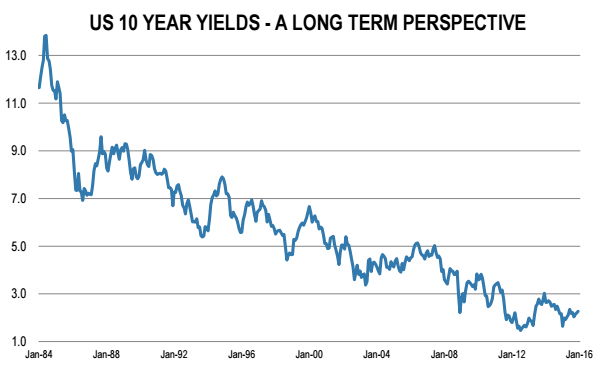
When Kamal Khan tells James Bond that he has a nasty habit of surviving in “Octopussy” in 1983, he does not refer to the bond market obviously….. But funny enough the year the movie was released more or less corresponds to the start of one of the longest bull markets in history, precisely on bonds.

At the end of the year 2012 one could have thought that good days were over and that being a bond investor, in particular on 10 year Government benchmarks, would become quite a challenging job. At that time markets were increasingly expecting the end of Quantitative Easing by the Federal Reserve, and a progressive “normalization” of the structure of the US yield curve. The reasons were pretty straightforward: self-sustained economic growth, better global growth prospects, improving housing and job markets, strong banking sector, and the list goes on.

The natural path of US government bonds yields was clearly on the upside, and a steepening of the yield curve was widely expected… and happened as US 10 year yields more than doubled from a low of 1.38% in July 2012 to a high of 3.05% in January 2014, a period during which the Fed talked a lot but barely acted (no changes were made on the interest rates side, but QE program was gradually tuned down).

Since then a new sequence of strong performance occurred on the bond side, with US 10 year yields falling back to 2% (as of January 2015) with a short incursion into the 1.60-1.70% zone at the beginning of 2015. What has happened to push yields to such low levels again? Here also the reasons seem quite obvious with hindsight: the initial big down move was triggered by the first spectacular fall in oil prices which started in July 2014 and ended at the beginning of 2015 (from $108 to $42 per barrel), perfectly matching the US 10 year yield move from 3.05% to 1.64%. The second round of falling yields started in June 2015 and is still in place today….there again perfectly correlated to the second round of falling oil prices.

On top of this spectacular fall in oil prices one can add the considerable weakness in almost all commodity prices, so there seems to be a logical reaction from fixed income markets which are anticipating non-existent inflationary – or even rising deflationary – pressures.

Another striking correlation comes with the Chinese Renminbi which peaked in January 2014 (like oil and US 10 year yields) at 6.04 per USD and has fallen to 6.58 per dollar since then. This is a very important event because there are now serious fears that China is on its way to let its currency depreciate further, which would certainly generate a wave of deflationary pressures around the globe.

What can be expected from now on with bonds? With such low levels the risk/reward proposal still appears unattractive and it seems to make more sense to invest on relatively short maturities (maximum 5 years) in order to roll down the curve while it’s still steep. But what if the doomsayers got it right? The Japanese recent history shows that first it is complicated to fight against deflation once it’s in place, and second that it is a highly risky business to bet against a bond market. Those having made money by shorting JGBs are the very lucky few, everybody else having lost money and patience.

And to remind us that this mid-80s – 2015 period has been exceptional, one quick look at the 30 year benchmark issued by the US Treasury in February 1986 and which matures next month is highly illustrative: with a 9.25% coupon, issued at par and reimbursed at par, an investor would have made a 9.25% return annualized, the maths are simple. During the same timeframe, the SP500 with dividends has compounded at 10.3%, a mere 1% better, but with far much more sleepless nights.

So yes, Mr Bond Market, you have a pretty nasty habit to survive!