Notz Stucki has just released its investment outlook for the last quarter of 2017.
Contrary to predictions at the start of the year, when it was expected that they would have to contend with rising interest rates, markets have been strong this year. Moreover one of the main hopes on President Trump’s election was that he would cut taxes and introduce a one billion dollar infrastructure plan. Not only has a clear tax policy not been set out by his Administration, but little else of any significance has been achieved so far, and the White House has suffered a dismaying series of shambolic incidents.
Evidence mounts that Mr Trump lacks the skills to run the executive arm of government, which is all the more disturbing given the bellicose situation in North Korea. However markets have risen against a background of steady economic growth and continued low interest rates. What the rise in the indices masks though is what a narrow market it has been. It has been a market driven by passive flows, with more and more money being run by ETFs. Any change to either the low interest rate environment or the cult of ETFs would have profound implications for investors.
Further evidence of the desperate hunt for yield was revealed in the last quarter.
Please click here to download the entire document.
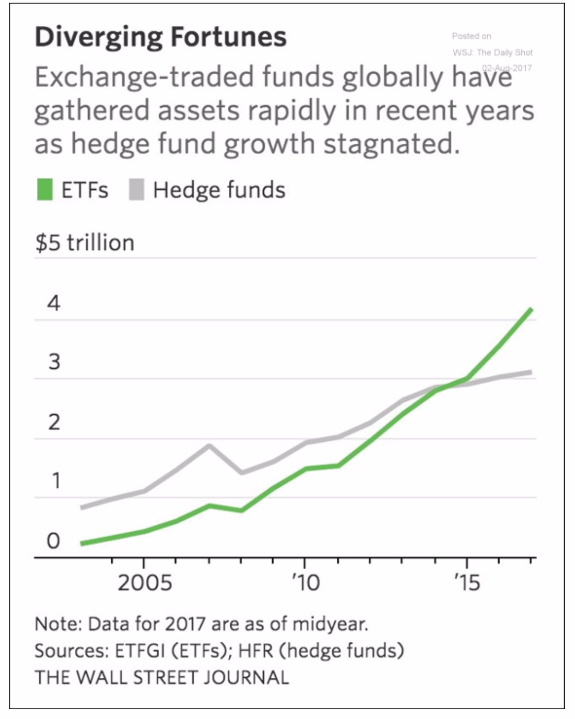
Chart of the Month – The rise of passives
The rise of passives
How the role of ETFs has evolved in an increasingly efficient market
Not a month goes by without an article in the press criticizing the high fee structures of both hedge funds and traditional long only funds and their underperformance in comparison to their benchmark indices. It comes as no surprise that ETFs have surpassed hedge funds in terms of total assets under management since the end of 2015 as they have become increasingly competitive in terms of pricing.
The rise in passive investing has clearly made active management more challenging, particularly in a rising market, which we have had since March 2009 (the second greatest bull market in modern history). To illustrate this, there have been numerous studies produced by the likes of S&P Global highlighting the fact that over 70% of equity managers underperform their benchmark net of fees over 10 years. The record is far worse for investment grade bond fund managers. With an increasing number of competitors within the investment community chasing the same opportunities (particularly in the US) it has become increasingly challenging to generate Alpha. Violent sector rotations have also become increasingly prevalent in equity markets creating significant challenges for active managers. Where passives may run into trouble is during sideway markets and is when active managers should be able to outperform.
During the past decade, it is estimated by JP Morgan that passives and quants have increased their share of equity trading volumes from less than 30% to around 60% dwarfing the volumes originating from fundamental discretionary managers. This partly explains the low levels of stock dispersion and high levels of correlations between stocks which makes it very challenging for active managers to outperform. In addition, it is becoming more difficult for active managers to compete against passive managers in terms of operating expenses not to mention the cost of regulation and technology. The low cost model no matter what the industry, is based on generating volumes and passives are no exception with the market leaders cutting fees with the goal of increasing their value proposition. Although they may continue to gain market share from active managers as investors realize the fact that many of their active managers underperform in the long run one should wonder what would occur if global markets had a massive pullback following a bull market that has 101 months in the making (the tech bubble that ended in March 2000 lasted 113 months!). The inevitable question arises as to who will be on the other side of the trade as there is bound to be an overshoot to the downside when everyone sells on panic mode. Together with trend following CTAs and the more fashionable cocktail of risk premia strategies out there which will tend to sell equities in a market downfall the wakeup call could be deadly. ETFs have clearly become more complex over the years and given the low levels in the VIX, leverage has increased in the aforementioned range of products. They have also become very creative; there is an ETF that is based on the inverse performance of the VIX which was up over 100% YTD (to the first week of August) and in the top 30 of the most traded securities. Creativity has no limits but could also be an accident waiting to happen!
Chart of the Month – Swiss Equity Market: low volatility does not mean low risk!
Swiss Equity Market
Low volatility does not mean low risk!
Source: Notz Stucki
In an environment characterized but high political and policy risk, low levels of market volatility seem paradoxical. Volatility expectations for stocks and bonds have sunk to levels not seen since 1990. The VIX Index, which reflects a market estimate of future equity volatility, traded below the psychological level of 10 during 16 days this year (it only occurred 35 times since 1990) and the MOVE Index, which measures bond volatility, reached its all-time low recently.
There are different explanations for such a low volatility environment:
On the macro side, low interest rates have encouraged investors to buy assets boosting their prices and in turn reducing volatility. With QE, central banks have put a floor under global asset prices with unprecedented balance sheet expansions. Finally solid economic growth with contained inflation means little reason for prices to move significantly.
Market participants have changed their way of investing with large inflows into passive investment solutions like index-trackers and ETFs across all asset classes and the growing popularity of low volatility/diversified risk premia funds. Due to regulation, banks and insurers have invested massively into Government bonds to the detriment of “traditional risk” assets. Finally, algorithmic trading represents more and more of daily market volumes and machines are able to capture short term moves or inefficiencies, which mean smaller and fewer swings in prices before equilibrium is found.
But this doesn’t mean low risk! In asset allocation models, exposure to risky assets have increased over the last few weeks as low volatility is a mathematical driver of trade sizing codified in hundreds of billions of risk managed investment strategies. This false signal of safety could result is an inability for investors to appreciate how quickly market conditions could change, which make trading strategies more vulnerable to unwinding and amplifying a risk-off event.
At the Notz Stucki Group, the Asset Allocation Committee decides of the asset allocation of managed portfolios. A balanced portfolio currently shows the following allocation: 50% equities, 25% fixed-income and 25% absolute return strategies with little cash.
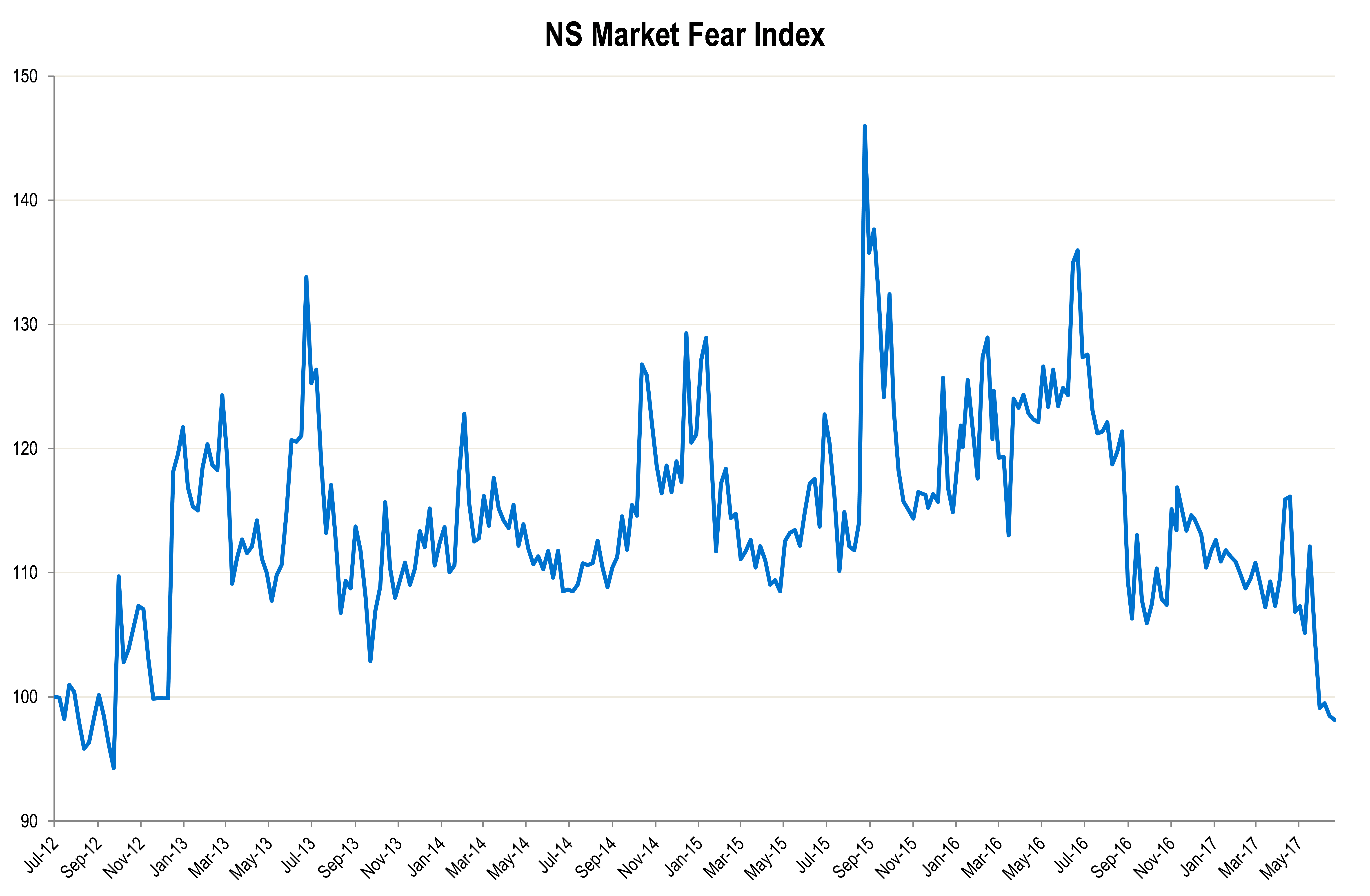
The NS Market Fear Index (please see above) is a fusion of volatility indices on equities, fixed-income, currencies and commodities with a similar weighting in each asset class as we have in the balanced portfolio over time. The recent levels reached by the NS Market Fear Index are among the lowest for the last 5 years.
But we are aware of the situation and are acting accordingly. First, we adapt our asset allocation in function of the changing market environment and we don’t hesitate raising cash if needed. Secondly our main focus is active management and we are invested both internally and externally with flexible independent asset managers who try to preserve capital. Finally, we bought some puts in equity portfolios, have maintained a short duration in fixed-income products, decreased the exposure to managers with higher leverage and keep a 25% allocation to absolute return strategies which are less sensitive to periods of risk off and volatility spikes.