Chart of the Month – Money for Nothing – and Your Debt (almost) for Free
Money for Nothing – and Your Debt (almost) for Free
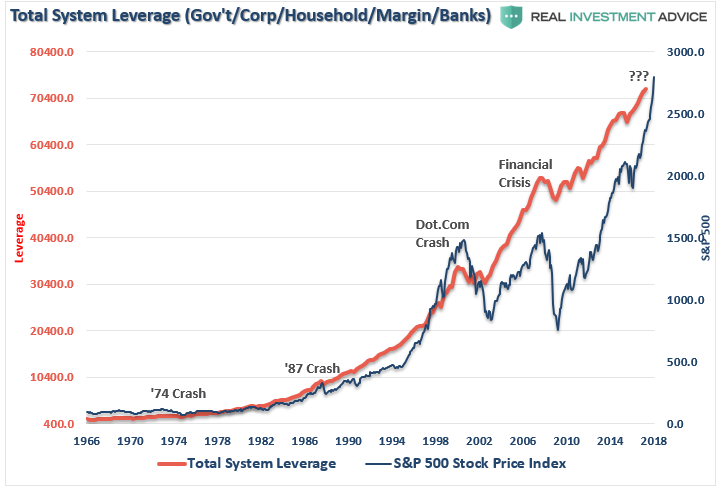
Source: Real Investment Advice
Most of our readers will be old enough to remember the hit single “Money for Nothing” that topped the US charts for three consecutive weeks and won MTV’s video of the year in 1985. Who would have thought that 25 years later one would witness negative interest rates? Following numerous re-iterations of quantitative easing the Fed has provided more than just a life support and fueled the longest uninterrupted bull market in US history which quadrupled the S&P 500 from its intra-day low of 666 on March 9th 2009. Over this period of record low interest rates, US corporates have been able to fund their share-buybacks and in many cases their dividends. More recently this phenomenon has been boosted by a one off tax cut. In addition, the increase in corporate debt has gone hand-in-hand with the increase in profits and cash-flows taking the stock market higher.
Where do we go from here? Inflection points in economic cycles are very difficult to predict and the transition from QE to QT has impacted equity markets of late. The massive sector and factor rotation witnessed in October and the beginning of November have clearly caused a lot of damage to most equity related strategies (long only, long short and market neutral). All this appears to have been sparked off by US monetary policy, setting off a knee jerk reaction in position unwinding by fund managers. With the recent change in Fed rhetoric, one wonders if the Fed has not underestimated the impact of Trump’s trade war. As we all know, leverage always comes back to bite you at some point. The question now is whether to continue to be long the equity market or take a hedged approach as markets are likely to remain volatile.
Investment Outlook Q3 2018
At 10 times revenues, to give you a 10-year payback, I have to pay you 100% of revenues for 10 straight years in dividends. That assumes I can get that by my shareholders. That assumes I have zero cost of goods sold, which is very hard for a computer company. That assumes zero expenses, which is really hard for a company with 39,000 employees. That assumes I pay no taxes, which is very hard. And that assumes that you pay no taxes on your dividends, which is kind of illegal. And that assumes with zero R&D for the next 10 years I can maintain my current revenue rate….what were you thinking.
Scott McNealy, CEO of Sun Microsystems at the time of the dotcom crash when the shares were selling at 10 times sales.
Scott McNealy
At mid-year world bond and equity markets have struggled, with bonds delivering a slightly negative return and equities fell 1.3% as measured by the MSCI World Index, a poor return given that S&P earnings are estimated to increase by 25% this year (largely thanks to the tax cut at the end of 2017). Emerging Markets have been particularly poor performers. The reason is that liquidity has been tightening. In the US, quantitative easing is being steadily drained from the system at a rate of $30 billion a month, which rises to $40 billion from July 1st, and then $50 billion on October 1st. The oil price has risen about 30% over the past year, which results in a severe drain of liquidity. Labour markets have also been tightening creating some wage pressure and with inflation measures trending higher, bond yields have risen. On top of all this investors have been unnerved by a number of political developments, most obviously the trade disputes as the Trump Administration has now specified particular areas against China and Europe, and in Europe an Italian political crisis has threatened the stability of the Eurozone. The US tax cuts achieved at the end of last year, are a clear positive for the stock market, representing a substantial infusion of cash to shareholders. However tightening liquidity, the threat of protectionism and inflation are unfriendly for markets, and constitute significant headwinds. Together they have made the outlook for financial assets much more murky than was the case a few months ago. All markets have been buoyed on an ocean of liquidity for the past few years, so as that is removed a major support to asset prices disappears.
It is unusual to have trade wars when activity is expanding; generally they are a reaction to weak economic activity.
Please click here to download the entire document.
Chart of the Month – Alpha generation is back!
Alpha generation is back!
Source: Notz Stucki
Equity markets have entered into a new volatility regime since February 2018. This could have been expected with the beginning of the end of QE decided by all major central banks since almost 10 years following the global financial crisis.
During this period of massive liquidity injections in markets, equities have performed well, especially in the US, particularly in the healthcare and technology sectors. The European economic recovery has been slower to materialize than in the US and the MSCI Europe Index was up +28.5% over the last 5 years.
Active managers like fundamental stock pickers or equity long/short managers have struggled to deliver alpha in a context of risk on/risk off mode driven by macro factors. The scenario has started to change over the last 12 to 18 months as can be shown on the cumulative alpha generated the managers selected in Lynx compared to European equities. Since February 2017, Lynx has generated more than 10% of alpha compared to the MSCI Europe Index.
With a lower correlation between stocks and sectors and a slow normalization of interest rates, we think that active managers should continue to deliver alpha and should be the approach to favor when investing in equities.
Investment Outlook Q3 2017
Notz Stucki has just released its investment outlook for the third quarter of 2017.
“The reduction of interest rates below their natural levels has poisoned the river at its source, and nobody knows whether the water is fit to drink.” Jonathan Ruffer
The markets performed well in the second quarter propelled by the reassuring election result in France which drew a line under the populist victories in the major elections last year.
Emmanuel Macron, 25th President of the French Republic
As the year has progressed the shocks of Brexit and the Trump victory have been digested, and there is more clarity on what they may signify. Ironically after four decades of being a difficult member of the EU Britain may become a better European state when it leaves, being forced to accept compromises. The Brexit negotiations are likely to offer more noise than light in the next year, the process has been likened to negotiating a divorce with 27 spouses simultaneously, but despite the nationalist rhetoric both sides are incentivised to come to a sensible agreement, and Mrs May’s disastrous election campaign has weakened the hand of the hard Brexit camp. Meanwhile the more one watches the Trump administration the more it seems that the Barbarians are in the Castle. Mr Trump’s unpredictability and lack of Washington experience has affected his ability to push his reforms through. Thus far the anglo-saxon world has seemed powerless to translate the visceral voter anger into legislation.
As politics becomes less of a concern investors can worry again about QE-fattened markets…
Please click here to download the entire document.
Currency wars and helicopter money : a former central banker speaks
It was Milton Friedman who was the first to talk about ‘helicopter money’ and used the metaphor of a helicopter dropping dollars from the sky. In his model, Friedman was trying to create a simple link between money and inflation. Raising nominal demand this way would have a quick and mathematical effect on price.
In these times of negative rates, continued slowdown in consumer demand in most economies and fears of deflation, money thrown from the sky may seem like the only policy response left to our beleaguered central bankers. Accompanied by constant mention of ‘money printing’ by the press, it’s starting to make us feel as though money had become completely worthless to a point of being printed and thrown out of moving aircrafts… a view certainly not lost on many market commentators who in in 2009, when we embarked on the first QE programs, left us pondering if FIAT currencies had seen their time.
On the one hand, we haven’t seen the levels of runaway inflation that would have acted as a harbinger of the demise of FIAT currencies. Also, currencies are still able to reflect the fundamentals in an economy and generate enough trust to fulfil their primary function as a stores of wealth. Although slowing down from its peak, cross border trade is still occurring helping nations and their people get closer thanks to newly built commercial ties. All of this thanks to the role of money in the least bad of options available to human kind which is capitalism. On the other hand, even though we still have a price for everything, assessing value has been more and more difficult.
To help Swiss Pension plans makes sense of the currency risks embedded in their portfolios, Chris Dreyer of the Swiss CFA Society and Nathalie Miazza of the Fédération des Entreprises Romandes (FER) invited Jean-Pierre Danthine former Vice President of the Swiss National Bank (SNB) to speak at their Swiss Pensions Conference on the role of Central Banks in managing money. To drive this point even further we were all given a dollar bill folded as an airplane with our documents. The CFA Society’s version of helicopter money it seems.
‘Understanding full well there are behavioural biases when investing, I think current levels of pessimism are overdone’ states Danthine. ‘It’s been a tough seven years and both economic and market participants are affected. Let’s not forget how spoilt we were ahead of the credit crunch: global growth had been in the 5% range from 2003 to 2008. In the 90s though, we were at 3% a bit like today where OECD forecasts were recently brought down from 3.3% to 3.2%. Financial stocks, up until the credit crunch, were on steroids and today’s volatility is a direct consequence of their falling out of favour. All is not dark though…in the US, growth is certainly there and even though it is slow, it is well established and firmly anchored.’
‘Central banks need to pass the torch and they need to leave markets alone’ opines Danthine and goes on to add ‘deflationary worries are overdone. When there is too much liquidity, structural periods of low inflation are an opportunity for markets. Bear in mind recessions always come when central banks use the ‘monetary brakes’ by raising rates. Today, there’s no risk of this happening as inflation is subdued and the Fed in the US is happy to be behind the curve’. Admittedly, we’re far from being in a normal cycle. According to Danthine, the only way to get inflation back to 2% is through the Coué method (from a French pharmacist who spoke of positive reinforcements and feedback loops) and although limited, would affect the economic agents in the economy by influencing how they see prices going forward. ‘QE ad nauseam is very dangerous’ interjects Danthine. ‘QE and currency wars are the same thing and no distinction needs to be made between the two. This beggar thy neighbour approach can only end in tears’. In the case of Switzerland for instance, NIRP (the Negative Interest Rate Policy) has become an unwelcome necessity at this juncture for the SNB as the Franc is too strong and uncompetitive. As long as the ECB is accommodative, rates will have to go lower in Switzerland although it has very limited benefits to the overall economy. IF the SNB reduces rates let’s say from 2% to 1.25% hypothetically, that’s a 75bps move which can help stimulate demand for credit. But in today’s world and as we delve deeper into negative territory, would a 75bps move have the same effect? Probably not as the cost of borrow for corporates wouldn’t move. At this stage, QE and NIRP are about currencies and only indirectly about the overall economy’ he opines.
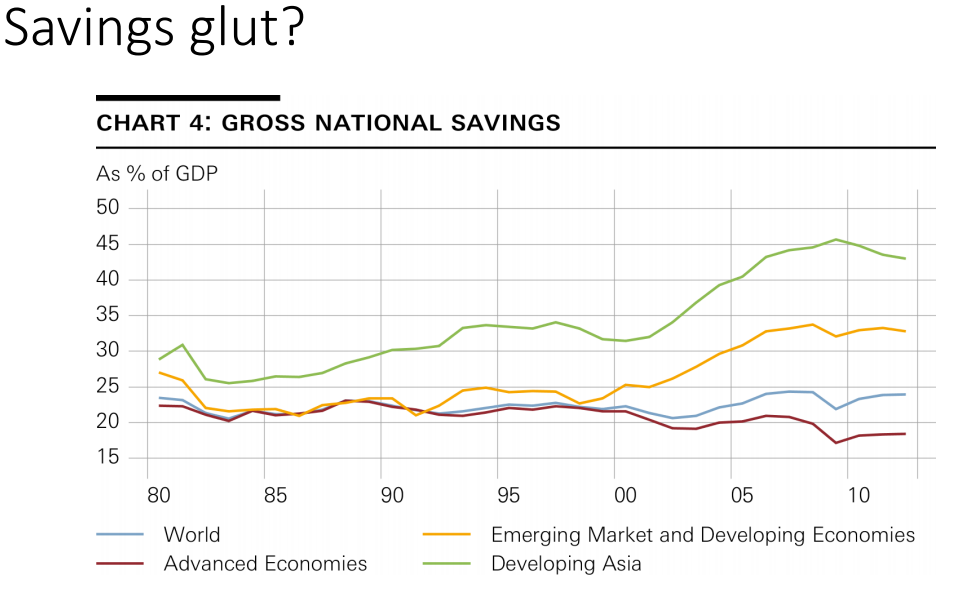
It’s interesting that for the amount of market participants that will claim there is too much leverage and debt in the world there are as many that state the opposite. Danthine is firmly with the latter. ‘The world-wide savings rate is too high’ states Danthine ‘and up until now the imbalance/equilibrium between savings and investment is heavily skewed towards keeping rates lower. Competition between holders of capital is bringing down yields and with negative rates, you’re compounding this problem by forcing investment.’ We can expect that trend to reverse according to him and should most likely see cycles where inflation will be higher. He went on to give us several examples where the global trend regarding savings levels is reversing: (1) in ’98, during the Asian currency crisis, reserve levels went higher acting as a buffer in case the NPL problems reoccurred. This is now changing (2) China also had very high reserves to increase the value of the RMB against the dollar. The currency is now devaluing slowly reducing reserve requirements (3) the Middle East had a surplus of petro dollars with the recent fall in the commodity prices also reversing this trend. Pressure on interest rates should therefore fall as these trends all reverse with the last currency manipulator (i.e. Germany), with its giant trade surplus, going against this grain for now.
Source: J.P. Danthine ‘s presentation
‘In the long run though we have to avoid secular stagnation and focus on its primary sources’ claims Danthine. ‘Admittedly, it’s a very American preoccupation. We’ve witnessed a recent period of strong productivity gains, exceptional by most accounts and according to pessimists it’s unsustainable….the end of innovation, the ageing of the populations of the developed world are all put forward as reasons.’ He feels we’re still on the right path and as a base scenario sees a slow and drawn out recovery with weak growth thanks to continued productivity gains. Switzerland will have a long wait due to the strong CHF and will need for Europe to normalize first. For solid growth, important and difficult reforms need to be made. Si vis pacem, para bellum (if you want peace, prepare for war) Vegetius (Epitoma Rei Militaris).
‘Pension plans in Switzerland are forced to be short term in their approach (negative rates are forcing them in that direction) but regulation must change to let them invest longer term and take on currency risk without having to match liabilities with assets in CHF’ opines Danthine. The Swiss franc is overvalued by the simple means that it is several standard deviations from its long term trend line. ‘If you are of the belief it will always be a currency in structural appreciation (due to its safe haven status) it is still too expensive….even more so if you feel there’s a cyclical component to the currency’s appreciation. Forcing Plans to be long the Swiss franc at this stage is dangerous and short sighted’ he concludes.
Chart of the month: The incredible bull market in bonds
Chart of the month
The incredible bull market in bonds
“You seem to have this nasty habit of surviving, Mister Bond”
Source: Bloomberg
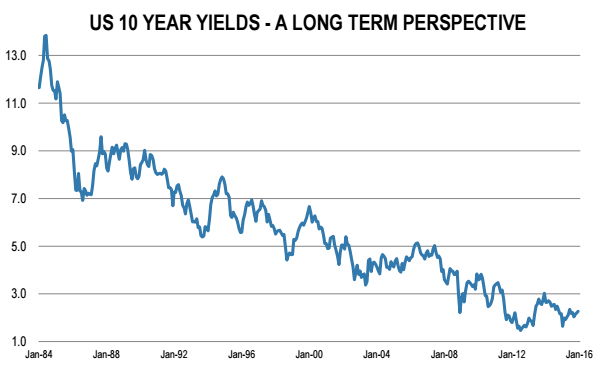
When Kamal Khan tells James Bond that he has a nasty habit of surviving in “Octopussy” in 1983, he does not refer to the bond market obviously….. But funny enough the year the movie was released more or less corresponds to the start of one of the longest bull markets in history, precisely on bonds.
At the end of the year 2012 one could have thought that good days were over and that being a bond investor, in particular on 10 year Government benchmarks, would become quite a challenging job. At that time markets were increasingly expecting the end of Quantitative Easing by the Federal Reserve, and a progressive “normalization” of the structure of the US yield curve. The reasons were pretty straightforward: self-sustained economic growth, better global growth prospects, improving housing and job markets, strong banking sector, and the list goes on.
The natural path of US government bonds yields was clearly on the upside, and a steepening of the yield curve was widely expected… and happened as US 10 year yields more than doubled from a low of 1.38% in July 2012 to a high of 3.05% in January 2014, a period during which the Fed talked a lot but barely acted (no changes were made on the interest rates side, but QE program was gradually tuned down).
Since then a new sequence of strong performance occurred on the bond side, with US 10 year yields falling back to 2% (as of January 2015) with a short incursion into the 1.60-1.70% zone at the beginning of 2015. What has happened to push yields to such low levels again? Here also the reasons seem quite obvious with hindsight: the initial big down move was triggered by the first spectacular fall in oil prices which started in July 2014 and ended at the beginning of 2015 (from $108 to $42 per barrel), perfectly matching the US 10 year yield move from 3.05% to 1.64%. The second round of falling yields started in June 2015 and is still in place today….there again perfectly correlated to the second round of falling oil prices.
On top of this spectacular fall in oil prices one can add the considerable weakness in almost all commodity prices, so there seems to be a logical reaction from fixed income markets which are anticipating non-existent inflationary – or even rising deflationary – pressures.
Another striking correlation comes with the Chinese Renminbi which peaked in January 2014 (like oil and US 10 year yields) at 6.04 per USD and has fallen to 6.58 per dollar since then. This is a very important event because there are now serious fears that China is on its way to let its currency depreciate further, which would certainly generate a wave of deflationary pressures around the globe.
What can be expected from now on with bonds? With such low levels the risk/reward proposal still appears unattractive and it seems to make more sense to invest on relatively short maturities (maximum 5 years) in order to roll down the curve while it’s still steep. But what if the doomsayers got it right? The Japanese recent history shows that first it is complicated to fight against deflation once it’s in place, and second that it is a highly risky business to bet against a bond market. Those having made money by shorting JGBs are the very lucky few, everybody else having lost money and patience.
And to remind us that this mid-80s – 2015 period has been exceptional, one quick look at the 30 year benchmark issued by the US Treasury in February 1986 and which matures next month is highly illustrative: with a 9.25% coupon, issued at par and reimbursed at par, an investor would have made a 9.25% return annualized, the maths are simple. During the same timeframe, the SP500 with dividends has compounded at 10.3%, a mere 1% better, but with far much more sleepless nights.
So yes, Mr Bond Market, you have a pretty nasty habit to survive!