Chart of the month: From safe haven to power play: the Swiss market unleashed

From safe haven to power play: the Swiss market unleashed

Source: Bloomberg, NS Partners


Switzerland is globally renowned for its breathtaking landscapes, world-class ski resorts, and prestigious watchmaking industry. However, beyond its scenic beauty, Switzerland boasts world-leading companies in niche industries and stands as a safe haven with untapped potential. It offers a compelling opportunity for investors seeking stability and long-term growth, supported by resilient market fundamentals and a strong economic framework.


In recent years, investors have heavily concentrated their portfolios in the U.S. technology sector, particularly in the “Magnificent 7.” However, the recent AI-driven “red wave” has highlighted the risks of overconcentration. The market’s reaction to DeepSeek’s debut served as a stark reminder of how quickly sentiment can shift, underscoring the importance of diversification. In this context, Swiss equities present a compelling opportunity. Known for their strong balance sheets and earnings growth, Swiss companies provide exposure to high-value niche industries. The Swiss market, by nature, has shown a defensive character over time, with key sectors including consumer staples, insurance, utilities, and pharmaceuticals accounting for more than half of its market composition. Post-DeepSeek turbulence, the Swiss market’s defensive qualities shine even brighter.


Since the beginning of the year, Swiss indices have outperformed global peers, with the Swiss Market Index posting impressive gains of 8.59% in January.  Demonstrating resilience on January 27th. Adding defensive position remains a time-tested strategy, amid persistent volatility and uncertainty in global markets. Swiss blue chips such as Nestlé, Roche, and Novartis continue to serve as cornerstone holdings for stability-focused portfolios. However, the true opportunity may lie beyond these household names. While large-cap Swiss stocks attract the most attention, mid-cap companies represent a largely untapped growth avenue. Mid-caps, often in their expansion phases, offer significant growth potential backed by strong fundamentals. That said, careful valuation assessments are essential to mitigate risks related to liquidity constraints and premium pricing.


Recent market movements have not disrupted the positive trajectory of several Swiss stocks, with double-digit gains in key names such as Cie Financiere Richemont, Logitech, UBS, Roche, and Partners Group. But also, gems like Galderma, Sandoz Straumann, Swissquote, Comet, Sulzer and Belimo.


Switzerland’s monetary policy remains supportive of economic growth. The Swiss National Bank is likely to maintain a dovish stance, with the potential for lower or even negative interest rates. Such a policy environment provides an additional tailwind for Swiss equities, particularly for export-oriented firms.


For investors seeking a blend of diversification, stability, innovation, and growth, Swiss equities offer a compelling solution. In today’s unpredictable market environment, having a solid Swiss allocation may not just be a luxury—it might be a necessity.


Past performance is not indicative of future results. The views, strategies and financial instruments described in this document may not be suitable for all investors. Opinions expressed are current opinions as of date(s) appearing in this material only. References to market or composite indices, benchmarks or other measures of relative market performance over a specified period of time are provided for your information only. NS Partners provides no warranty and makes no representation of any kind whatsoever regarding the accuracy and completeness of any data, including financial market data, quotes, research notes or other financial instrument referred to in this document. This document does not constitute an offer or solicitation to any person in any jurisdiction in which such offer or solicitation is not authorized or to any person to whom it would be unlawful to make such offer or solicitation. Any reference in this document to specific securities and issuers are for illustrative purposes only, and should not be interpreted as recommendations to purchase or sell those securities. References in this document to investment funds that have not been registered with the FINMA cannot be distributed in or from Switzerland except to certain categories of eligible investors. Some of the entities of the NS Partners Group or its clients may hold a position in the financial instruments of any issuer discussed herein, or act as advisor to any such issuer.  Additional information is available on request.
© NS Partners Group

Chart of the Month – David and Goliath

Chart of the Month – David & Goliath

In modern times, the expression « David and Goliath » has taken on a popular meaning, denoting an underdog situation, when a little guy faces a bigger power, a taller person. This is an interesting parallel when we consider and confront companies of different sizes in a market.

When it comes to investing in Switzerland, we tend to pick Nestlé, Roche, Novartis among others. A portfolio’s exposure to Switzerland is often exclusively concentrated on the large caps. However, the Swiss market is just as interesting, and more diverse, when you decide to look at smaller companies. By definition, the Swiss market has demonstrated a defensive nature over time. This market is export-oriented, largely specialising in high added value products and full of specific and niche companies. It is easy to find and invest in companies with, among others, stable earnings, low beta and constant dividend. The Swiss performance extra price return index is a capitalization-weighted index composed of all companies in the SPI small & mid cap excluding any companies in the SMI Index. Over the last 5 years, performance is +66.39% (+10.73% annualised) against +54.68% (+9.12% annualised) for the famous SMI Index. This is also true over the last 10 years and, in the shorter term, over the last three years.

In terms of composition, both indices are in line across all sectors with the big difference being the exposure to the industrial and health-care sectors. With a smaller exposure to health-care and a larger exposure to industrials for the small and medium sized companies index -a sector that tends to perform well in expansionary phases and has historically reacted positively to rising inflation.

The best performers on an annualised basis over the last 5 years are Bachem (specialising in the development and manufacture of peptides and oligonucleotides), Straumann (a leader in implant and esthetic dentistry), as well as Swissquote (the leading Swiss online bank) and industrials VAT Group (high-performance vacuum valves, multi-valve units) and Interroll (products for unit-load handling systems, internal logistics and automation). They all outperformed the SMI components.

Investing in smaller companies requires being selective. You are exposing yourself to other possible issues such as liquidity, possibly lower margins and higher valuation, but on average, you get a similar dividend level and companies are in an acceleration phase of growth, facing rapid innovation.

Just like David and Goliath, in Switzerland, the little guy wins!


Past performance is not indicative of future results. The views, strategies and financial instruments described in this document may not be suitable for all investors. Opinions expressed are current opinions as of date(s) appearing in this material only.

References to market or composite indices, benchmarks or other measures of relative market performance over a specified period of time are provided for your information only. NS Partners provides no warranty and makes no representation of any kind whatsoever regarding the accuracy and completeness of any data, including financial market data, quotes, research notes or other financial instrument referred to in this document.

This document does not constitute an offer or solicitation to any person in any jurisdiction in which such offer or solicitation is not authorized or to any person to whom it would be unlawful to make such offer or solicitation. Any reference in this document to specific securities and issuers are for illustrative purposes only, and should not be interpreted as recommendations to purchase or sell those securities. References in this document to investment funds that have not been registered with the FINMA cannot be distributed in or from Switzerland except to certain categories of eligible investors. Some of the entities of the NS Partners Group or its clients may hold a position in the financial instruments of any issuer discussed herein, or act as advisor to any such issuer.

 Additional information is available on request.

© NS Partners Group
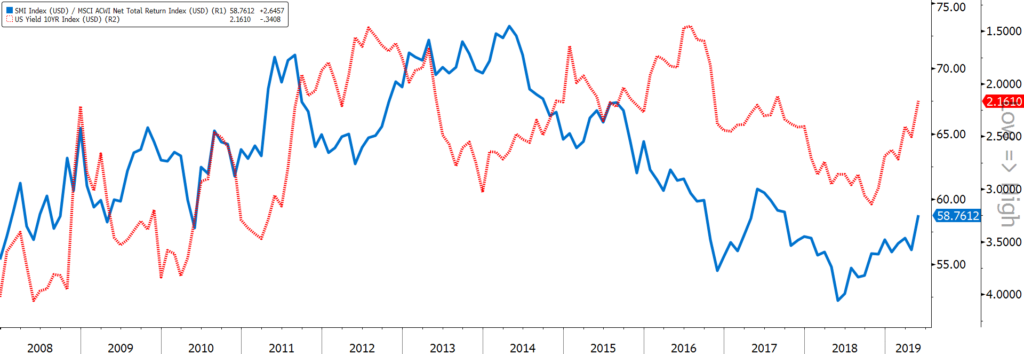
Chart of the Month – Something wrong? Eat chocolate.

Chart of the month

Something wrong? Eat chocolate.

Source: Bloomberg, Notz Stucki

The month of May has come with its various news, we experienced the first month in negative territory since December 2018. We had however started the year well with four consecutive positive months. May brings some questions to investors: Should I sell? Do I have to worry? … What can I do?

One simple action would be to increase exposure to defensive stocks. Find and invest in companies with, among others, stable earnings, low beta and constant dividend. By definition, the Swiss market has demonstrated a defensive nature over time. Links exist between movements on the US yields and world equity markets, the impact could be more or less significant. In the graph above, over an eleven-year window, we find the 10-year US yield on an inverted scale and the ratio Swiss market over the MSCI All Country World Index. The trend has been reversed since mid-2018: the Swiss market outperforms the world index. We notice that lately when yields go down in US (in our example the 10-year) Swiss market performs and since mid-2018 much better in relative terms.

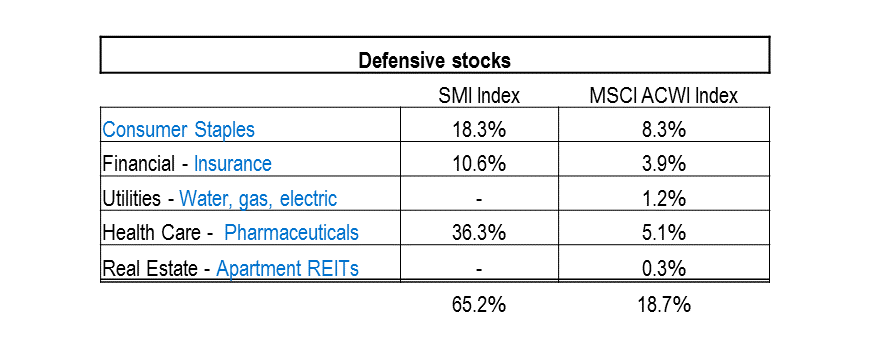
One step further, what is the actual composition of the Swiss market? Is it really defensive compared to MSCI All Country World Index? Analysis focused on the major Swiss Index: SMI Index. We selected the sectors and subsectors that have a defensive nature, this means Consumer Staples, Insurance, Water, Gas and Electric-related companies, Apartment REITS and Pharmaceuticals, excluding Biotech companies. Results are straightforward: Swiss market detains more Consumer Staples (18.3% against 8.3%), more Insurance companies (10.6% against 3.9%), more Pharma (36.3% against 5.1%) than the MSCI All Country World Index and there is no exposure to Utilities – Water, Gas and Electric-related companies or Apartment REITS. The large Swiss exposure to Staples and Pharma through Nestlé, Roche and Novartis is well known, however, the exposure to insurance and therefore the overexposure to the world index is probably not as well-known.

To conclude, more than half of the Swiss market, i.e. 65.2% is composed by defensive stocks versus 18.7% for the World Index. If we extend the analysis to the SPI Index, as the Swiss market is full of specific and niche companies, results are similar. We do not specially expect a downturn and we are not ready to sell but to add defensive in one’s portfolio can be an attractive direction. Last month, Swiss stocks demonstrated resilience with a scant negative performance of -2.52% bringing the SMI’s performance to 12.99% YTD. Last but not least, it is difficult to ignore the very good performance of the king of Swiss Staples: Nestlé, at +24.75% YTD.