Chart of the month: US economic consensus 2025 less good than expected
US economic consensus 2025 less good than expected
Donald Trump’s November 2024 election victory sparked optimism for a revitalized US economy, with expectations of good GDP growth and a reduction in the hefty budget deficit inherited from the Biden administration. Equity markets soared after Election Day, signaling confidence in Trump’s economic agenda. The initial Bloomberg Consensus for 2025 projected GDP growth at 2.2%, with hopes of fiscal discipline to tackle the long-standing deficit challenge.
Yet, Trump’s tariff obsession, marked by “Tariffs Day” in April 2025, defied David Ricardo’s free trade principles, creating a lose-lose scenario. The updated 2025 consensus reveals a GDP growth drop to 1.4% and a core PCE inflation spike to 3.0%, reflecting expected short-term inflationary pressures. This tariff-driven approach has disrupted global trade, stifled growth, decreased corporate profits and raised consumer costs, undermining the early economic optimism.
The situation deteriorated further with the first draft of Trump’s “Big Beautiful Bill,” which unexpectedly widened the budget deficit disappointing investors who anticipated fiscal restraint. While tariff revenues may partially offset the deficit, the bill has hampered DOGE’s (Department of Government Efficiency) efforts to curb spending. Rising concerns over sustained borrowing have caught the attention of bond vigilantes, pushing US 30-year government bond yields to 5.0%.
The 2025 consensus now paints a less rosy picture: GDP growth at 1.4%, higher inflation (set to ease in 12-18 months), and a persistent -6.5% budget deficit. This has weakened the dollar, driven interest rates higher, left equity markets flat, and fueled uncertainty among consumers and corporations.
However, Trump has shown a willingness to pivot when needed, so we may see tariff reductions and a revised “Big Beautiful Bill” that better aligns with market expectations, potentially easing some of these economic strains.
After the strong performance in almost every equity market in 2017, characterised by a remarkable lack of volatility, the financial weather changed abruptly in the middle of the last quarter. The trigger was a stronger than expected jump in US hourly wages in January. This inflationary fright rattled markets and led to a steep sell off in bonds and equities. As the quarter progressed a less alarming picture of inflation emerged. However markets had become extended and they have not settled down, while further anxiety was caused by President Trump threatening trade tariffs which could upset the global trade system that has been in place for the last thirty years, and a scandal involving Facebook, one of the market leaders.
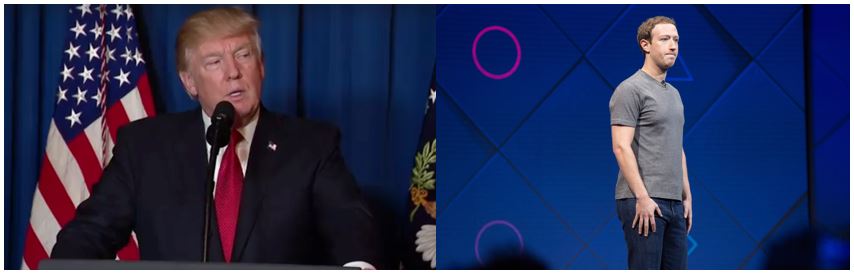
President Trump, Mark Zuckerberg
Markets took Trump’s election victory calmly with the S&P 500 recording gains in every month of 2017. One of the positive features of his Administration has been the reduction of regulations. For example the number of pages of the Federal Register has risen steadily since World War II. In the past year they have dropped from almost 100,000 pages to 54,153, partly due to the Trump program requiring two regulations to be cut for every one added. They cut more on top of that. This is a dramatic change that gives American business considerably more operating flexibility. The tax cut he pushed through in December led to a spike in the stock market in December and January, but the inflation number and some geopolitical rumbles caused the market to be more sceptical of Trump. On the economic side the concern for the bond market is the substantial supply of bonds that will be needed to finance the recent tax cuts. The US budget deficit is forecast to expand from 3.5% to 6%, at a time when the Federal Reserve is withdrawing its policy of QE by reducing their purchases of bonds at a rate that will reach $50bn a month by October, so the bond market faces significant negative changes to both supply and demand. The tax stimulus is coming at a time of nearly full employment so the market is particularly sensitive to wage increases. On top of this the market must contend with the capricious nature of the President, whose policies frequently appear to be unanchored. It is never quite clear what his strategy is, and he has shown a far greater tendency to shift position on a policy than previous incumbents. One example of this is there has been an uncomfortably high turnover of White House staff during his tenure. This is unsettling for markets which prefer clear signals from global leaders on which they can base their decisions. President Trump also seems uninterested in the global bodies that have dominated the world over the past half century such as WTO, NATO and the UN. Whatever the merits of his view that these organisations constitute a bad deal for the US, the danger arises that if the US show less commitment to them then the world is left without a night watchman at a time when security fears are growing, creating further uncertainty. Another concern is the proposal of tariffs being imposed by the US. Anything that inhibits free trade is a negative, so the threat of protectionism weighed on the market at the end of the quarter. However the greatest threat may come from the changes that President Trump made to his senior team in March, which points to a far more hawkish approach on foreign policy, particularly towards countries that the US perceive as rogue states like North Korea and Iran. As a consequence geopolitical tensions have risen considerably this year. While any serious international rift effects markets, an action against Iran would directly affect the oil price and is therefore of more concern.
Please click here to download the entire document.
Investment Outlook Q4 2017
Notz Stucki has just released its investment outlook for the last quarter of 2017.
Contrary to predictions at the start of the year, when it was expected that they would have to contend with rising interest rates, markets have been strong this year. Moreover one of the main hopes on President Trump’s election was that he would cut taxes and introduce a one billion dollar infrastructure plan. Not only has a clear tax policy not been set out by his Administration, but little else of any significance has been achieved so far, and the White House has suffered a dismaying series of shambolic incidents.
Evidence mounts that Mr Trump lacks the skills to run the executive arm of government, which is all the more disturbing given the bellicose situation in North Korea. However markets have risen against a background of steady economic growth and continued low interest rates. What the rise in the indices masks though is what a narrow market it has been. It has been a market driven by passive flows, with more and more money being run by ETFs. Any change to either the low interest rate environment or the cult of ETFs would have profound implications for investors.
Further evidence of the desperate hunt for yield was revealed in the last quarter.
Please click here to download the entire document.
Notz Stucki Investment Meeting – Notes 11 04 2017
Over the past year world economic growth has been stronger than expected, for several reasons. First China’s growth has been solid. Instead of imploding the industrial side of the economy bounced back in 2016 in response to the policy measures of a year ago. Growth in China may fade a bit this year as the stimulus wears off, but it won’t collapse. Second the Brexit shock turned out to be a damp squib. Aside from sterling’s fall it affected little, though it underlined Central Banks’ determination to underwrite the system in response to any shock. Third Trump’s election led to a surprising rally in risk assets on hopes of a reflation. There are signs now that this rally is fizzling out as Mr Trump is running into the usual Washington impasse. Meanwhile the Eurozone appears to be bottoming out and growth rates are improving. Even the southern countries are doing better. The Germans are realising that some inflation is needed, and if German wage growth outpaces wage growth of the Mediterranean countries then the long-hoped for rebalancing will be underway.
While economic growth is better, the outlook for asset markets is more complicated. Equity markets have discounted the recovery, and have been further puffed up by governments’ monetary policy. Low interest rates didn’t trigger new investment, it just raised asset prices. The rate of growth of US productivity, a vital component of growth, has been falling since 2005 as business investment has been meagre, and creative destruction didn’t happen. At the time of the crisis in 2008/09 western governments were already carrying too much debt so fiscal stimulus was unpalatable, and they had little choice but to cut interest rates and adopt quantitative easing. The resulting asset price rises did nothing for productivity. Structurally companies face more problems than in the past. The companies that should have been allowed to fail in the crisis have continued, and these zombie companies have prevented the stronger companies from taking market share. Regulation is more complex. The tax code is fiendishly complicated. All these factors favour the big company over the small start-up who faces much greater obstacles than in the past, and the steadily declining productivity growth may point to the economy being less dynamic today. In this context Trump’s promise to cut taxes and regulation are clear positives, but his cronyism (e.g. appointments of family members) and his threats of protectionism are likely to weigh on productivity.
An important question will be how the US dollar behaves. It is strong already and Trump seems to want it lower. On the other hand the Fed is in tightening mode and the trade balance is starting to improve which will support it. On balance the dollar is unlikely to go much higher, and will probably weaken somewhat. Traditionally a weaker dollar is good for Emerging Markets as it allows them to loosen their liquidity. The more problematic question is who will fund the US fiscal deficit. The Fed is trying to reduce its balance sheet. The best outcome would be the consumer saving more, but Trump wants to boost consumption through tax cuts. Foreigners can usually be relied on to plug the gap but with shrinking trade deficits they have fewer dollars to invest. The fracking revolution may help on this score as the American energy sector is the most dynamic in the world, and is creating energy surpluses and jobs in the US.
China remains a conundrum for investors. Western observers worry about the debt – both the scale of it, and its alarming rate of increase. But with capital controls this is less of a problem, and there is no obvious trigger for the debt to undermine the system. For twenty five years investors have expected the Japanese bond market to blow up. Chinese debt is matched by the deposits in the banking system, but as the debt expands it will be supported by interbank funding, and as this requires more confidence in counterparties it can be more flighty. It is also likely that China’s growth will slow slightly. Slower growth and lower inflation, similar to the Japanese model, will make Chinese bonds an attractive asset. The risk is the currency but China is determined to make the renminbi the deutschemark of Asia so Gavekal see little risk of a devaluation.
If the bull market continues then investors need to start to look outside the US. European and Asian markets represent better value, and sectors like defence and financials should be favoured in equities generally, and Asian consumption and Indian financials in particular. In currencies sterling stands out as good value, and the Brexit negotiations may be smoother than the market fears. Finally after several years of lacklustre performance there is increasing evidence that stock picking is starting to work again, possibly because, with markets at expensive levels, relative valuations are more interesting than the momentum investing that has dominated recently.
Investment Outlook Q2 2017
Notz Stucki has just released its investment outlook for the second quarter of 2017.
The first quarter was considerably calmer than that of 2016. On the political front the Dutch election was won by the sitting Prime Minister, which marked a break of a string of losses by incumbents in recent major elections. With predictions for the French election pointing to M. Macron as the likely winner the rise of the extremist parties in Europe seems to have been halted for the time being. In the US President Trump took office.
Trump’s election on the pledge that he would throttle the State (‘drain the swamp’) was an attractive pitch, and brought the voice of the middle states to the elitist coast. However by the end of the quarter the complexity of getting anything done in Washington was starting to restrain him, as his first major legislative test to overturn Obamacare failed. That said business confidence has perked up following Trump’s election, partly due to the hope of tax cuts, but also to a revival of energy in middle class entrepreneurs.
Please click here to download the entire document.
Chart of the Month – Drivers of US GDP growth: Can the US grow faster?
DRIVERS OF US GDP GROWTH: CAN THE US GROW FASTER?
Source: BEA, BLS, J.P. Morgan Asset Management. GDP drivers are calculated as the average annualised growth between 4Q of the first and last year. Future working age population is calculated as the total estimated number of Americans from the Census Bureau, controlled for military enrollment, growth in institutionalised population and demographic trends
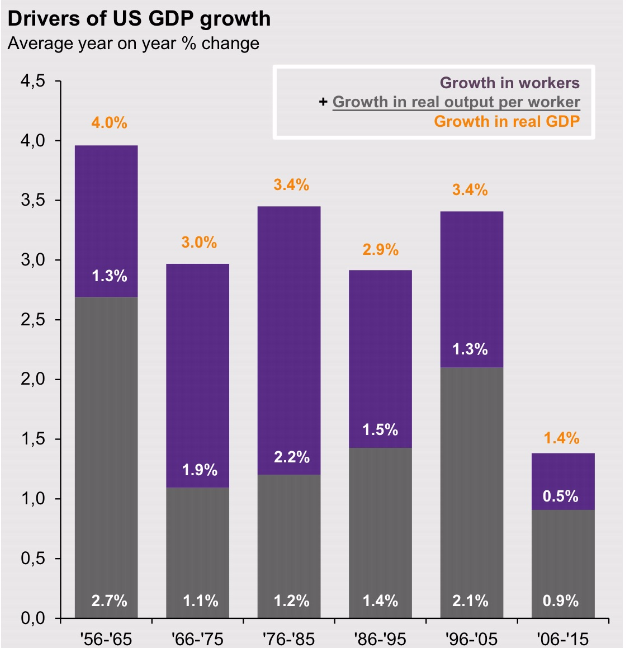
Before the US election, the consensus view was that potential growth for the US economy was about 1.5% – 2.0%. After Trump won the elections, many market players are discounting higher growth rates due to the coming deregulation and fiscal stimuli. Whether this potential growth is 1.5% or 3.0% has very important implications in the capital markets, so it is worthy to review the main drivers of growth and what we can expect.
The chart shows the two sources of GDP growth, and unfortunately what we see is a deceleration in the growth rate during the last decade that might continue during the next decade also:
Growth in workers.
Natality rate has been decreasing over time, so the previous disappointing trend of lower birth rate is likely to continue.
Immigration rate, if properly controlled, has been an important source of growth in countries like the US, Australia, UK or Switzerland to name a few successful ones. If UK or USA reduce the immigration rate, chances are that this source of growth decreases during the next decade. It would be especially bad for the US to restrict immigration for the high skillful people who would go to the USA to work for the Information Technology industry.
Growth in real output per worker. First of all, it sounds counterintuitive that productivity has increased at a lower rate during the last “information age” decade. We are not going to talk about this as there are a lot of good academic papers that covers this issue without a definitive conclusion, but facts are facts, and productivity growth is running at the lowest Post-WW2 level.
Capital investments: Good capital investments in infrastructure, IT, etc. increase real output per worker. The infrastructure investments that will be done by the Trump administration will certainly contribute to higher productivity in the USA.
Regulations: Red tape and excessive bureaucracy are deterrents of GDP growth. The Trump administration will improve this.
Human capital: This is one of the most neglected part of the sources of GDP growth even though is evident to most people (we all spent a lot of money on our children’s education). In the Trump’s agenda there is no indication that the US will be spending more money on human capital. A very interesting idea is to promote the vocational school system in place in countries like Germany, Austria or Switzerland where productivity is good and unemployment is low, even in the sectors exposed to globalization.
Free International Trade: It is difficult to introduce this element in the chart, but according to most academic studies since Ricardo, Free International Trade is mutually beneficial to everybody. That is why WTO has been so successful and that is why the European Union started with 6 countries and went to 28 (likely to go to 27 after Brexit).
The summary of these considerations can be:
GDP growth enhancers: Infrastructure investments and lower regulations.
GDP growth deterrents: Immigration policy and less international trade.
GDP growth neutral: Similar natality rate and no changes in the educational system.
Depending on the magnitude of those policies, we will see the impact on the coming GDP growth, and honestly we do not know at this stage, but is good to have a handy framework with the relevant variables.
Notz Stucki January 2017 investment conference in Geneva : notes
On the occasion of its semi-annual Investment Conference in Geneva held on January 10th, 2017, Notz Stucki welcomed the following guest speakers:
Jeffrey Saut,Chief Investment Strategist & Managing Director, Equity Research, Raymond James Louis-Vincent Gave, Chief Executive Officer, Gavekal Christian Kopf, Director of Economic Research and Investment Strategy, Spinnaker Capital Group Juerg Nagel, Partner, Member of the Management Board, Head of Portfolio Management & Marketing, MIV Asset Management
Damiano Paterno Castello introducing the conference and our guest speakers
Here are the notes on the conference.
2016 was a year of political surprises, and in markets a year in which almost all managers struggled to keep up with the indices. The political upsets have been well covered. The poor relative performance of active managers has been widely discussed too. 2016 was a tough year for them as illustrated by considering that the Dow moved 31,000 points as calculated by the daily moves, yet ended the year almost flat. The speakers all pointed to signs of a better environment for active managers, and a few other reasons why the last few years have been so difficult. First the S&P has been remarkably strong, outperforming almost everything. For example in 2015 only US Real Estate and International Small Caps did better. More interestingly if the cash holdings in mutual funds and implementation costs are stripped out then 50% of active managers beat their relevant ETFs. Indices have been driven by a fairly narrow group of stocks. These dominate the ETFs. As these stocks become overvalued it makes sense to have active rather than passive managers. Rising interest rates will also favour active managers as company fundamentals will count for more. Likewise the withdrawal of QE will help as QE has gushed money into relatively few stocks which have developed a momentum trade of their own. As QE ends stocks will have to rely more on their earnings to rise. The conference was presented with two different views of the US. Raymond James presented an extremely bullish view, and then Gavekal gave a much more cautious view, though they remain positive on markets elsewhere.
Jeffrey Saut, Chief Investment Strategist & Managing Director, Equity Research, Raymond James @Notz Stucki Investment Conference
Raymond James’s view is that the market will continue to grind higher, albeit with periodic setbacks which are part and parcel of all bull markets. This is the most hated bull market in history and consequently most people are not in it. Yet bull markets usually endure for fourteen years suggesting that we are barely half way through this one. Encouragingly in July 2016 the market broke out to the upside after an eighteen month consolidation. Following the US elections and the Republican sweep of the Presidency and Congress there will be much more co-operation in Washington. This will enable the smoother passage of the proposed tax reform, and fiscal package. Alongside this the Fed is likely to raise interest rates at a glacial pace. As profits recover the market will transition from one driven by interest rates to one driven by earnings. Low inflation, rising earnings, and slow rises in interest rates will create a strong environment for a rising market. Employment is strong which will keep consumption strong and the US is underpinned by soaring levels of creativity and technological improvements. US energy is booming, the banks are in good shape, manufacturing is improving, and corporate balance sheets are healthy. In 2017 S&P earnings are forecast to be $131 which puts the market on a multiple of 17 times. However every 1% of tax cut can increase those earnings by $1.31 so if Trump achieves the 20% tax cut he’s proposed the earnings can increase by up to $26. The one area to avoid are the bond proxies as the bond bull market is probably over. Themes like waste collection, cyber security, e-commerce, defence and disruptive technology all have powerful tailwinds. With no sign of investor enthusiasm for the market and plenty of supports the market should grind higher.
Gavekal is not worried about two of the issues that are on many commentators worry list for 2017, namely Europe and China. Europe’s elections this year will be less dramatic than last year’s. Le Pen won’t win in France, and Merkel will win in Germany. With oil prices low and the euro weak the European economy is supported. Indeed it may be a coiled spring as having experienced little investment for ten years, if things do improve then the rebound could be dramatic. Europe can therefore be a source of upside surprise. China is in a year of political transition and will be focused on things being stable at all costs.
Gavekal’s concerns centre more on the US. These concerns are largely Trump related. The largest uncertainty is the question as to what extent his campaign rhetoric on reducing globalisation to protect American jobs will be put into practice. Potentially this is extremely harmful for a whole range of US companies and those in the rest of the world. If Trump really attacks globalisation it will be hugely disruptive. The risk of this seems uncomfortably high. It is hard to assess but given the high levels of US equities they seem vulnerable to having priced in the good news (not yet enacted), and to be ignoring any negatives which could be substantial.
Another concern is how the fiscal deficit will be financed. Trump starts his Presidency with US Government debt at $20 trillion. This debt has ballooned in the last few years and most of it was bought by the Fed, but they have stopped buying and are trying to unwind their position. US consumers or companies could buy it but the Trump plan envisages them to continue spending and to start to invest. Foreigners could but they have been selling US bonds recently. With the Fed shrinking its balance sheet and foreign Central Banks withdrawing money, liquidity is tightening. This could lead to problems but markets have been behaving as though we are entering a reflation. This is why Trump’s attitude is on globalisation and trade is so crucial. If the US turns protectionist then from the current exuberant position the markets’ reaction could be severe. If not, and Trump retreats from his rhetorical position and basically accepts the evolving trading relations of past decades, then the world may experience a similar cycle seen in the last forty years whereby a strong US lifts everywhere else, but particularly those export countries that sell there like North Asia. The US fiscal deficit will then expand to the benefit of the rest of the world. The binary nature of this situation shows the difficulty of this market. It is impossible to invest for both outcomes.
Christian Kopf, Director of Economic Research and Investment Strategy, Spinnaker Capital Group about
“A Rising Tide – Spinnaker Capital’s Outlook for Emerging Markets” @Notz Stucki Investment Conference
Markets have started strong in the first week of 2017, continuing the rally in the last two months of 2016. Mr Trump will be inaugurated as President in ten days and then we will start to see what his policies really are. Given the strength of the recent rally a consolidation is likely anyway. Whether the optimism of the markets is justified or whether the markets have got ahead of themselves will become evident as the new administration reveals itself during the course of the year. However the dynamism of US business should never be under-estimated and that will continue to present opportunities regardless of the politics. There are lower valuations in the rest of the world and following several gloomy years if Europe and Asia can achieve a more confident attitude then these markets may surprise. The US market may be the most hated bull market but virtually no-one owns Europe with confidence so any improvement in sentiment could lead to a better market.
Juerg Nagel, , Partner, Member of the Management Board, Head of Portfolio Management & Marketing, MIV Asset Management, about “Innovation in Medtech” @Notz Stucki Investment Conference
Written by James Macpherson
Perception vs. Reality: US Election
Daniel Kahneman, the Nobel Prize in Economic Sciences in 2002, wrote a best-selling book entitled “Thinking, Fast and Slow”. The central thesis of the book is that human beings have two modes of thought: System 1: Fast, instinctive and emotional; System 2: Slow, deliberative and logical. We can say that System 1 resembles the PERCEPTION, whereas, System 2 is closer to the REALITY. Being so fast and so emotional, sometimes the PERCEPTIONS may distort or exaggerate the news delivered by the market, whereas REALITY gives the investor a medium-long term framework to better assess the market situation.
Discover our monthly series “Perception vs. Reality”!
Source: RealClearPolitics
PERCEPTION
Americans prefered Trump to Clinton.
The polls were totally wrong.
REALITY
Although Trump was elected president because of the peculiarities of the US electoral system, Clinton had more votes than Trump.
Clinton: 47.7% Vs. Trump: 47.1%
Source: Twitter
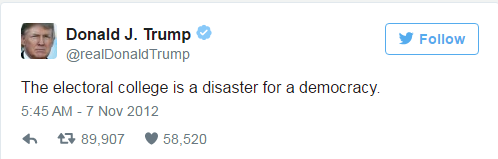
In fact what Trump called “the electoral college disaster” in 2012 was making him president, despite having had less votes.
Was the election outcome a surprise?
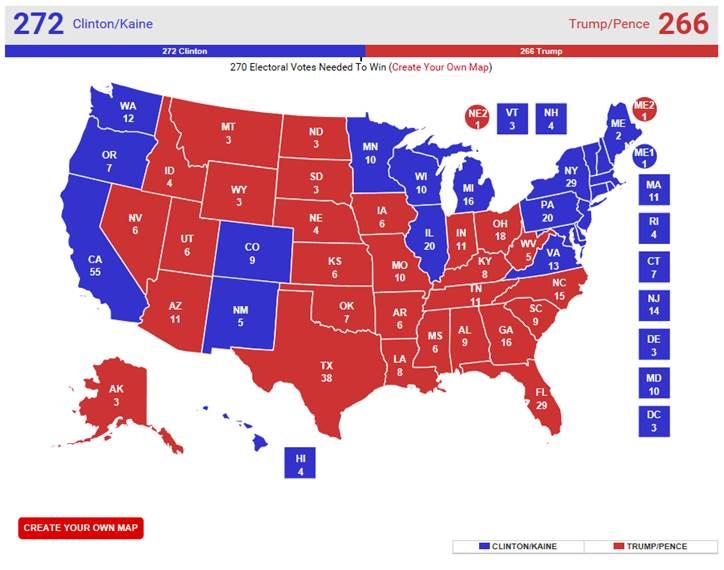
Only to certain extend. This chart was the best estimation the day before the election. Trump won PA (+20), WI (+10), MI (+16) and lost NV(-6), and he went from 266 to 306 electors. In PA, WI and MI the difference was only +1% and that made the difference.
CONCLUSION
The polls, were not that bad, but the media and investors were the ones who did not properly read that beforehand was already a very closed call.
Investment Outlook Q4 2016
Notz Stucki has just released its investment outlook for the last quarter of 2016.