September General Markets Comments

September General Markets Comments

« Another one bites the dust » – Queen, 1980

Well, another one, and many others? Equity markets already did, as well as fixed-income securities overall. September saw the British Pound on its knees, Gold breaking down, Oil recording its largest loss this year and Credit Suisse’s CDS rising to 2008 levels; FedEx and Nike had very bad days on the stock exchange, and Italy’s spread versus Germany widens by the day . On the front, the Russian army also bit the dust and is losing ground.

All asset classes suffered in September, with the continuous pressure exerted by long term interest rates, which, once again, rose significantly.

With hindsight, it looks like under the direction of conductor Jerome Powell, we’re gradually picking up where we left off, before February 2020 and the Covid outbreak, which led to all kinds of excesses and aberrations, triggered by the profligacy of Central Banks and Governments.

The S&P 500 lost no less than 9.3% in September, and the Nasdaq 10.6%; the MSCI Emerging Markets sunk 11.9% and now lags all major indices, barring the Topix, which is only down 7.9% year-to-date (but the Yen cratered by 25.8% versus the dollar!). Growth stood behind Value, once again, and lost 10.2% last month; the MSCI World Growth is down 32.8% this year, versus -20.1% for the MSCI World Value. This has to be put in the context of ever rising interest rates: the US 10-year yield added 64 bps (+57 bps for Germany) and is now 232 bps higher than the level prevailing at the beginning of 2022 (+229 bps for the Bund). Oil abandoned 11.2% and Gold 3%. Credit somewhat resisted, with the Itraxx Crossover “only” down 41 bps.


Past performance is not indicative of future results. The views, strategies and financial instruments described in this document may not be suitable for all investors. Opinions expressed are current opinions as of date(s) appearing in this material only. References to market or composite indices, benchmarks or other measures of relative market performance over a specified period of time are provided for your information only. NS PARTNERS SA provides no warranty and makes no representation of any kind whatsoever regarding the accuracy and completeness of any data, including financial market data or other financial instruments referred to in this general comment. This document does not constitute an offer or solicitation to any person in any jurisdiction in which such offer or solicitation is not authorized or to any person to whom it would be unlawful to make such offer or solicitation. Any reference in this document to specific securities and issuers are for illustrative purposes only, and should not be interpreted as recommendations to purchase or sell those securities. References in this document to investment funds that have not been registered with the FINMA cannot be distributed in or from Switzerland except to certain categories of eligible investors. Some of the entities of the NS Partners Group or its clients may hold a position in the financial instruments of any issuer discussed herein, or act as advisor to any such issuer. Additional information is available on request. © NS Partners Group
A (deep) contrarian view #2: Buy Sterling Pound Vs. Us Dollar

BUY STERLING POUND VS. US DOLLAR

CURRENT SITUATION

On June 23rd, UK citizens voted to leave the European Union (Brexit). The GBPUSD rate was 1.481 before the referendum. Two days later GBP had fallen 10.8% to 1.321. After that date, the currency has been more or less stable until October 2nd, when the new UK Prime Minister Theresa May announced that by March 2017, the UK would invoked the famous Article 50 to leave the EU. Being consistent with the message “Brexit means Brexit”, Mr. May gave a message that was perceived as a “hard Brexit”, meaning that UK wanted to control immigration and its destiny as a country. This message might indicate a tough negotiation process with the EU, which caused a further fall in the GBP to today’s level of 1.220, the lowest level since 1985 and 17.6% lower than the rate before the vote.
One of the contributors to this fall is the UK high currency account deficit of 5.7% in 2016. Consensus expect 4.4% in 2017 and 3.0% in 2018. This high numbers tend to be a drag to the country currency. Nevertheless, it is more important to know that the Net International Investment Position (NIIP) was only -6.7% as of 1Q16. Furthermore, as 60% of UK liabilities are denominated in foreign currencies and 90% of the assets, the NIIP might be positive as of today (Figures taken from the Bank of England report published in July16)

NET SPECULATIVE POSITIONS

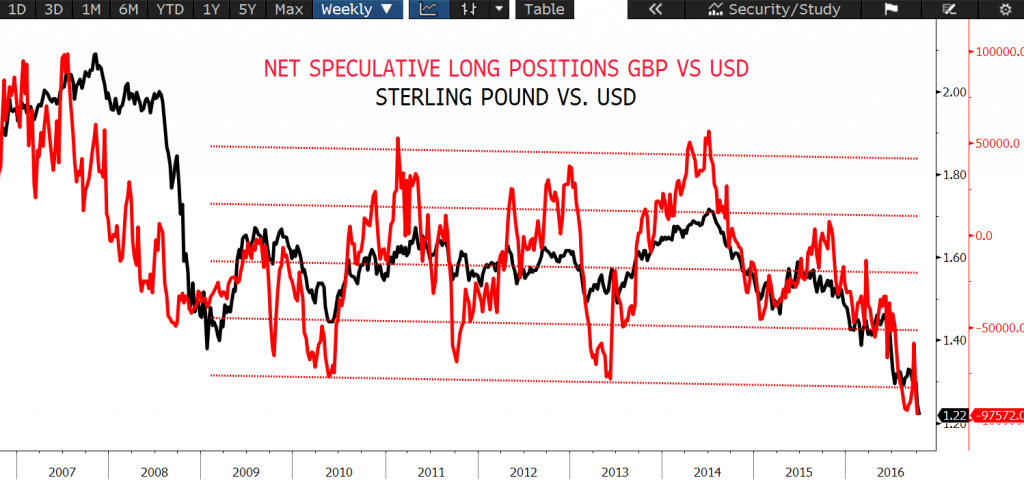
The chart above shows the net speculative positions in the GBPUSD futures market (red line). This measure tends to be a very good CONTRARIAN indicator when the positions are very extreme, and we have reached this week a 2 standard deviation reading, which in the past has been a good short-term trading indicator. Interesting to remember the famous Buffett sentence: “Be fearful when others are greedy and greedy when others are fearful”.

Source: Bloomberg and Notz Stucki.

TECHNICAL OSCILLATORS – MACD

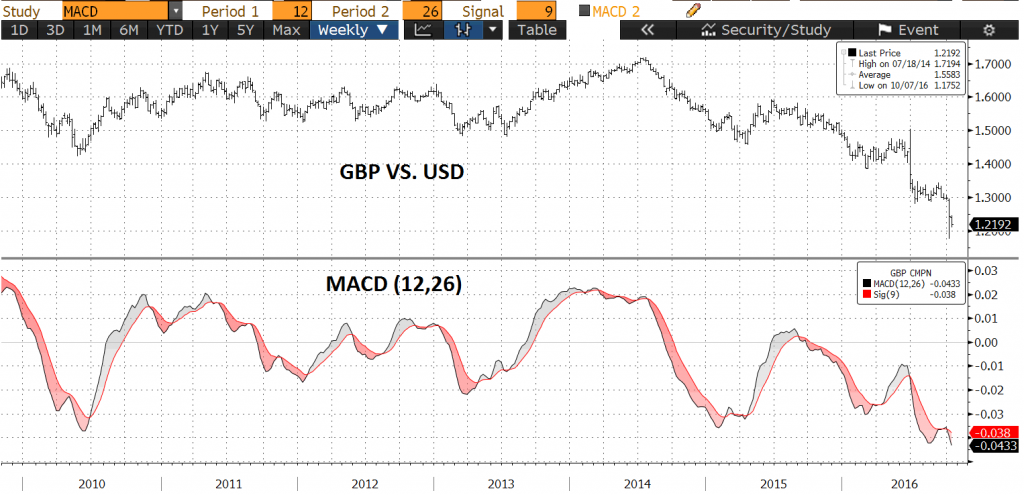
From the technical point of view, the most widely used oscillators (RSI, MACD, etc) are telling us also that the GBP is oversold. The chart below shows just the MACD which is at levels that reflect an extreme oversold situation, and so a good contrarian indicator

Source: Bloomberg and Notz Stucki.

PURCHASING POWER PARITY (PPP)

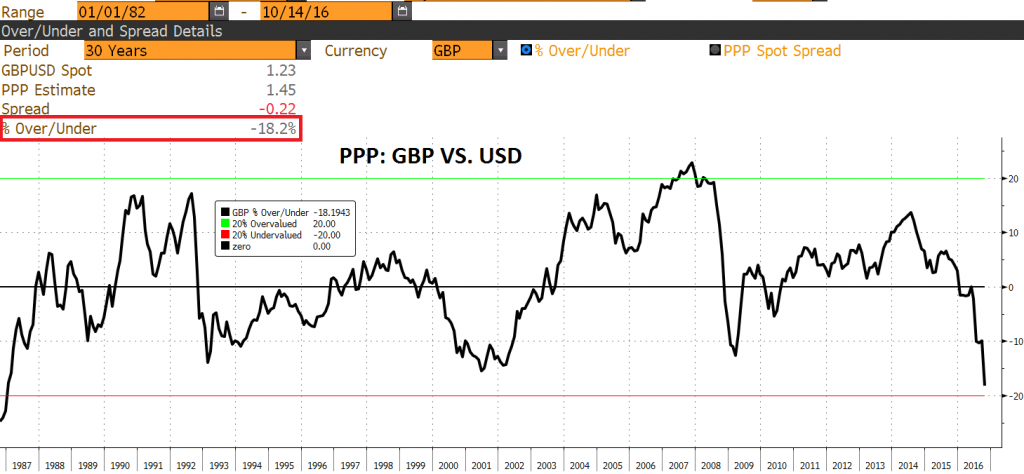
PPP is not a good indicator on a short-term basis, as currencies can remain overvalued or undervalued for a long time, but it gives a reasonable indication of long-term value. It is better to trade with a positive tailwind behind us. The chart below shows that the GBP is trading at the lowest level on a PPP basis since 1986, and again, 2 standard deviations below the average (we took this idea/graph from Charles Gave on a note to investors sent on October 11th).

Source: Bloomberg and Notz Stucki.

RECOMMENDATION

There is a clear political risk and uncertainty in the UK after the Brexit, and there is also a high current account deficit in the UK, but several indicators point to an overshoot in the value of the GBP. A drop of 17.6% in the currency value of the 6th largest economy in the world (France has overtaken the UK after the recent GBP fall) is more typical of an unbalanced emerging market economy. The United Kingdom is a serious country with solid democratic institutions, with savvy corporate managers, with great universities, with a positive Net International Investment Position today, great human capital, etc, so we may expect at least a short term recovery in the next 3-6 months.