Chart of the Month – There is life outside the SP500

There is life outside the SP500
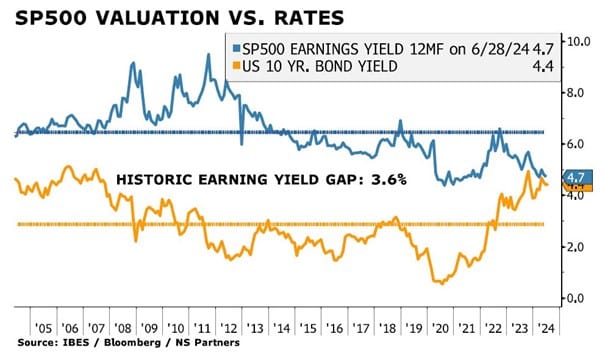
The S&P 500 has dominated performance charts for the last decade, with its lead becoming even more pronounced in the past three years, outpacing global indices. This stellar performance is driven by several factors: a robust US economy, healthy corporate profits, and the prominence of megacap stocks benefiting from the artificial intelligence boom. Additionally, the Federal Reserve is expected to cut rates this year and potentially lower them by another 1.00% in 2025.

However, this impressive performance comes at a cost. The chart above compares the Earnings Yield 12-month forward (EY12MF) of the S&P 500 with the yield of a US 10-year government bond. Historically, the average gap between these two yields has been around 3.6%, but it currently stands at just 0.3%. This indicates an extreme or very extreme valuation gap, suggesting that the S&P 500 may be overvalued.

Navigating Market Timing and Seeking Alternatives

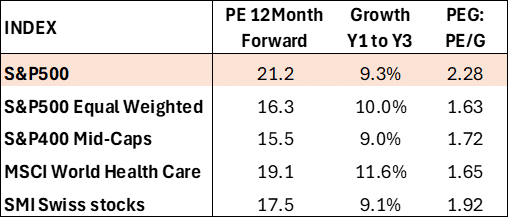
Experienced investors understand that market timing can be challenging and often frustrating. So, what should investors do with this information? Our recommendation is to diversify investments by considering the following alternatives, which offer attractive valuations and growth prospects (See table below).

S&P 500 Equal Weighted Index: Unlike the traditional S&P 500, assigns equal weight to each company, resulting in better performance during periods when smaller companies excel. It offers attractive valuation and similar growth levels, making it a compelling choice.

S&P 400 Midcap Index: This index focuses on medium-sized companies, offering a balance between growth potential and stability. With favorable valuations, it allows investors to acquire stocks at a lower price relative to their earnings growth prospects.

Health Care Sector: This sector stands out for its attractive valuation relative to expected growth and its defensive nature. This sector remains resilient during economic downturns, making it a prudent choice for stability and appreciable returns. It benefits from the ageing population trend.

Swiss Market Index (SMI): This index includes major Swiss stocks known for strong fundamentals and consistent performance. With more attractive valuations than the S&P 500 and a defensive stance, it offers a solid choice for geographic diversification.
CONCLUSION: There is a good a life also outside the S&P500


Past performance is not indicative of future results. The views, strategies and financial instruments described in this document may not be suitable for all investors. Opinions expressed are current opinions as of date(s) appearing in this material only. References to market or composite indices, benchmarks or other measures of relative market performance over a specified period of time are provided for your information only. NS Partners provides no warranty and makes no representation of any kind whatsoever regarding the accuracy and completeness of any data, including financial market data, quotes, research notes or other financial instrument referred to in this document. This document does not constitute an offer or solicitation to any person in any jurisdiction in which such offer or solicitation is not authorized or to any person to whom it would be unlawful to make such offer or solicitation. Any reference in this document to specific securities and issuers are for illustrative purposes only, and should not be interpreted as recommendations to purchase or sell those securities. References in this document to investment funds that have not been registered with the FINMA cannot be distributed in or from Switzerland except to certain categories of eligible investors. Some of the entities of the NS Partners Group or its clients may hold a position in the financial instruments of any issuer discussed herein, or act as advisor to any such issuer.  Additional information is available on request.
© NS Partners Group

August General Market Comments

August General Market Comments

« You gimme fever, and a cold sweat » – James Brown, 1970

Like in the 70s, markets are giving us cold sweats on a regular basis since the beginning of the year. And fever sometimes, when they rebound sharply. August was a perfect illustration: after a red-hot July (+7.9%), the MSCI World roared until mid-month, adding more than 3.7% at some point, but miserably tanked thereafter to close the month with a -4.3% return.

Forget about what’s happening on the ground in Ukraine: it’s all about politics, from Governments and Central Banks. The politics of Energy, with Russia clearly willing to clamp down gas supplies to Europe and the panic this triggers on Electricity prices; the politics of Trade, with the US putting more and more limits for US corporations to deal with China when it comes to sensitive stuff (semiconductors for example); the politics of Climate, with countries all around the world thriving to reduce their carbon emissions; and, perhaps more importantly, the politics of Central Banks, with the Fed deliberately freaking out investors by announcing pain down the road, as its monetary policy will be tougher for longer.

A relatively pleasant earnings season has vanished very quickly in people’s minds, the focus being now on the consequences of Jerome Powell’s stubbornness. Soft landing? Soft recession? Deep recession? The worst situation for markets in general is when there are big uncertainties; among these, the first and foremost is the magnitude of the hiking cycle by the Fed: when will they stop, and at what level?

All this is too much for markets to stand still. The second half of August was painful, to say the least, and all major assets were down at the end of the month: as mentioned, the MSCI World lost 4.3%, more or less like the S&P 500 (-4.2%), the MSCI Europe was down 5.2%, World Value 3.3%, World Growth 5.4%. The Japanese Topix rose 1.2%, but the Yen tumbled a further 4.1% versus the USD, and is down a whopping 20.5% this year!

No respite on Government bonds, as the US 10 year rose 54 bps and the 10 year Bund 72 bps, while credit weakened again: the Itraxx Crossover fell 2.6%. Gold lost 3.1%, Oil suffered its worst drawdown this year with the WTI down 9.2%.

That’s it for this month’s Market Comments, stay tuned, markets never skip a beat.


Past performance is not indicative of future results. The views, strategies and financial instruments described in this document may not be suitable for all investors. Opinions expressed are current opinions as of date(s) appearing in this material only. References to market or composite indices, benchmarks or other measures of relative market performance over a specified period of time are provided for your information only. NS PARTNERS SA provides no warranty and makes no representation of any kind whatsoever regarding the accuracy and completeness of any data, including financial market data or other financial instruments referred to in this general comment. This document does not constitute an offer or solicitation to any person in any jurisdiction in which such offer or solicitation is not authorized or to any person to whom it would be unlawful to make such offer or solicitation. Any reference in this document to specific securities and issuers are for illustrative purposes only, and should not be interpreted as recommendations to purchase or sell those securities. References in this document to investment funds that have not been registered with the FINMA cannot be distributed in or from Switzerland except to certain categories of eligible investors. Some of the entities of the NS Partners Group or its clients may hold a position in the financial instruments of any issuer discussed herein, or act as advisor to any such issuer. Additional information is available on request. © NS Partners Group

July General Market Comments

July General Market Comments

« Whose Side Are You On? » – Matt Bianco, 1984

Are you on the optimists’ or the pessimists’ side? Or rather on the side of those who have no idea?

So far, 2022 tends to plead in favour of the pessimists, but optimists could argue that July 2022 was the best month for the S&P 500 since November 2020 (when Pfizer-BioNTech announced they had a vaccine against Covid), and those who have no idea could point out that finally markets were roughly flat for June-July 2022, as June was a dreadful month.

There are many things to factor in, and all of them give arguments to one side or another: inflation is high, but expected to normalize, especially since Central Banks seem keen on tackling it rapidly; geopolitics are a mess with not only the conflict between Russia and Ukraine, but also the heightened tensions between the US and China regarding Taiwan; corporate and private debt does not seem to be a source of problems today, but Government debt across developed markets is immense; earnings reports have been surprisingly good so far, but they are expected to slow down significantly going forward; commodities do not move in sync, but there seems to be a growing threat from Russia about gas deliveries in Europe for this winter, triggering skyrocketing gas prices. With all this happening at the same time, it is not easy to choose your side and it’s not surprising to see numerous experts change their minds, depending on the most recent events.

Buoyed by convincing earnings releases and some more risk appetite, equity markets soared in July: the MSCI World gained +7.86%, the S&P 500 +9.11%, the Nasdaq +12.55%, the MSCI Europe +7.52% and the Topix +3.71%. The only detractor was Emerging Markets, down 0.69%. As nominal and real yields fell, Growth outperformed Value with a +11.51% return for the MSCI World Growth versus +4.44% for its Value counterpart.

In such a risk-prone month, Credit also rose (+3.06% for the Itraxx Crossover), and Government yields fell (-36 bps for the US 10 year, -52 bps for Germany); Gold and Oil receded by 2.29% and 6.75% respectively, and the Euro fell further against the dollar (-2.51%), weakened by the possible looming energy crisis in Europe and an unfavourable interest rate differential.

That’s it for this month’s Market Comments, stay tuned, markets never skip a beat.


Past performance is not indicative of future results. The views, strategies and financial instruments described in this document may not be suitable for all investors. Opinions expressed are current opinions as of date(s) appearing in this material only. References to market or composite indices, benchmarks or other measures of relative market performance over a specified period of time are provided for your information only. NS PARTNERS SA provides no warranty and makes no representation of any kind whatsoever regarding the accuracy and completeness of any data, including financial market data or other financial instruments referred to in this general comment. This document does not constitute an offer or solicitation to any person in any jurisdiction in which such offer or solicitation is not authorized or to any person to whom it would be unlawful to make such offer or solicitation. Any reference in this document to specific securities and issuers are for illustrative purposes only, and should not be interpreted as recommendations to purchase or sell those securities. References in this document to investment funds that have not been registered with the FINMA cannot be distributed in or from Switzerland except to certain categories of eligible investors. Some of the entities of the NS Partners Group or its clients may hold a position in the financial instruments of any issuer discussed herein, or act as advisor to any such issuer. Additional information is available on request. © NS Partners Group

June General Market Comments

June General Market Comments

« I want to know » – Adriano Celentano

I want to know… we all want to know: are we headed into a recession, or a slowdown? Have valuations sufficiently shrunk for this type of economic environment, or should we expect more pain ahead? Are fixed-income markets right when they bet on inflation coming back to 2.5% five years from now, or is core inflation higher and stickier? Are Central Banks still behind the curve, or ahead  now that economic activity seems more fragile? Will Russia and Ukraine agree one some kind of ceasefire soon, or will this conflict last for years as many military experts warn?

So many questions and so little clear answers indeed. We would like to know, but we don’t.

Uncertainty is the biggest handicap for financial markets to perform correctly and/or to behave smoothly; this is the reason why markets are so challenging and frustrating this year. The only strong message we receive from equity markets is that a severe slowdown, or a recession, is underway: only defensive sectors resist to the meltdown, and recently we have seen Energy and Materials, two good sectors so far this year, crack as well. Fixed-income markets indicate a mixed outlook: Government bonds yields are still quite high (read: low probability of a recession), but  Credit suffers, as witnessed by the Itraxx Crossover which lost 5.2% in June, and this is a signal of economic trouble ahead. Commodity markets are difficult to interpret: if a recession was due, they should crater, but they don’t, due to obvious supply constraints.

The MSCI World sank 8.8% in June, the S&P 500 8.4%, the MSCI Europe 7.9% the MSCI Emerging Markets 7.2%, and if Japan seemed to resist with a 2.2% drawdown for the Topix, this has to be mitigated by the dismal performance of the Yen (down 5.5% versus the dollar in June, 17.9% year to date!).

Oil fell 7.8%, more or less like Equity markets, Gold abandoned 1.6%, and Government bonds yields rose again: +17 bps for the US, +21 bps for Germany and +14 bps for Italy.

That’s it for this month’s Market Comments, stay tuned, markets never skip a beat.


Past performance is not indicative of future results. The views, strategies and financial instruments described in this document may not be suitable for all investors. Opinions expressed are current opinions as of date(s) appearing in this material only. References to market or composite indices, benchmarks or other measures of relative market performance over a specified period of time are provided for your information only. NS PARTNERS SA provides no warranty and makes no representation of any kind whatsoever regarding the accuracy and completeness of any data, including financial market data or other financial instruments referred to in this general comment. This document does not constitute an offer or solicitation to any person in any jurisdiction in which such offer or solicitation is not authorized or to any person to whom it would be unlawful to make such offer or solicitation. Any reference in this document to specific securities and issuers are for illustrative purposes only, and should not be interpreted as recommendations to purchase or sell those securities. References in this document to investment funds that have not been registered with the FINMA cannot be distributed in or from Switzerland except to certain categories of eligible investors. Some of the entities of the NS Partners Group or its clients may hold a position in the financial instruments of any issuer discussed herein, or act as advisor to any such issuer. Additional information is available on request. © NS Partners Group